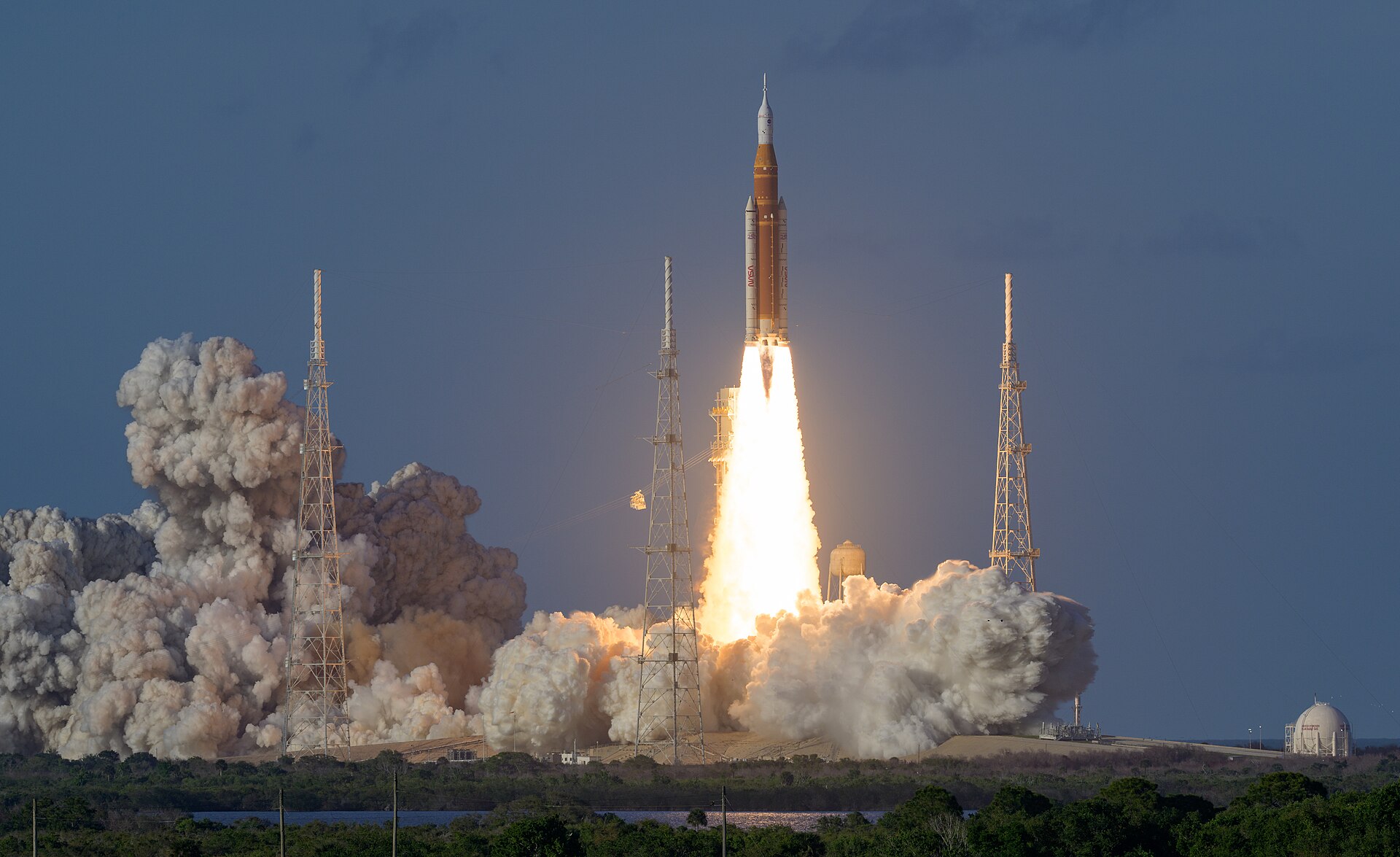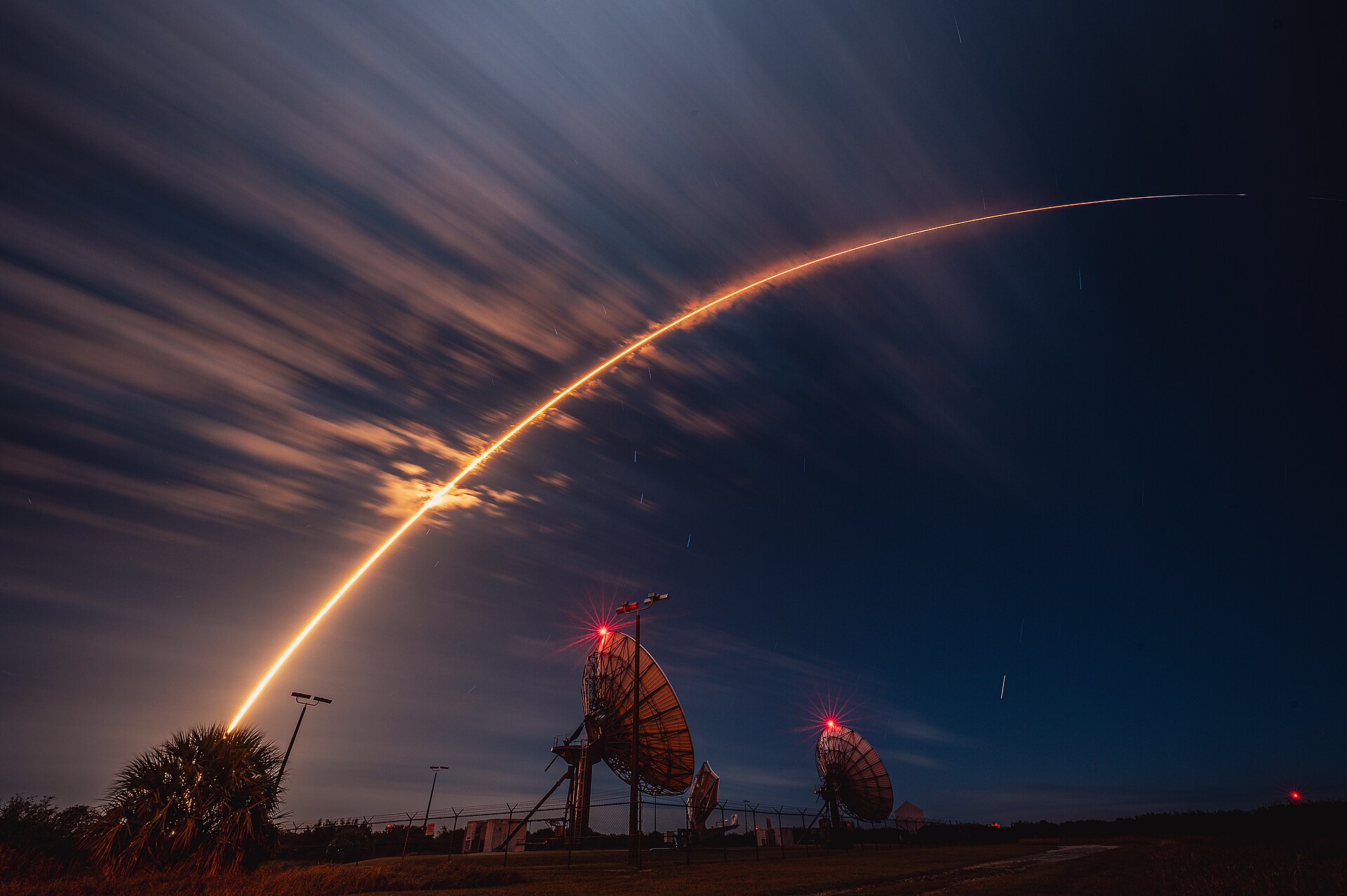
A Falcon 9 carrying the Starlink 6-88 mission lifts off from Cape Canaveral on Jan. 4, 2026. Archive photo by Gwendolyn Kurzen, U.S. Space Force (Public domain).
Elon Musk says a network of more than 100,000 satellites linked by lasers could compete with undersea internet cables. The SpaceX chief executive made the claim on Nov. 6 while discussing a future version of Starlink. The closest thing to an operating benchmark in SpaceX’s latest results is much smaller and more useful. The company reported that Starship had delivered 26 V3 broadband satellites on a revenue-generating mission and estimated the batch added roughly ten times the downlink capacity of a typical Falcon 9 Starlink launch. The claim and the launch describe different stages of a network that still has to get data back to Earth. XenoSpectrum’s reporting on Musk’s remarks SpaceX’s third-quarter release filed with the SEC
The difference explains why the satellite capacity discussion is worth following. A laser between two spacecraft can transfer data very quickly. An internet customer uses a whole route, which can include a radio link to orbit, several laser links, a gateway on the ground and a connection from that gateway to the rest of the internet. Increasing one part of the route can help. The volume of traffic a customer can send still depends on the other parts having room to carry it.
What Musk claimed for a future Starlink design
Musk’s post described roughly 100 lasers per satellite and more than 10 terabits per second for each link, according to XenoSpectrum’s account. In a separate conversation with investor Ron Baron that day, Musk described a smaller number of long-distance links. The public remarks do not establish whether he was counting the same type of link in both settings. Either way, those are descriptions of a future design and of the traffic it could pass between satellites. They do not establish the volume of traffic the network can currently deliver to people or data centers. XenoSpectrum’s comparison of the post and interview Baron Investment Conference program
Even a consistent count would leave open what gets counted as a unit of capacity. A laser link is a connection between two spacecraft. Counting the equipment on both ends does not double the number of bits that move across that connection. A packet forwarded through three spacecraft may use capacity on several links during one trip. The design can add paths and let the network move traffic around a busy or unavailable route. Adding up the advertised speeds of all the links would answer a different question from how much new traffic arrives at the destination.
Latency is a separate measure. Light travels faster in a vacuum than in optical fiber, an advantage Musk cited in arguing that some paths through space could be quicker. Actual delay also depends on distance, the number of hops and what happens at the endpoints. A cable between two well connected coastal cities could offer a short route of its own. A remote customer with a long or indirect ground connection may benefit from a different path. The interesting comparison is between two completed routes for the same origin and destination, under actual load. XenoSpectrum on the latency claim
What the V3 launch tells us
SpaceX reported that the Starship mission deployed 26 V3 satellites into its broadband constellation. Its earnings release compared the added downlink capacity with a Falcon 9 mission and put the difference at about tenfold. Downlink is the flow from a satellite to Earth, so that figure describes something closer to what a customer needs than an estimate of laser traffic between two spacecraft. It remains a capacity estimate from the company. A launch establishes that the hardware got to orbit, while the day-to-day service customers receive depends on how it is brought into operation. SpaceX’s third-quarter operational results
The figures point to the importance of Starship in the plan. If a launch adds more capacity to the constellation, it can change how quickly the operator can serve new demand or replace older spacecraft. The relevant rate over a year depends on how often the vehicle launches, what it carries and how much of what it deploys becomes available. Even a large increase on a single mission will reach customers gradually if flights are infrequent or newer satellites are concentrated in areas that already have substantial coverage. SpaceX’s third-quarter operational results SpaceX’s quarterly filing and deployment risks
SpaceX reported 13.6 million Starlink consumer subscribers at the end of September, up from 12 million at the end of June. The demand and the capacity figures matter together. An operator can add traffic on a network very quickly and still have to decide where the next increment of capacity will be most useful. One region may have many customers trying to connect at the same time. Another may have lighter demand and room to take on more. A global subscriber total does not tell a customer whether a particular beam will have room on a Friday evening. SpaceX’s third-quarter subscriber figures
There is a practical way to read the launch comparison. If a past mission added a given amount of nominal downlink, SpaceX says this batch represented about ten times that amount. It does not follow that every customer got ten times the speed after launch. The new satellites join an existing fleet. A terminal can benefit only when a suitable satellite and beam are available to serve it and the rest of the route has capacity. Much of the business value may come from serving more customers at the same speed during the busiest periods, an improvement a single download test may not capture. SpaceX’s third-quarter operational results
Service quality also has a time dimension. A satellite in low Earth orbit moves relative to a customer, who may be handed from one spacecraft to another. Capacity at a given instant and capacity that stays available through successive handoffs are different measures. Both matter to a business that needs an uninterrupted connection. SpaceX’s description of its broadband constellation
Where the radio links become the constraint
The satellite has to use radio spectrum to reach a terminal or gateway on the ground. Spectrum is finite, and operators can reuse frequencies in different places when the design and rules allow it. What matters at any given time is how much traffic can be served in a given area with the antennas, frequencies and spacecraft available there. SpaceX’s FCC authorization for a gateway facility in Goodyear, Arizona, describes multiple antennas and several frequency ranges. It is a concrete example of the ground equipment behind the simplified image of a constellation of satellites. FCC notice on SpaceX’s Goodyear earth station
There are also two different kinds of service often described with the Starlink name. A fixed broadband terminal is built to point an antenna at satellites and pass a substantial volume of data. A phone connecting directly to a satellite has a much smaller antenna and shares the available mobile capacity with other devices. The launch and downlink figure in the earnings release concerned broadband satellites. The speed a person could get with a particular phone depends on the mobile service, its spectrum, the device and the coverage available in that place. SpaceX’s broadband results SpaceX’s description of Starlink Mobile
Location also affects how useful more capacity would be. One satellite passing over an ocean can use a laser link to move traffic to another spacecraft that can see a gateway. That can extend service beyond the area around a ground station. If the gateway or its connection to local networks is congested, the additional routing options in orbit have a smaller effect. A system capable of handling busy hours needs enough gateways and connections near the destinations people actually use.
What a 100,000-satellite network would have to prove
SpaceX has sought permission for a Gen3 constellation of up to 100,000 satellites. The FCC filing and the company’s discussion of future plans establish the scale it wants to pursue. Permission to operate, the number of satellites launched, the number in service and the capacity available to a paying customer are separate milestones. The 26 V3 satellites in the September launch provide an observed starting point for the new launch method. They are a more concrete data point than a calculation made from the largest proposed constellation. SpaceX’s Gen3 FCC application record Starlink’s network updates SpaceX’s third-quarter operational results
Undersea cables have their own limits, including the cost of building them, the location of landing stations and the need to repair failures. For traffic between two busy places, they can carry steady volumes without requiring a radio link to a satellite at either end. A constellation could still be valuable to an operator that wants another path when a route goes down, or to a customer who cannot reach a cable on economical terms. The value in either situation depends on actual service availability when the ordinary connection is unavailable. XenoSpectrum’s analysis of cable and satellite paths
A comparison useful to customers would measure end-to-end capacity on specific routes at busy times, alongside latency, availability and price. It would show whether a gateway or a satellite beam became the limit and how traffic was rerouted if a connection dropped. Numbers for an optical link tell engineers what equipment they might have to work with. Measurements across the whole route tell a network operator what it can offer a customer under pressure.
The strongest evidence this fall is that SpaceX has started putting a new generation of broadband satellites into orbit with a vehicle designed to carry more of them. Musk’s larger claim sets out a much more demanding goal. The milestone that would make it matter for cable operators is regular service moving comparable traffic between the same places at a competitive cost. Until that happens, the useful way to read every Starlink capacity figure is to ask where in the route the figure applies and whether anyone has measured the rest of it. SpaceX’s third-quarter operational results Reporting on Musk’s longer-term claims