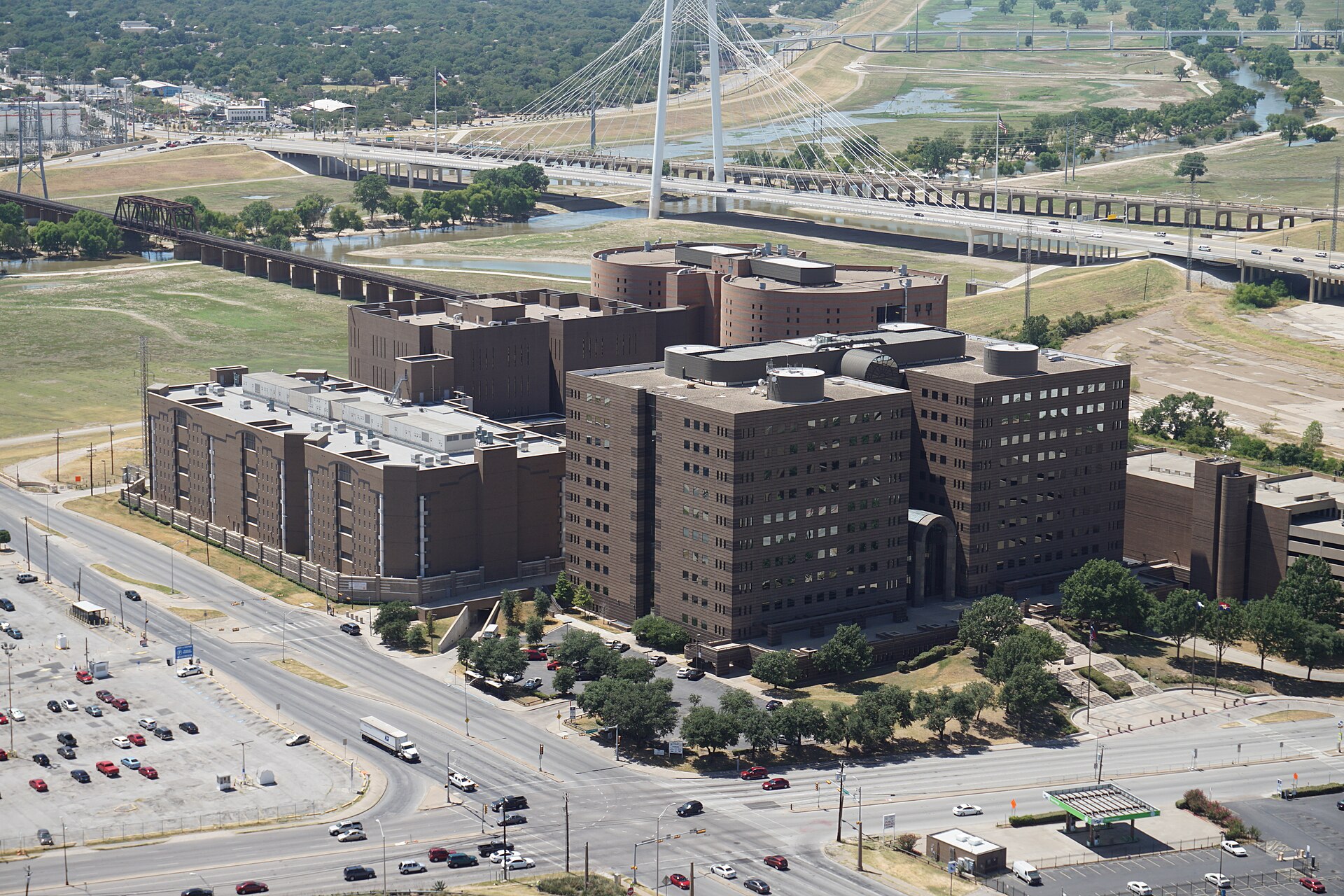
The Frank Crowley Courts Building in Dallas, photographed from Reunion Tower in August 2015. Archive photo by Michael Barera (CC BY-SA 4.0).
A Dallas County jury found Yella Beezy guilty of capital murder Wednesday in the killing of fellow rapper MO3, and he was sentenced to life in prison without parole. The verdict came Nov. 11, exactly six years after MO3 was shot on a Dallas interstate. Prosecutors said Yella Beezy, whose legal name is Markies Conway, arranged the killing by paying a gunman $40,000. Conway had pleaded not guilty, and his lawyers argued that the state’s account depended on speculation. The jury’s unanimous decision resolved the question of guilt against him. The Associated Press’s verdict report FOX 4’s report from the trial
The killing had already produced a separate conviction. Kewon White, identified by prosecutors as the shooter, was convicted of capital murder in September and sentenced to life without parole. Conway’s trial asked a different question: whether the evidence proved he had employed another person to kill Melvin Noble, the artist known as MO3. It was a case about how the attack was arranged as well as who carried it out. Phone evidence, witness accounts and the meaning of messages became central points of dispute. The earlier conviction and the state’s allegation NBC 5’s reporting on disputed messages

What the jury decided in the MO3 murder case
Conway was convicted of capital murder, the charge connected in this case to the prosecution’s murder-for-hire theory. Texas law explicitly includes employing another person to commit murder for payment or a promise of payment within its capital-murder statute. That is why the fact that Conway was not accused of personally firing the shots did not end the legal question. The state’s case was that he commissioned the killing. The defense’s task was to challenge whether the evidence established that connection to the required criminal standard. Texas Penal Code Section 19.03 The charge and verdict in Conway’s case
Life without parole is the sentence reported in this case. It is more specific than saying Conway received a life term, because parole eligibility is a separate question under the law. Wednesday’s judgment also does not decide the allegations against every other person charged in the broader investigation. FOX 4 reported that Devin Brown, another defendant charged with capital murder, remained awaiting trial. His case has its own proceedings and its own burden of proof. A conviction in one defendant’s trial cannot be substituted for a verdict in another’s. The sentence and status of the other defendant
The attack on Interstate 35E
Noble was killed on Nov. 11, 2020, while traveling in Dallas. Police described a daytime attack in which he left his vehicle and tried to get away before being fatally shot. Another person was also wounded and survived. The location gave the case a significance beyond a dispute between two performers: the attack unfolded on a busy public road, exposing people with no part in the conflict to the violence. The trial returned repeatedly to how the shooter found Noble and what evidence connected the planning to Conway. XXL’s account of the killing and trial
By the time the jury deliberated, the killing itself was no longer an unexplained event in the case record. White had been convicted. The harder question in Conway’s trial lay in the communication and conduct around it. A witness might describe a meeting, a phone record might show contact and another exhibit might establish where someone was. The prosecution needed the jurors to see those pieces as parts of a criminal arrangement. The defense tried to show that the connections the state drew went further than the evidence justified. The disagreement is easier to follow when the physical attack and the alleged agreement behind it are kept distinct. NBC 5 on the communication evidence FOX 4’s account of the closing-stage evidence
The evidence that divided the two sides
Phone records were a major part of that dispute. FOX 4 reported that Detective Eric Barnes described investigators using cell-tower information and travel records to build a chronology around the shooting. Such records can be important without answering every question an attorney asks of them. Showing where a device communicated with a network is one kind of evidence. Establishing who used it for a particular conversation, what the conversation meant and how it relates to an alleged payment requires other connections. The trial put the state’s proposed connections under cross-examination. FOX 4’s reporting on Barnes’s testimony
The defense called a digital-forensics witness, Brian Ingram, who offered his own analysis of phone and location records. FOX 4 reported his testimony about a data stream that followed a text exchange and that he considered consistent with a video call through FaceTime or another service. The point was not merely that phones had been used. The lawyers disagreed about what the pattern of activity could establish and whether the prosecution’s interpretation was the only reasonable one. That kind of technical dispute mattered because the alleged arrangement was not presented as a single, publicly witnessed transaction. The defense’s phone-data evidence
A disputed text message also drew attention during the trial’s second week. NBC 5 reported that the judge allowed the message into evidence while the two sides gave competing interpretations of it. The distinction between admission and meaning is important. A judge deciding that a jury can consider an exhibit has not told jurors what conclusion they must reach from it. They still have to assess the context supplied by witnesses and the explanations tested by the lawyers. Wednesday’s verdict reflects their decision on the case after hearing those competing accounts. NBC 5 on the disputed text and the court’s ruling
The prosecution also introduced videos involving Conway and argued that they helped establish context and state of mind, FOX 4 reported. The defense objected to evidence it argued did not prove the charged arrangement. A performance, a public statement and an agreement to commit a crime are different kinds of conduct, which is why context matters when the state puts an artist’s public material before a jury. The relevant issue was how any particular exhibit connected to the alleged killing, rather than whether a performer’s persona appeared confrontational. FOX 4’s account of video exhibits and objections
In closing arguments, Conway’s lawyers challenged the payment theory and the inferences prosecutors drew from the evidence. AllHipHop’s account of those arguments described disputes over cash and phone contact involving people in the investigation. The defense maintained that the state had failed to prove the case. The jurors ultimately rejected that position on the charge before them. Their verdict establishes the trial outcome; it is not a separate written explanation of how much weight they gave each witness, message or financial detail. Reporting on the final defense arguments The unanimous verdict
Why the separate trials matter
White’s conviction and Conway’s conviction concern distinct roles alleged in the same killing. That distinction can be lost when a story is compressed into a line saying one rapper killed another. The state identified White as the gunman and Conway as the person who hired him. The capital-murder statute covers the payment arrangement as well as the person carrying it out. Keeping the roles clear explains both why there were separate trials and why the prosecution in Conway’s case spent so much time on evidence that preceded or followed the shooting itself. The statutory provision on murder for payment The roles and separate cases described in the verdict report
It also helps explain why a later trial can contain arguments about matters an audience assumed were settled by an earlier one. Each defendant can challenge the evidence being offered against him, including the significance of another person’s actions. The state has to prove the charge in that courtroom. Public knowledge of the earlier verdict may make a chronology seem simple, while the record in the next proceeding remains contested. Brown’s unresolved case should be understood in the same way: the charge identifies an allegation that still has to be decided in his own case. The reported status of Brown’s case
The artists behind a case followed across Dallas
Before the prosecution, Conway was widely known for That’s On Me. The song reached No. 56 on the Billboard Hot 100 in 2018, a milestone visible in the magazine’s contemporaneous chart. That success helped make him a national name while his musical identity remained tied to Dallas. For an audience that encountered him first through a hit, the trial was also a reminder that an artist’s professional visibility can cause a local criminal case to be followed far beyond the city where the evidence and witnesses are located. Billboard’s December 2018 Hot 100 chart
Noble’s death left listeners without the next part of an active career. His work included Errybody and a remix with Boosie Badazz, and he was known for singing as well as rapping. In reporting on the verdict, XXL treated the case as the prosecution of the killing of a working artist, not simply a dispute between names that appeared in headlines. That is an important part of the record. The years of testimony and investigation concern a person who died, a surviving bystander and the people whose lives continued around the case while the courts worked toward a decision. XXL’s report on MO3 and the trial
What the verdict leaves in the record
Wednesday’s verdict is a decisive development: Conway was convicted and received life without parole. It should be reported plainly alongside the position his defense took at trial. The unresolved proceedings for another defendant remain separate. Any later challenge to the judgment would need to be assessed through an actual court filing and ruling, rather than inferred from a disappointed reaction to the result. That is the way to keep the next stage as clear as the one the jury concluded on Nov. 11.
The six-year interval between Noble’s killing and the verdict makes the result especially stark. The courtroom had to turn a long investigation into evidence the two sides could test in front of jurors. The record shows where that test was concentrated: the alleged payment, the communications around it and the connection between those pieces and the man who fired the shots. The jury found the state had proved its case against Conway. The sentence is now part of the legal outcome, while Noble’s music and the effect of his death extend beyond what any verdict can resolve.