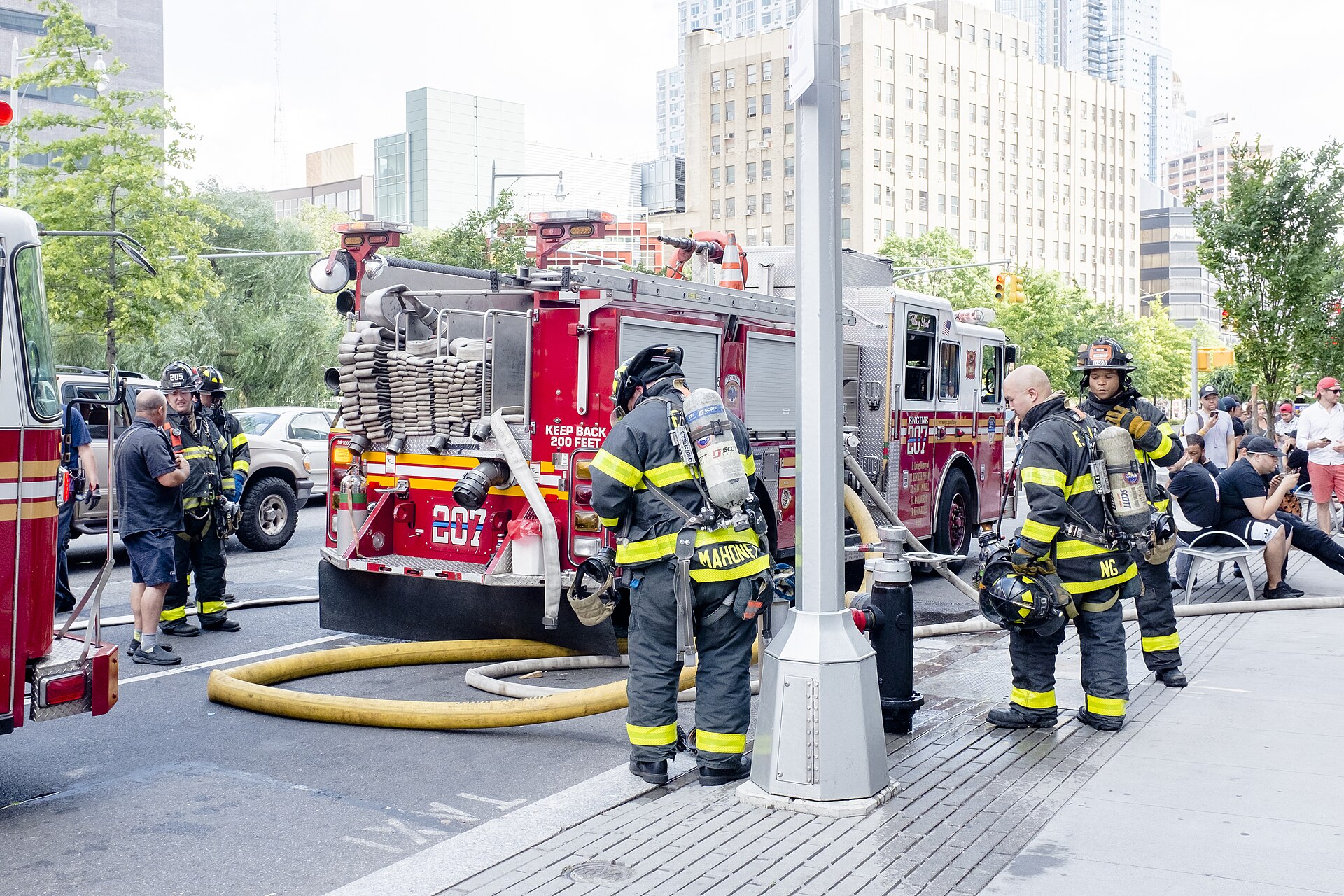
FDNY personnel in Brooklyn in July 2017. This archive photograph does not show the Nov. 11, 2026, collapse. Archive photo by Billie Grace Ward (CC BY 2.0).
A three-story building collapsed beside an excavation site in Brooklyn’s Flatbush neighborhood Wednesday afternoon, killing at least one person and injuring 10 others, authorities said. Four of the injured were in critical condition, according to the FDNY figures reported by NY1 and The Associated Press. Rescue work continued into the evening. The first emergency call came at 4:01 p.m., and firefighters were working through debris near Flatbush and Bedford avenues as the city began checking the stability of surrounding structures. The Associated Press’s evening report ABC News’s account of the response NY1’s 6:37 p.m. ET update
The collapsed property was identified in city records cited by NY1 as 1321 Flatbush Avenue. WABC reported that it fell into the open construction site at 2625 Bedford Avenue, while part of the neighboring building at 1323 Flatbush Avenue was also torn away. The different addresses in early reports describe parts of the same emergency. They matter because the response involves the building that failed, a construction site beside it and a standing structure whose exposed rooms show how much of the shared edge was lost. NY1’s report on the property records WABC’s description of the affected buildings
As of the Wednesday evening reports reviewed for this article, the city had not announced a final cause. Department of Buildings inspectors were helping at the scene and assessing nearby properties, according to ABC News. That work runs alongside the rescue effort. The immediate question is where people are and how they can be reached. The investigation will also need to establish what changed at the adjoining site, whether that work matched approved plans and how the affected buildings were supported before the collapse. Those are questions for the records and engineering evidence, rather than conclusions that can be drawn from the first aerial pictures. What DOB said inspectors were doing DOB’s published excavation requirements
What happened at Flatbush and Bedford avenues?
The FDNY sent a major technical rescue response after reports that people were trapped. ABC News reported that construction workers were among those taken to hospitals and that firefighters were trying to account for everyone working at the site. In the first hours, injury figures changed as people were reached and assessed. The later reports from NY1 and the AP put the total at one death and 10 injured, including four people in critical condition. An earlier figure should therefore be read with its time attached. The number of people accounted for is part of what rescuers are still working to establish. The initial call and worker accounting The later FDNY injury figures
NY1 reported that FDNY operations were ongoing at 6:15 p.m. The rescue and the stability assessment have different endpoints. Reaching a person in the debris does not determine whether a wall nearby is safe, and inspecting a neighboring building does not mean every person from the work site has been located. That is why an emergency perimeter may remain in place even after ambulances have left with the first patients. The streets serve as access for crews and equipment while officials decide which parts of the area can be safely used again. The timing and scope of the continuing operation DOB’s neighboring-building inspections
WABC reported that a portion of the building on the corner remained standing with apartments exposed. That condition makes the damage more than a loss of interior space in the collapsed property. It creates a separate assessment for residents whose building still exists but has lost part of its enclosure or support. Whether they can enter, whether they need temporary housing and what work would make their rooms safe again are practical questions that do not wait for the investigation to assign a cause. The city’s published vacate-order guidance explains how those occupancy decisions are made. WABC’s description of the adjoining structure NYC311’s guide to vacate orders
What officials have said about the construction site
NY1 reported that DOB had recorded problems at the neighboring project in May, including work during a stop-work order, inadequate overhead protection for neighboring properties and departures from approved drawings. Those findings warrant examination as part of the site’s history. They do not, by themselves, establish which condition caused Wednesday’s collapse or whether the cited items had the same status on Nov. 11. The chronology is essential: an investigation needs to connect a particular condition, its correction or persistence and the work actually taking place when the structure failed. The reported DOB findings at the adjoining project
A stop-work order is also more specific than the phrase can suggest. DOB distinguishes between a full order, which stops work throughout a site, and a partial order that limits particular work or an affected area. Its public guidance describes how the unsafe condition must be corrected and how the order is addressed. For the Flatbush project, the important records will include the scope of any order, when it was issued, what the agency required and whether it was lifted. A headline about an earlier order cannot answer those separate questions. DOB’s guide to full and partial stop-work orders
The same care applies to housing violations at the occupied building. NY1 reported a long record of HPD violations dating to 1972. A total accumulated over decades describes a history that may contain many different conditions. It does not sort out which entries were open, which concerned the structure or which had been corrected. The useful next step is to identify the actual entries, dates and agency findings relevant to the wall or foundation that failed. Treating a large total as a ready-made explanation would skip the work the number should prompt. The reported HPD record How to look up a building’s public information
Why excavation next to an occupied building needs close oversight
New York City requires permits for most excavation work, including underpinning, and requires work to follow the approved plans. Its excavation guidance describes precautions such as shoring, bracing, enclosures and safe access. Those requirements reflect the fact that a construction site is not isolated from the ground and structures around it. Soil that is removed from one property can affect support conditions close to a neighbor. Engineers have to account for those conditions when deciding what can be removed and what must be supported during each stage of the work. DOB’s excavation and trench safety guidance
The city’s guidance also calls for checking walls for cracks or other distress, examining supports and watching for changes at the excavation. Monitoring is useful because it creates a record of what was observed and when. A baseline survey made before work begins has a different role from a report made after a wall moves. In any investigation, the sequence can help distinguish an old condition from a new change. Nothing in the publicly confirmed account yet establishes which surveys or monitoring records exist for this particular site. Those documents, if required and available, would be part of answering the central questions. DOB’s inspection and oversight requirements
The agency states that its own monitoring does not remove engineers’ and contractors’ professional responsibilities. That distinction will matter as the record develops. A city inspection, an approved drawing and a contractor’s daily work record document different parts of the project. Understanding how they fit together takes more than finding that each document exists. Investigators will need to know what each one required, what was observed and whether the work on the ground followed it. The presence of an excavation beside the fallen building makes that comparison important; it does not decide the result in advance. DOB’s statement on professional responsibilities
Street closures and help for displaced residents
Mayor Zohran Mamdani announced that Flatbush Avenue was closed between Clarendon Road and Bedford Avenue, according to NY1. WABC reported that police asked people to avoid the area around the two avenues and use alternate routes. For people living or working nearby, the perimeter can affect a trip home, a pickup or a business delivery even when their own address is outside the damaged property. The current street situation should be checked through city alerts, since a closure established for the first response can change as crews move equipment and inspectors assess access. The mayor’s closure announcement Police guidance near the scene Official Notify NYC alerts
NYC Emergency Management and the Red Cross opened a reception center for affected residents at the Flatbush YMCA, 1401 Flatbush Avenue, WABC reported. A reception center is a point of contact for people affected by the incident; it should not be read as a promise that every displaced household has already received a particular housing placement. The staff handling the response can determine needs and explain the assistance available. For residents who left without keys, documents or medication, having a place to report the problem is a first step separate from recovering property from a damaged apartment. The reception center location and agencies involved
The city can issue a partial or full vacate order when a property is unsafe. NYC311 explains that posted notices identify the issuing agency and that orders may also be checked through city building systems. A standing building and a building that can be occupied are different categories during an emergency. The order, where one is issued, governs access until the unsafe condition is addressed and the agency determines the next step. Residents should use the contact information on the actual notice for their address rather than assume that an order applying next door also describes their own apartment. NYC311’s explanation of vacate orders
DOB’s tenant guidance explains the process for returning: after a condition is corrected, the owner asks the agency to inspect the work and lift the order when appropriate. If more than one agency has issued an order, each must clear its own restriction. The same guidance points residents to public permit information so they can follow applications and work at their building. That information becomes important after the first night, when a family needs to understand whether displacement will be brief or whether a larger repair program is required. DOB’s questions and answers for displaced tenants
Wednesday’s confirmed toll makes the first priority clear: rescuers must account for people at the site and care for those injured. The records already reported also justify a detailed investigation of the adjoining construction and the buildings around it. The next meaningful updates will be the end of the search, the condition of the hospitalized patients, the safety of nearby homes and an evidence-based explanation of the failure. Keeping those questions distinct allows the public to see what officials have established and what work still has to be done.