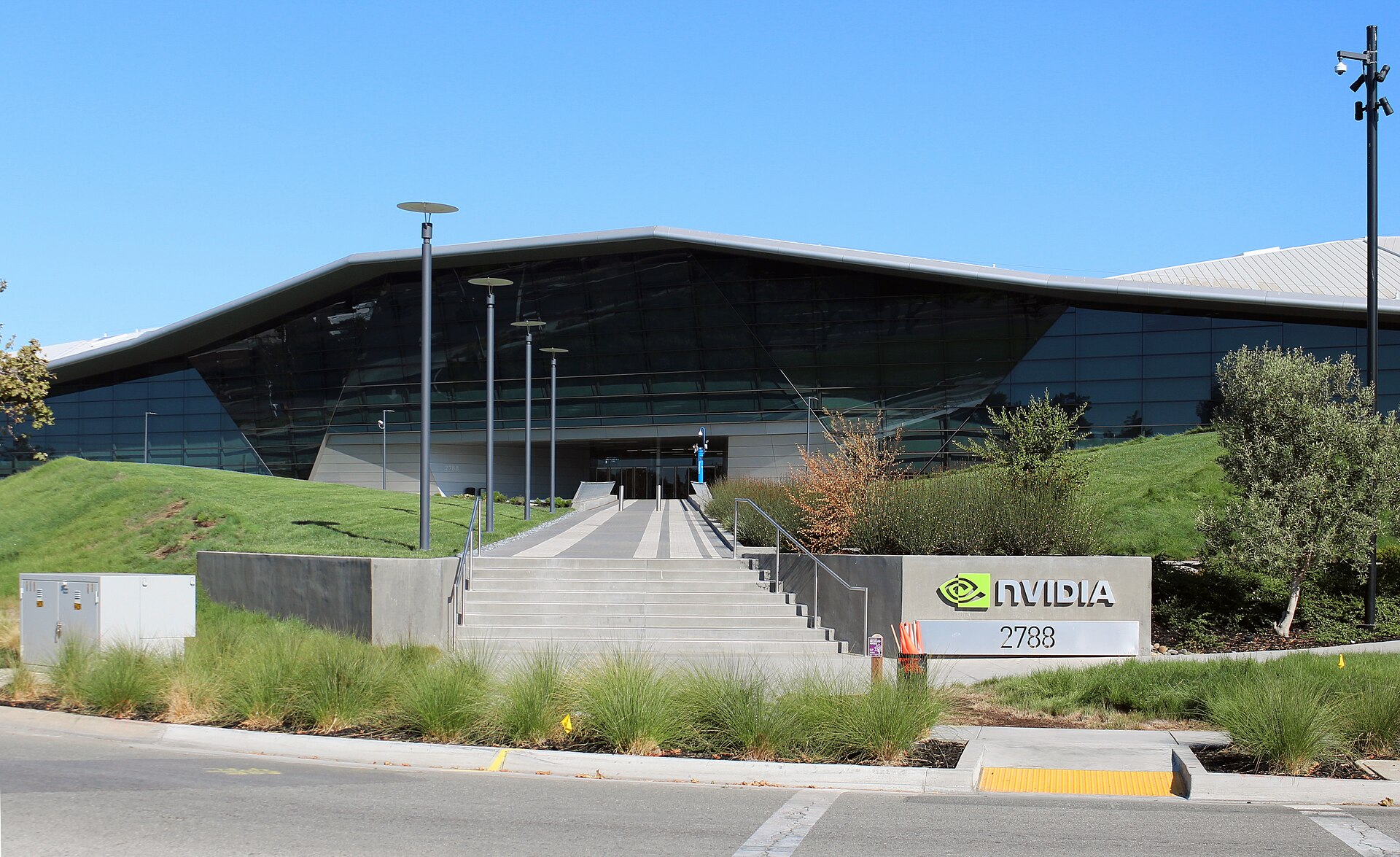
Nvidia’s Santa Clara campus, photographed Aug. 4, 2018. Archive photo by Coolcaesar (CC BY-SA 4.0).
Kimberly Powell has spent much of her Nvidia career explaining what accelerated computing could do for medicine. On Wednesday, Nov. 11, the company’s vice president of healthcare was drawn into a very different conversation after the New York Times reported that she had had a relationship with chief executive Jensen Huang. The report, described by Reuters as based on five people who worked at Nvidia, put a senior executive with a long record in medical technology at the center of a widening corporate-governance story. Read Reuters’ account of the New York Times report.
The allegation concerns a relationship with an executive who reported to Huang. Reuters said Nvidia had not immediately responded to its request for comment when that account was published Wednesday evening. Taken Social has not independently verified the alleged relationship. Powell’s public professional record, however, is extensive and documented by the company itself: she oversees healthcare platforms spanning medical imaging, drug discovery, life sciences and analytics.
A separate development made the news more consequential for shareholders. The Wall Street Journal reported that Nvidia’s board was preparing to remove Huang, according to a later Reuters account. That is a report about preparations, based on people familiar with the matter, rather than an announced board decision. It arrived as independent directors were already overseeing an inquiry into earlier reporting about a possible foreign-intelligence effort targeting the chief executive. Read Reuters’ account of the reported board preparations.
Those developments overlap at the level of Nvidia’s leadership, but they are not interchangeable allegations. The report naming Powell does not establish that she was involved in the foreign-intelligence matter. Combining the two into a single accusation against her would go beyond the evidence described by the sources. Understanding her role requires looking at both the new reporting and the business she has spent years helping to build.
From medical imaging to a wider healthcare business
Nvidia’s official biography says Powell joined the company in 2008, initially working to establish its graphics processors as an acceleration platform for medical-imaging instruments. Her present responsibilities cover the worldwide healthcare business, including hardware and software used for computing, artificial intelligence and visualization. The biography also records earlier leadership of higher education and research, Nvidia AI Labs and the Inception program for startups. Read Nvidia’s published biography of Kimberly Powell.
That career path follows an important change in the company’s ambitions. Graphics processors became useful in fields where large numbers of calculations could be performed in parallel. In healthcare, the opportunity was not simply to display an image more attractively. It was to help process demanding scientific and imaging workloads, then connect those capabilities with software that researchers, equipment manufacturers and medical organizations could actually use.
A historical example makes the progression concrete. Nvidia’s September 2018 introduction of Clara described hardware and software for medical instruments, including computing workflows for CT, MRI and ultrasound. The platform paired computing modules and GPUs with software libraries for graphics, AI and processing. Powell was already identified as vice president of healthcare in that announcement, explaining the challenge of interpreting the large volumes of data generated by modern instruments. Read the original 2018 Clara platform announcement.
The date is significant. Clara’s initial announcement predates the current wave of public enthusiasm for generative AI by several years. Powell’s documented work therefore sits within a longer effort to bring specialized computing into healthcare, rather than a role created solely in response to the most recent investment cycle. That history also illustrates why a professional profile should account for the platforms, partners and practical problems attached to an executive’s responsibilities.
Medical imaging and drug discovery present different technical demands. An imaging system may need to process information within the workflow of a scanner or an operating environment. A drug-discovery researcher may need to train a model, evaluate molecular structures or analyze experimental results at much larger computational scale. Serving both markets requires more than a single general-purpose product description. It involves infrastructure, software and collaboration with specialists who understand how the results will be used.
What Nvidia’s healthcare strategy looks like in practice
Powell’s own published work offers another window into that strategy. In a January 2025 company article, she described Nvidia’s collaboration with IQVIA on customized models and AI agents for healthcare and life sciences. The proposed applications included clinical-development workflows, evidence management and the preparation involved in bringing therapies and devices to market. The article described tools for working with information stored in documents, charts and tables, alongside the computing infrastructure needed to develop the models. Read Powell’s account of the IQVIA collaboration.
The practical appeal is easier to understand through a specific task. A research organization may have extensive information spread across documents that were written for human readers rather than structured for software. Extracting the relevant material accurately is a necessary step before it can support a useful automated workflow. An AI system that produces an elegant answer from incomplete or misread evidence would not solve that problem. The quality of the underlying information remains central.
Nvidia expanded the same broader approach in January 2026, announcing additions to BioNeMo, its development platform for AI-driven biology and drug discovery. The company described a cycle connecting model development with laboratory experiments, so that experimental results could inform subsequent computation. Announced additions included tools for training biological models, molecular-design libraries and models aimed at RNA-structure prediction and the practical synthesis of proposed molecules. Read the January 2026 BioNeMo announcement.
The announcement also described collaborations with Lilly on an AI co-innovation lab and with Thermo Fisher Scientific on laboratory infrastructure. These partnerships illustrate the industrial logic of Nvidia’s healthcare business: combine computing capabilities with the scientific expertise and instrumentation of organizations already working in the field. Powell summarized the intended feedback cycle with the phrase “every experiment informs the next.” The important commercial proposition is the connection between digital models and physical evidence.
Such announcements describe technology and ambitions, not guaranteed medical outcomes. Faster computation can help researchers investigate more possibilities, but a promising model output and a validated treatment are different things. For business readers, the useful questions concern adoption, reproducibility, integration into existing work and the results customers can demonstrate. A healthcare strategy earns its value through those steps, beyond the appeal of an AI label.
The governance questions behind the latest report
The corporate issue raised by a reported relationship between a chief executive and a direct report concerns authority as well as personal conduct. A chief executive can influence compensation, promotion, resources and access to decision-makers. If a personal relationship exists within that reporting structure, a board may need to determine whether it was disclosed, whether conflicts were managed and whether employment decisions were handled fairly. Those are questions for evidence and policy review, not assumptions about a person’s professional competence.
Nvidia’s published code of conduct provides a relevant framework. Its conflicts section identifies personal relationships among situations that may create conflicts of interest, directs personnel to seek guidance about perceived or actual conflicts and calls for withdrawal from decision-making when conflicts arise. The document also discusses the role of its compliance committee and the handling of waivers. Applying those provisions to particular people would require facts that the Wednesday reporting alone does not establish. Read Nvidia’s published code of conduct.
The independent investigation predates the report naming Powell. On Nov. 8, Nvidia’s board said it was initiating a review in response to reporting that Huang had been targeted by a foreign-intelligence effort. The board said it had no reason to believe national security or company secrets had been compromised, while committing to examine the available information. It also expressed confidence in Huang and the leadership team at that time. Read the board’s Nov. 8 statement.
On Nov. 10, independent directors announced that they had retained former acting U.S. Attorney Joon H. Kim and Wachtell, Lipton, Rosen & Katz to conduct the investigation. That is a confirmed company announcement about the review’s oversight. It is not a published finding resolving the allegations, and the brief statement does not announce conclusions about Powell. Read the independent directors’ announcement.
Huang’s Nov. 8 message to employees acknowledged marital infidelity, apologized to his family and colleagues and promised cooperation with the inquiry. The message did not identify Powell. It therefore cannot be treated as an admission confirming the specific relationship subsequently reported by the Times. His statement establishes what he chose to acknowledge publicly; the newer allegation requires its own sourcing and response. Read Huang’s published message to employees.
Why the market response and the professional record both matter
The market’s reaction underscored the significance investors attach to Nvidia’s leadership. Reuters’ Wednesday evening market report described the stock falling about 8% after the closing bell following the report about preparations to remove Huang. That followed a 2.9% gain during the regular session. The two moves describe different trading periods. An after-hours decline should not be presented as the closing performance of the day’s regular Nasdaq session. Read Reuters’ Wednesday market report.
Leadership uncertainty can affect a company’s perceived direction even before a customer changes an order or a product changes its performance. The immediate questions include continuity of decision-making, the credibility of oversight and the ability to communicate reliably with employees and partners. A share-price move records how investors are responding to information and uncertainty. It does not establish the truth of an allegation or determine the outcome of an investigation.
For Powell, the sudden attention brings two distinct records into view: a newly reported allegation about her relationship with the chief executive, and a documented career helping Nvidia enter demanding scientific markets. Responsible coverage must examine the governance issue without inventing conclusions about her work, advancement or involvement in a separate security controversy. Her healthcare responsibilities remain relevant because they explain her standing inside the company and the business context of the story.
The next decisive information will come from direct responses, board announcements and the findings of the independent review. Until then, the evidence supports a clear but bounded conclusion: Powell is a longstanding healthcare executive named in a consequential new report, Nvidia’s leadership is under intensifying scrutiny, and the company’s formal investigation remains a process rather than a verdict. Both the allegations and her professional record deserve to be described accurately.