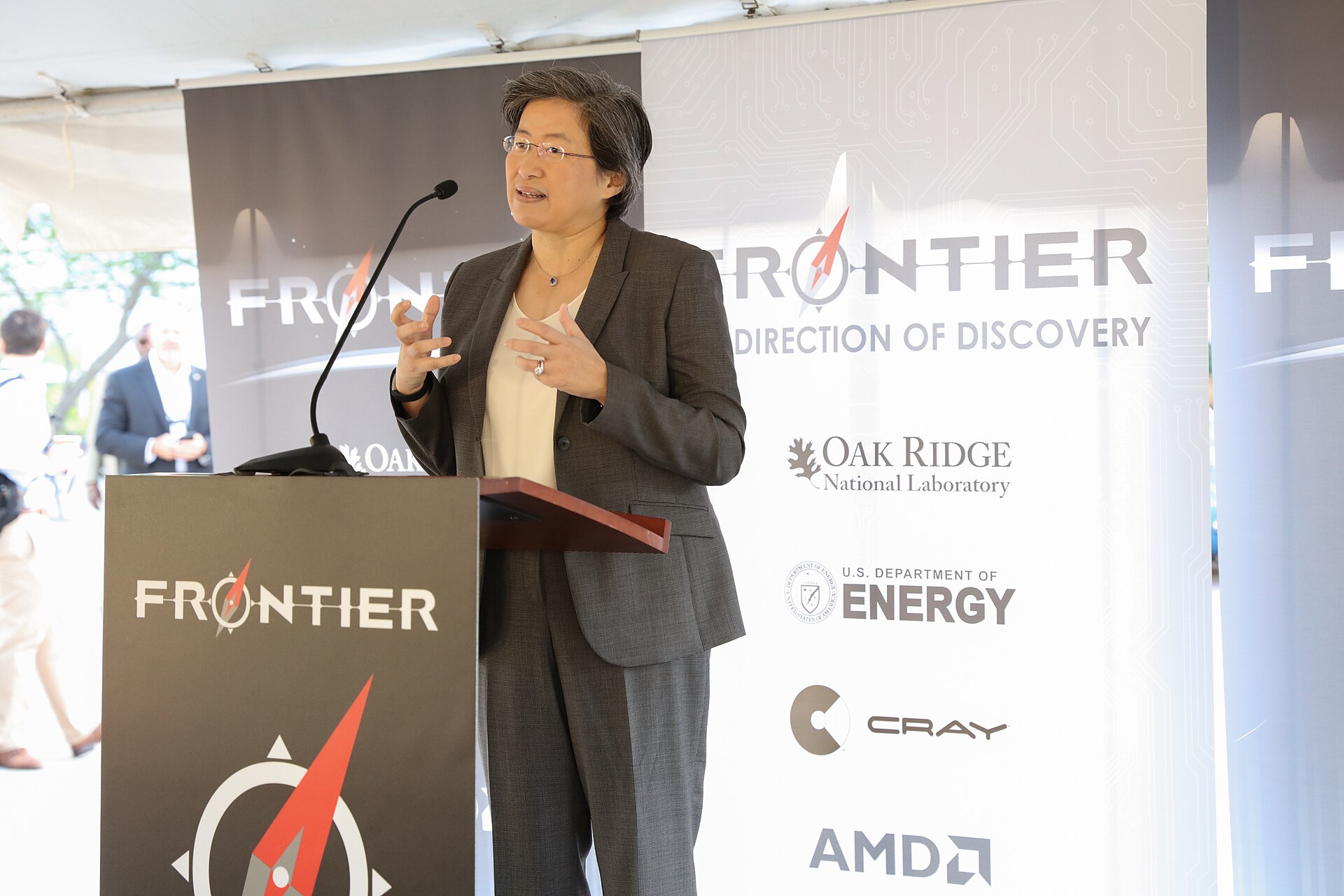
AMD CEO Lisa Su speaks at Oak Ridge National Laboratory in Tennessee on May 7, 2019. Archive photo by Genevieve Martin, Oak Ridge Leadership Computing Facility at ORNL (CC BY 2.0).
Advanced Micro Devices rose to $485.17 at 10:09 a.m. ET Monday, Nov. 9, up 8.05% from Friday’s $449.04 close, according to Stock Analysis. It was the second leg of a rebound: AMD gained 11.04% on Friday after falling 17.26% the day before. Monday’s early move brought it close to its $488.78 Wednesday close. The swings show what investors are trying to price: a semiconductor company delivering record results today and planning a much bigger delivery schedule for the coming quarter. AMD’s dated market prices AMD’s third-quarter earnings release
At 9:25 a.m. ET Monday, Stock Analysis showed AMD at $472 in premarket trading, about 5.1% above Friday’s close. That earlier quote came from a separate trading session. The Associated Press reported that the broader market also rose shortly after the open as oil prices fell. On the business side, there is a firmer baseline. AMD reported $13.38 billion in third-quarter revenue, up 45% from a year earlier, and expects about $17 billion in the fourth quarter. The case for the company’s growth has become easier to see in its financial statements. What investors are willing to pay for that growth remains a separate judgment. Stock Analysis quote and historical prices AP’s Monday market report AMD’s quarterly financial presentation
AMD stock price: Why the Friday rebound needs context
The company released results after the market close on Nov. 3. The stock finished the next session at $488.78, just over 1% above its Tuesday close. On Thursday it dropped to $404.40 amid a broad selloff in technology and artificial intelligence shares. The Associated Press reported that the S&P 500 fell 4.4% in that rout. Friday’s gain recouped $44.64 per share of AMD’s $84.38 Thursday drop. An investor measuring from Wednesday’s close to Friday’s close would still be looking at a decline of about 8.1%. Daily Nasdaq price history AP coverage of Thursday’s market selloff
The arithmetic is useful when a stock shows up on a list of the market’s biggest movers two days in a row. A gain and loss of the same percentage do not cancel because the second change is applied to a different starting price. Here, the 11% gain came off a little over $404. A full recovery to Wednesday’s close would have required nearly 21% from there. Even at Friday’s close, the shares ended the week about 11% below their Oct. 30 close of $504.80. Historical closes and daily returns
The broader chip trade brought another source of volatility into Monday. Nvidia said it was opening an independent investigation involving reports that its chief executive had been targeted by a foreign intelligence effort, and its shares weakened before the opening bell, according to the AP. Nvidia was still down in early regular trading, the AP reported. AMD has its own report and execution schedule. Its divergence from Nvidia in early trading can be observed, but the prices alone cannot show how much trading came from changing views about the two companies, market positioning or other news. AP’s Monday market report Taken Social’s coverage of Nvidia’s announcement
What AMD’s third-quarter earnings showed
AMD generated $8.55 billion in data center revenue, up 97% from the year-earlier quarter. The segment supplied about 64 cents of every revenue dollar, based on the company’s reported totals. AMD attributed the expansion to demand for EPYC server processors and the launch of its Instinct MI450 accelerator series. The distinction between those products is useful. EPYC processors handle a wide range of server tasks. Instinct accelerators are designed for workloads that benefit from many calculations running in parallel, including training and running AI models. Growth in both can make the segment more than a bet on one product. AMD’s data center and product disclosures AMD’s revenue by segment
The rest of the company moved in different directions. Client and Gaming revenue came in at about $3.7 billion, down 8%. Within that segment, client revenue rose 7% to $2.9 billion, while gaming fell 40% to $773 million. Embedded revenue rose 29% to about $1.1 billion. The breakdown shows how much the company depends on data centers for its current growth. It also shows why a reader following AMD for its PC or console chips can see a different business picture from someone who follows demand from the largest cloud operators. AMD’s Client, Gaming and Embedded results
Quarterly gross margin was 54% under standard U.S. accounting rules and 56% on AMD’s adjusted measure. Diluted earnings were $1.46 per share under those rules and $2.09 after adjustments. The company publishes a reconciliation that explains the differences, including the effects of stock compensation and amortization of acquired assets. For a comparison with fourth-quarter guidance, use the adjusted figure because that is the measure management forecast. For assessing the costs that reach reported profit and the amount available to shareholders per share, the accounting results and share count still matter. GAAP and adjusted results and reconciliation
The $17 billion question in AMD’s fourth-quarter outlook
Management’s $17 billion revenue estimate, plus or minus 3%, implies a range of roughly $16.49 billion to $17.51 billion. The midpoint represents about 66% growth from a year earlier and 27% growth from the third quarter. Lisa Su, AMD’s chief executive, tied the expected acceleration to expanding production of Helios systems and the new EPYC processors code-named Venice. Delivering that increase means bringing a large amount of complex hardware through production and into customer hands in a relatively short period. AMD’s fourth-quarter guidance and CEO commentary
Helios also illustrates why the pace of a chip launch is difficult to judge from individual announcements. AMD describes it as a rack-scale system that combines its accelerators, server processors and other components. A customer buys into how the whole rack works, including how chips talk to one another and how software runs across them. An accelerator that can perform well on its own still needs memory, networking, power and cooling to work at the promised scale. For AMD, the revenue opportunity extends further into the system; so does the work needed to deliver it reliably. AMD’s description of Helios and its deployment risks
AMD said Anthropic, Meta, Microsoft, OpenAI and Oracle Cloud Infrastructure were running models or other workloads on early Helios systems. That is evidence of use in the field as described by the supplier. The company did not disclose each customer’s future shipment volume or the revenue from those deployments in that announcement. The next useful evidence would be regular shipments, additional deployments and a report showing how much of the promised growth actually reached the segment’s accounts. A list of users is a meaningful milestone. Investors still have to judge how quickly it translates into repeat business. AMD’s disclosures about early Helios customers
Management expects adjusted gross margin of approximately 55% in the fourth quarter, a point below the third quarter. A business can sell much more hardware, generate more gross profit in dollars and still keep a slightly smaller percentage of each sales dollar. The mix of systems and components, the timing of the ramp and manufacturing costs can all affect that percentage. The next report will make it possible to check whether AMD’s total profit grew with revenue and how much operating expense was needed to support the expansion. Fourth-quarter margin guidance
What will help explain the next move
Demand from large cloud companies is the most obvious part of the story. Delivery is the other half. AMD’s earnings release flags risks around export rules, third-party manufacturing, memory supply, yields and the timing of customer orders. Some bottlenecks would delay sales; others could change costs or where products can be sold. A quarter with a very steep production increase can make those distinctions more important. Investors following the stock can compare what management says about availability and supply against the next actual change in data center revenue. AMD’s risks and forward-looking statements
Cash is a useful check alongside the headline sales number. As production increases, a company can have more capital tied up in inventory and more money owed by customers, even when it has already recorded revenue. Operating cash flow helps show when the sales turn into cash. Looking at inventory, receivables and operating cash flow over several reports can give more information than reading the change in a single quarter as good or bad by itself. AMD’s release provides those figures alongside its separately defined free cash flow measure. AMD’s balance sheet and cash flow disclosures Quarterly cash flow and balance sheet highlights
Software is the other part of the competition that deserves attention. A cloud operator deciding where to run a model has to consider how much engineering work it will take to move the model, test reliability and keep it running. AMD’s ROCm software supports its accelerators, and the company has been reporting on deployment with customers whose workloads vary considerably. A practical test is whether customers move from putting an early system to work to relying on it for a larger share of regular operations. That matters even if competitors’ stocks are moving for entirely different reasons on a given day. AMD’s platform and customer updates
At Friday’s close, Stock Analysis put AMD at about 97 times its trailing earnings. That ratio looks back at reported results, including quarters before the latest data center ramp. Forward ratios, in turn, divide the price by an estimate of future earnings that can change quickly. Using one measure for AMD and another for a peer can make a comparison look more favorable than it really is. The market reaction will depend in part on what the next round of results does to the estimates already built into the price. Stock Analysis trading and valuation figures
Friday’s $449.04 close and Monday’s early trading put a price on an unsettled week for AI shares. AMD’s earnings point to a more concrete change: data centers now provide nearly two-thirds of its sales, and the company expects roughly $3.6 billion more total quarterly revenue at the midpoint of its new outlook. The next report will show whether AMD can ship enough systems to reach that target and what margin and cash flow accompany them. Those are better tests of the company’s progress than whether the next bounce makes back the last selloff.