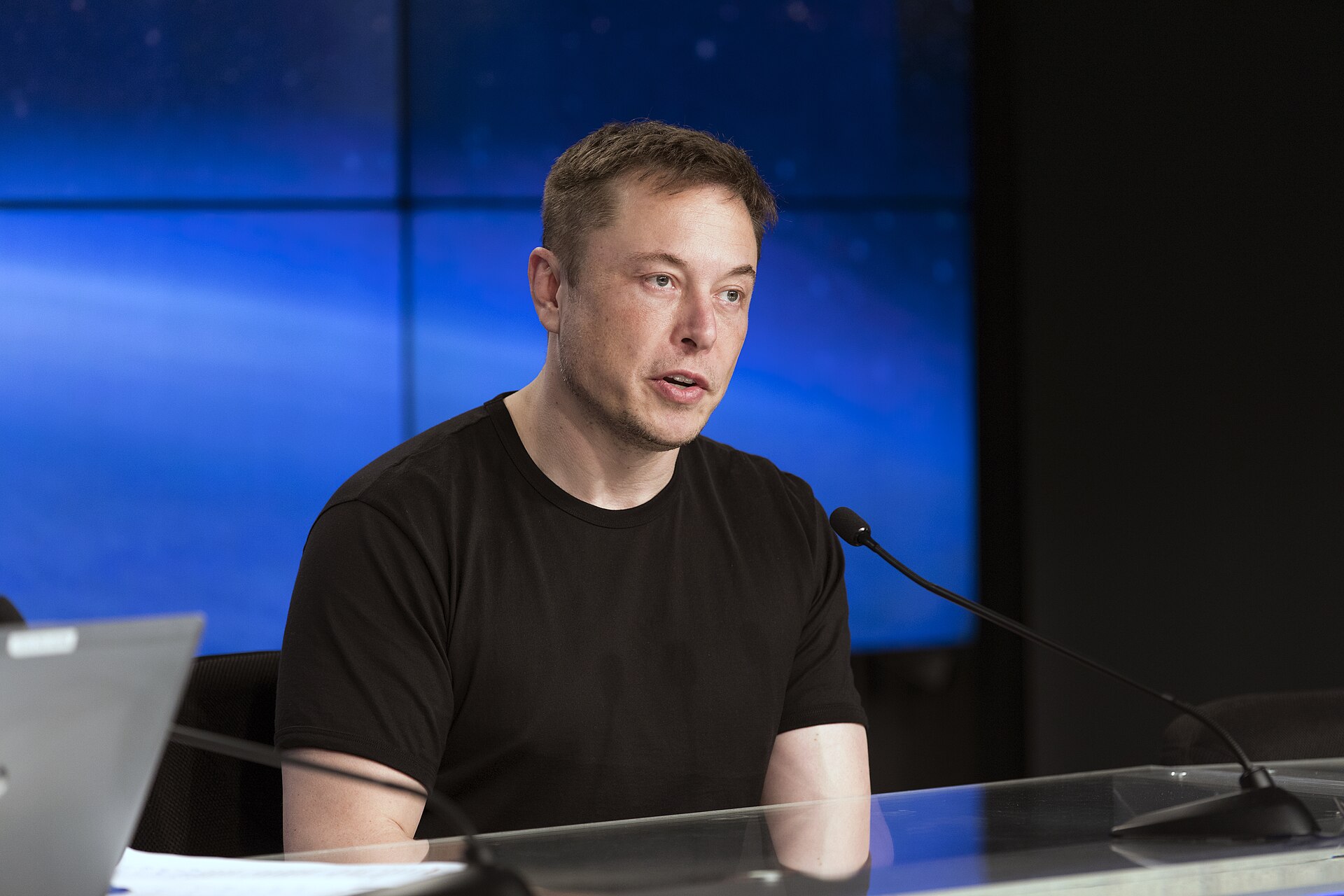
SpaceX chief executive Elon Musk at a press conference after the first Falcon Heavy flight in February 2018. Archive photo by NASA (Public domain).
Elon Musk raised the possibility that SpaceX could buy an established telecommunications company at the Nov. 6 Baron Investment Conference. He argued that SpaceX could use a carrier’s spectrum more efficiently. He did not name a company, give a price or announce an agreement. There is already a more specific move underway. Qualcomm says it will supply equipment technology for a Starlink Mobile ground network that SpaceX plans to start deploying in 2027. The two developments explain why a company known for connecting people from orbit is being discussed as a potential competitor to the largest U.S. wireless carriers. Baron Investment Conference program Reporting on Musk’s conference remarks Qualcomm’s Nov. 4 announcement
There is also a real transaction behind some of the speculation. EchoStar’s latest filing puts the total consideration for its amended SpaceX spectrum agreement at approximately $20 billion. The agreement concerns specified spectrum assets and related rights. Its terms and closing schedule are public. A purchase of an entire carrier would be a different transaction, with customers, a network, contracts and other assets that would have to be identified in a deal of its own. EchoStar’s quarterly filing with the SEC
What Musk actually put on the table
The conference remark was about one possible way to obtain the spectrum and infrastructure needed for a bigger mobile business. Musk said SpaceX could acquire a legacy carrier and make much better use of its frequencies, according to reporting on the event. A claim about efficiency needs a baseline. An operator could mean more simultaneous users, more data transmitted per unit of spectrum or lower cost for the same coverage. The remarks described a strategic idea. An engineering comparison would need to specify the service and conditions being compared. Reporting on Musk’s conference remarks Baron Investment Conference program
An acquisition could supply assets that would take time to build independently. A carrier might already have leases for antenna sites, stores and customer service, a billing system and agreements to move data between its network and other operators. It could also have existing obligations, including contracts, debts, older equipment and coverage commitments. The value of an acquisition would depend on how much of the network SpaceX could use and how difficult it would be to integrate it. Those questions cannot be answered from a remark that names no target.
SpaceX has other ways to get some of the same pieces. It can buy specific frequencies, build sites, enter agreements with other carriers and work with equipment suppliers. The choices can also be used together. The public record already shows a spectrum transaction with EchoStar and a supplier agreement with Qualcomm. Those are concrete examples of how SpaceX can move toward its goal even while the prospect of buying a carrier remains open. EchoStar’s quarterly filing Qualcomm’s announcement
Why EchoStar’s spectrum agreement matters
EchoStar’s quarterly filing says amended terms increased the aggregate consideration from $17 billion to about $20 billion. It says up to $11 billion would be paid in SpaceX shares under the terms it describes. The structure matters because a headline dollar figure can sound as if the buyer has already transferred that amount in cash. The filing describes consideration for the transaction and conditions that still have to be met. It targets Nov. 30, 2027, for the spectrum closing, subject to the applicable terms. EchoStar’s quarterly filing, SpaceX transactions section
Radio spectrum is the set of frequencies on which a network can transmit. Having more suitable spectrum can help an operator add users or carry more data in a given area, subject to interference and licensing rules. Licenses are valuable because neighboring operators need to know which transmissions to expect and because a company cannot simply begin broadcasting on a frequency someone else is licensed to use. An agreement to obtain those rights helps answer part of the question of what a SpaceX phone network would run on. It does not tell us how many people will be able to buy service on a given day. EchoStar’s description of the spectrum assets SpaceX’s discussion of spectrum authorizations
The EchoStar filing also describes contemplated commercial agreements for access by its wireless subscribers to next-generation Starlink direct-to-cell services. That detail shows why a spectrum transaction can matter to consumers who remain with an existing provider. A carrier can sell access to a partner’s technology while keeping the customer relationship. The roles of spectrum holder, network operator and retailer can be distributed across several companies. A hypothetical acquisition could move the billing relationship and the duty to provide service to a new owner. EchoStar’s quarterly filing, commercial arrangements
EchoStar had an operating wireless business at the time of the filing. Its quarterly results reported about 7.19 million wireless subscribers at the end of September. The number provides scale for the business from which the spectrum transaction arose. The purchase agreement does not describe those subscribers as being acquired by SpaceX. They are people who have service arrangements with EchoStar’s wireless business, and any future agreement that changed the company serving them would require separate terms. That is a practical reason to read the part of the filing that identifies the assets instead of relying on the size of the transaction. EchoStar’s quarterly filing, wireless segment and spectrum transactions
What Qualcomm will supply for Starlink Mobile
Qualcomm announced on Nov. 4 that SpaceX selected its Dragonwing cellular infrastructure platform for base stations in a planned U.S. 5G network. It says SpaceX expects to start rolling out the network in 2027 and deploy tens of thousands of sites over the multiyear agreement. The deployment start and the total count describe different points in the plan. A network can begin serving some places before it has the sites, connections and coverage needed to operate as a nationwide competitor. Qualcomm’s announcement on the terrestrial network
The release describes antenna equipment with 64 transmitting and 64 receiving paths. Multiple antenna paths can help a base station direct signals and make use of a channel to serve more traffic. The result at street level depends on where a base station is installed, the surrounding buildings and terrain, how much spectrum it uses and the number of people sharing it. Specifying the radio equipment answers an important design question. It still leaves the work of securing sites, supplying power and connecting those sites back to the network. Qualcomm’s description of the base station design
That last connection, often called backhaul, is easy to overlook. The radio at a cell site needs a route to carry the traffic it receives into the rest of the network. In a dense area with heavy use, enough capacity on that route matters as much as a good signal on a phone. In a rural area, getting a site connected can be a large part of its cost. SpaceX’s satellite capabilities may offer options in some places. The economics of building and operating each location will still influence how far and how fast a rollout proceeds. Qualcomm’s plan for base stations Axios on the challenges of a nationwide network
How a network on the ground changes the offer
Direct satellite connections can reach a compatible phone in places without nearby towers. A ground network provides a different kind of capacity, especially where a large number of devices are using a small area. The logic of combining them is that the network can use one type of coverage where it is better suited and the other when the phone loses the ground signal. Making that work in everyday use means testing how devices switch, which features are available on each link and what happens when many users are trying to connect. SpaceX’s mobile service and risk disclosures Qualcomm’s ground network announcement
For an existing carrier, the relevant question is how much it could gain or give up by working with SpaceX. A partnership could help extend coverage. It might also put a supplier closer to its customers or strengthen a company that intends to build its own competing network. Axios reported on the trade-offs around SpaceX’s mobile strategy. The specific financial and service terms of any arrangement will matter more than general claims about whether the companies should cooperate. Axios’s reporting on the wireless strategy
U.S. licenses also give regulators a concrete role. In a recent order on a separate wireless license transaction, the Federal Communications Commission explained that it must assess a proposed transfer or assignment under the public-interest standard in Section 310(d) of the Communications Act. The precise review would depend on the structure of any new deal. If a purchase involved an existing national carrier, decision-makers would have specific coverage, competition and spectrum questions to examine once an application identified the assets. The first thing an announcement could clarify is which rights would actually change hands. That detail would also establish what could happen to any licenses, customers or service commitments outside the scope of the purchase. FCC order explaining its license-transfer review
There is a near-term way to tell which of these possibilities is moving forward. A formal acquisition would identify the business involved and its terms. A spectrum transfer has licensing and closing milestones. A rollout will produce sites, tested coverage and service offers customers can evaluate. Progress in one can affect the others without resolving them. A supplier agreement can help SpaceX design radios while the company is still waiting for a particular set of spectrum rights to close. EchoStar’s timetable and closing conditions Qualcomm’s deployment announcement
Musk’s remarks raised a plausible route into the wireless business. The clearest evidence today is the money and equipment committed to getting spectrum and building a ground network. The next consequential step for customers would be a service they can compare with the one they already use, with a price, tested coverage and a reliable handoff when a tower is out of reach. Those details will show whether Starlink Mobile has become an alternative in the places where people use their phones most. Qualcomm’s rollout announcement EchoStar’s quarterly filing