Published November 6, 2026 · Taken Social Editorial
Amazon Prime members in the United States have a new way to order dinner: Uber Eats restaurant delivery is now built into Amazon's website and shopping app. The partnership, announced November 5, waives the delivery fee on qualifying restaurant orders of $25 or more. It also introduces a limited launch promotion, making the change an immediate consideration for households that already use Prime.
The important word in that offer is “delivery.” A waived delivery fee does not make the meal free or remove every possible charge. The practical value depends on the restaurant's menu prices, the other charges shown at checkout and whether the order is something the customer would otherwise have purchased.
That distinction is why the Amazon Prime–Uber Eats announcement merits more than a promotional headline. It changes where customers can place an order, replaces an earlier Prime delivery relationship and gives two large platforms a new opportunity to compete for routine household spending.
What changed for Prime members
According to the companies' announcement, U.S. members can order through Amazon's Uber Eats page or the Amazon Shopping app without creating a separate Uber account. The delivery-fee benefit applies to eligible restaurant orders meeting the $25 threshold.
The launch offer provides $20 off each of the first two qualifying orders during the initial 14-day promotional period. Eligible Prime Visa members can receive 5% back on Uber Eats orders through December 5. These offers have conditions and availability limits; the checkout page is where the actual benefit on a particular order becomes visible.
The Associated Press reported that the arrangement replaces Amazon's Grubhub partnership. That makes this a change to an existing membership benefit as well as a new integration. Customers who have another delivery subscription should examine that subscription separately rather than assuming a new Amazon offer automatically cancels an old payment arrangement.
The broad business proposition is straightforward. Amazon supplies an established shopping destination and a large membership relationship. Uber supplies restaurant-delivery infrastructure. The customer can initiate a meal purchase in a place already used for other shopping, reducing one reason to open a competing delivery app.
Which fees are actually waived?
Uber's explanation of delivery charges distinguishes a delivery fee from a service fee and a possible small-order fee. The applicable amounts depend on the order and are disclosed in the ordering process. A promotion affecting one category should not be read as eliminating the others.
Taxes and any selected tip also belong in a household's cost comparison. The useful number is the final amount payable for the same food delivered to the same address. Looking only at a crossed-out delivery fee can obscure a higher menu subtotal or another charge elsewhere in the transaction.
For example, consider a hypothetical $30 food subtotal with a $4 service charge, $2.40 in tax and a $5 tip. With a zero delivery fee, the total is still $41.40. Those figures are illustrative, not a quoted Amazon or Uber price. They show why “$0 delivery” and “$30 dinner” are different propositions.
A second hypothetical makes the threshold issue clearer. If a customer wants $22 of food and adds a $5 item solely to qualify, the food bill becomes $27. If the avoided delivery fee would have been $3, spending $5 to save $3 increases the total by $2 before considering any change in tax or other charges. The extra item may be worthwhile, but the threshold alone does not make it a saving.
The launch discount and the everyday benefit are different
The introductory promotion can be much larger than the ongoing delivery-fee reduction. A qualifying $25 food order discounted by $20 leaves $5 of that subtotal before applicable taxes, fees and any tip. That arithmetic does not mean every customer can receive a complete delivered meal for $5.
It also does not describe the third order or orders placed after the promotion expires. Households evaluating an ongoing membership should separate a temporary acquisition incentive from the repeatable value of a benefit. Both can be useful, but they answer different questions about the cost of keeping a service.
Amazon lists ordinary Prime membership at $14.99 monthly or $139 annually in the launch announcement. Twelve monthly payments total $179.88, which is $40.88 more than the stated annual price. The annual option costs less over a full year, while requiring a larger upfront commitment. Eligibility for discounted memberships changes that comparison.
For someone already paying for Prime because of shipping or entertainment, the restaurant benefit may have no additional membership cost. Someone considering joining mainly for delivery faces a different calculation. The relevant comparison is the entire subscription expense against savings the household reasonably expects to use, rather than the advertised maximum value of a bundle.
How to make a useful cost comparison
A fair comparison uses the same restaurant, the same items and quantities, and the same delivery address at approximately the same time. Compare the final checkout totals rather than promotional banners. A direct restaurant order, another delivery platform or pickup may offer a different overall price even when one option advertises a lower delivery fee.
Time has value as well. A household may reasonably pay more for delivery when collecting dinner would require a long trip or interrupt caring responsibilities. That is a convenience purchase, and it can be evaluated honestly as one. Calling every additional cost a saving makes the decision harder to understand.
Frequency matters. If an illustrative delivery benefit saves $4 on each order and a household uses it twice a month, that is $96 over a year. At four orders a month, the same assumed saving is $192. Neither figure is a forecast: the calculation changes if fees, ordering frequency or eligibility change.
Amazon's advertised potential annual savings are based on ordering assumptions and available promotions, rather than a payment guaranteed to every member. The household that orders rarely should not assign itself the same expected value as one that routinely buys delivered meals. A benefit can be attractive without being equally valuable to all customers.
Comparisons also become misleading when the basket changes. If one service encourages a larger meal or another includes a side dish, their totals no longer price the same purchase. A useful record separates the cost of the chosen food from the cost of bringing it home. That makes it easier to distinguish a lower delivery expense from a higher overall dinner budget, especially when an introductory offer encourages more frequent orders than the household would ordinarily place.
Prime's perk is not the same thing as Uber One
GeekWire reported that the memberships operate independently and that the Prime benefit applies to Uber Eats orders placed through Amazon. Customers should therefore avoid assuming that opening the ordinary Uber Eats app automatically applies the Amazon arrangement.
The distinction matters most to people already paying for multiple bundles. Before adding or removing a subscription, compare which benefits are attached to each account and which ordering route activates them. A delivery discount, ride benefit, credit-card offer and general shopping membership can overlap without being interchangeable.
There is also a difference between having access to a restaurant network and having every restaurant available at a particular address. Delivery range, operating hours and merchant participation constrain the practical selection. The restaurant list shown after entering an address is more useful for dinner planning than a national count of participating businesses.
Why the companies want dinner inside a shopping app
Restaurant orders offer a recurring reason to visit a platform. A television might be purchased once in several years; dinner decisions can recur several times a week. Integrating those decisions into an established shopping app gives Amazon another opportunity to make membership feel useful in everyday life.
For Uber, the arrangement can put participating restaurants before customers who might not otherwise begin their search in a dedicated delivery app. For restaurants, that may create additional demand, although the economics of an individual order depend on merchant agreements and operating costs that the public launch announcement does not disclose.
The customer-facing delivery waiver does not mean that delivering food has no cost. Restaurants prepare the meal, couriers perform the trip and platforms operate ordering and payment systems. Promotions redistribute or subsidize parts of those costs. Understanding that structure is more helpful than treating a zero on one fee line as the disappearance of the underlying work.
The checkout total remains the clearest test
The Federal Trade Commission has examined pricing transparency in online food delivery in a rulemaking notice on fees. That proceeding provides wider context for why the presentation of delivery prices matters. It is not a finding that this particular Amazon offer violates the law or a guarantee that all delivery pricing is identical.
For members, the immediate news is concrete: Amazon now offers a U.S. restaurant-delivery route powered by Uber Eats, with a qualifying-order delivery waiver and temporary launch discounts. The strongest use of the perk is to compare the complete bill on an order already worth making. The promotion can then be judged by money actually saved, rather than food bought merely to unlock it.
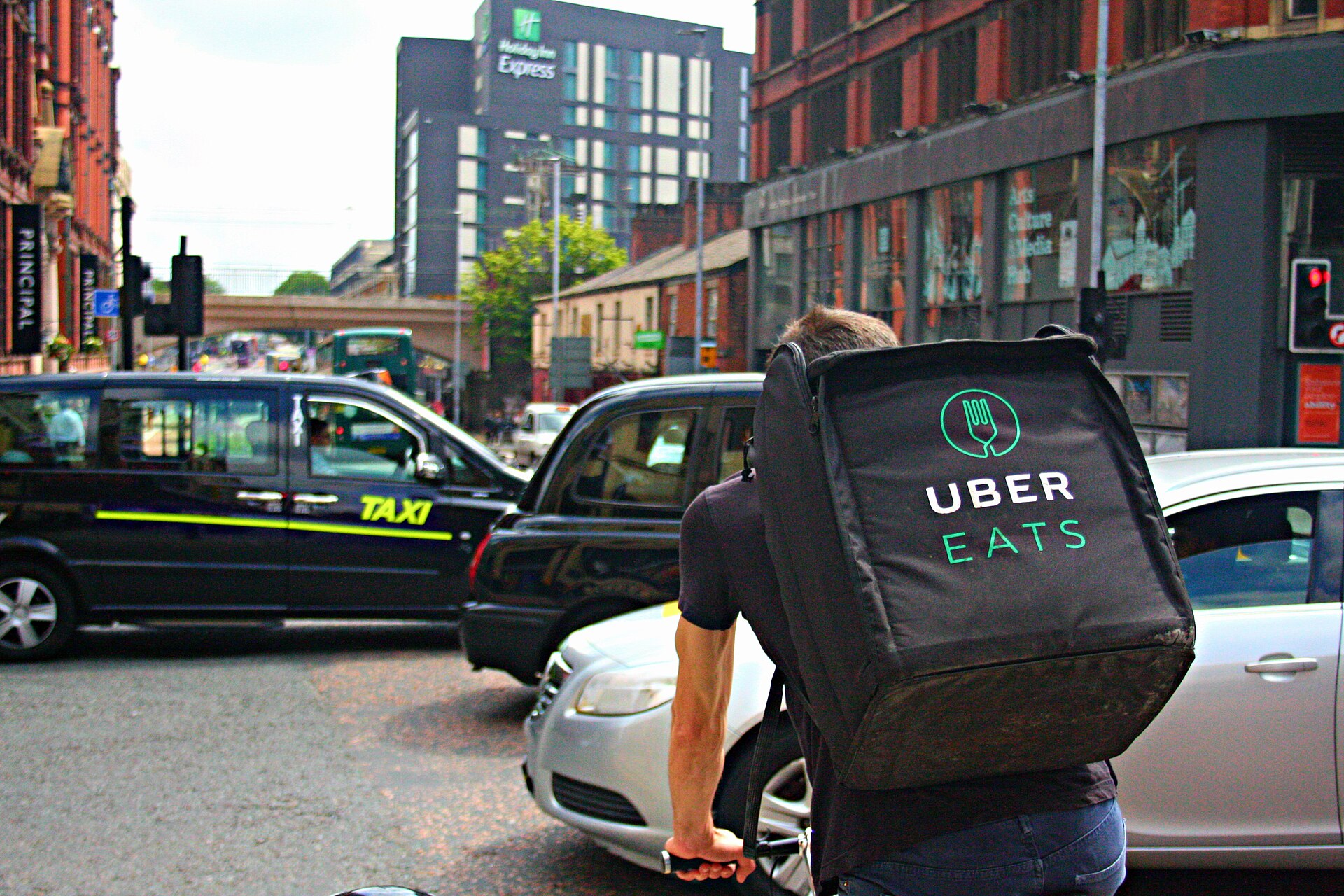
An Uber Eats courier on Oxford Road in Manchester, England, photographed in May 2017. Archival photograph by shopblocks; CC BY 2.0. The new Amazon benefit described in this report applies to the United States. Source: Wikimedia Commons. Image license.