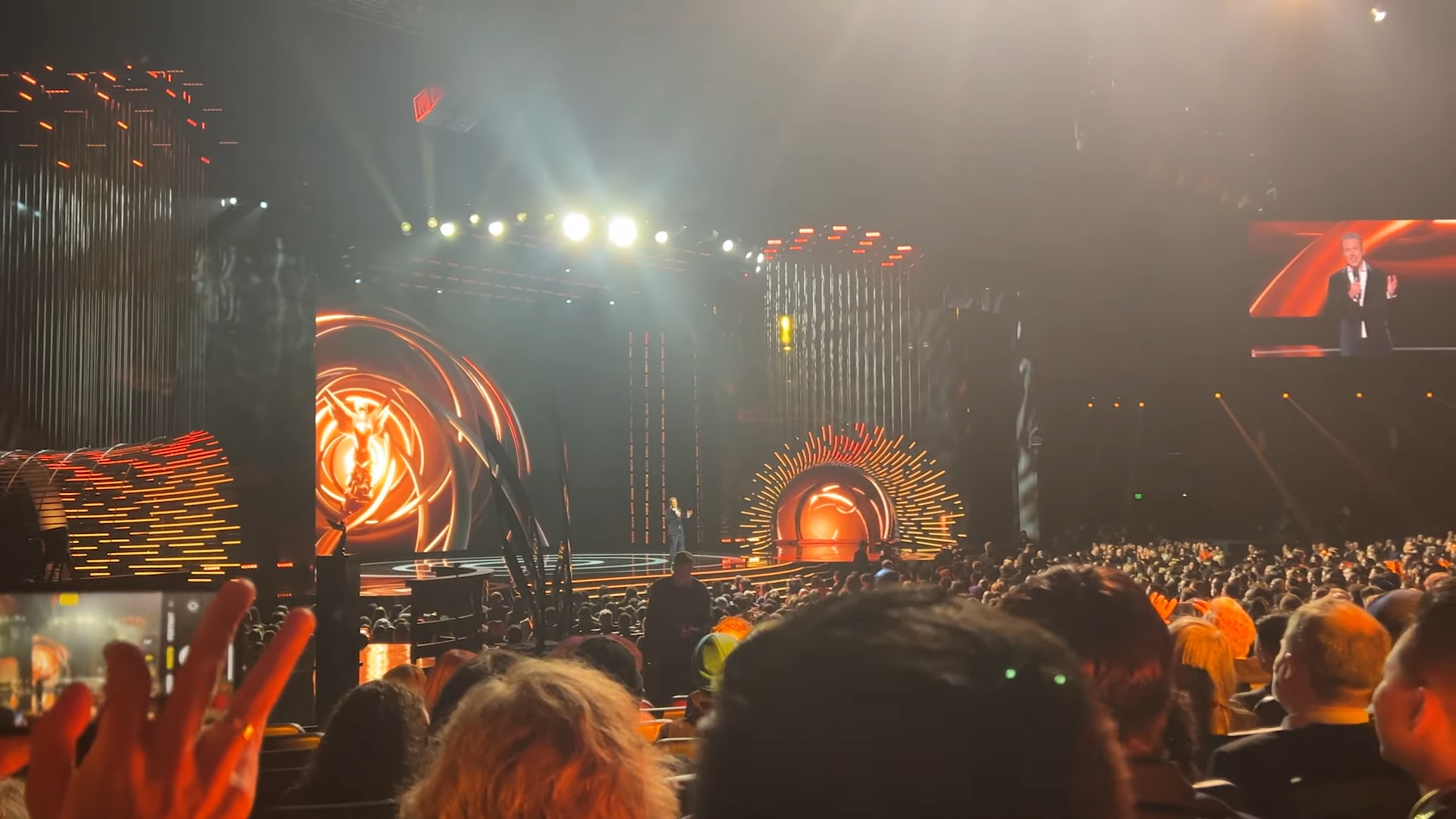
Geoff Keighley presents at The Game Awards in 2022; the archive photograph does not show the 2026 nomination announcement. Archive photo by Zion Grassl (CC BY-SA 4.0).
Grand Theft Auto VI leads the conversation around The Game Awards 2026 after the November 17 nomination announcement, but the ballot offers a larger story than one blockbuster. Six games are competing for Game of the Year, a performance nomination has put Manni L. Perez in the spotlight, and a late-year release is raising a familiar question about when critics get to judge a game that most players have not yet received.
The ceremony takes place December 10 at the Peacock Theater in Los Angeles. The official schedule lists the opening act at 7:30 p.m. Eastern and 4:30 p.m. Pacific, with free online streaming. That is the opening-act time, rather than a promise that the biggest awards will be presented immediately. The Game Awards’ schedule and rules.
The Game of the Year nominees are 007 First Light, Control Resonant, Grand Theft Auto VI, Phantom Blade Zero, Resident Evil Requiem and The Legend of Zelda: Ocarina of Time. The official category page is the authoritative place to check the ballot. A nomination is recognition from the awards process, not a guarantee of a win or a substitute for an individual player’s judgment. The official Game of the Year ballot.
Gematsu’s published count gives GTA VI eight nominations, with Control Resonant and Resident Evil Requiem receiving six apiece and Phantom Blade Zero five. Those totals help explain the immediate attention, but the distribution across categories is more informative than a simple league table. An award for acting asks a different question from one for art, sound or direction. Gematsu’s nomination report.
A blockbuster ballot, with more than one route to recognition
The six-game headline category brings together several forms of familiarity. Grand Theft Auto, Resident Evil and Zelda arrive with established audiences and expectations attached to their names. James Bond carries a different kind of recognition into 007 First Light. Control Resonant extends a recognizable game identity, while Phantom Blade Zero gives the ballot another point of comparison. Those starting positions shape the public conversation, but they do not settle the quality of the finished work.
For an awards voter, the challenge is comparing unlike experiences. One game may ask players to spend a long time inside a world; another may distinguish itself through carefully directed action, atmosphere or a particular system. There is no neutral stopwatch that turns those differences into a single answer. The value of a ballot lies partly in making the competing judgments visible, even when the final choice remains subjective.
Nintendo’s official roundup highlights nominations for games available on its systems, including Ocarina of Time, 007 First Light and Resident Evil Requiem in the top category. It also points readers toward smaller-scale work in other categories. The company’s list is useful for checking platform availability, while remaining a publisher’s selection of the overall field rather than a complete account of every nominee. Nintendo’s nominee roundup.
That distinction becomes useful when planning what to play before the show. A publisher naturally foregrounds the games available within its own ecosystem. A player may instead want to compare the top nominees across platforms or explore an unfamiliar independent title. The awards can function as a discovery list without becoming an instruction to buy everything carrying a nomination badge.
The categories also reward different kinds of work that a single headline can obscure. A strong soundtrack does not automatically establish the strongest narrative. An impressive visual identity does not answer every question about interaction. Treating all nominations as identical points in a brand contest misses the creative labor the separate awards are intended to recognize.
Why GTA VI can be nominated before its public release
The timing is the most immediate source of confusion. Rockstar’s official site lists GTA VI for November 19, two days after the nominations were announced. The awards’ eligibility deadline is November 20 at 9 p.m. Pacific. The rules allow publishers to provide advance or prerelease access for critical evaluation. The dates therefore explain how a game can appear on the ballot before general customers have it. Rockstar’s GTA VI page; Eligibility and advance-access rules.
That explanation does not require assuming the public has already reached a consensus about the game. It also does not give Taken Social a basis to describe a full playthrough or pronounce on scenes we have not evaluated. At this stage, the news is the nomination and the process that permits it. The wider public response will develop after release, through experiences that may differ from those of critics and from one another.
There is a legitimate discussion about the relationship between the awards calendar and the release calendar. A late launch can receive major recognition while many fans have had little opportunity to form a view. Moving the deadline would solve one timing problem while creating another boundary elsewhere. The important starting point is that the rules are published and that readers understand which stage of evaluation the announcement represents.
Anticipation can also blur the difference between visibility and achievement. A long-awaited title will attract attention whether it wins eight nominations or none. The existence of that attention is not a reason to dismiss every nomination as marketing, but neither should excitement be treated as independent proof of excellence. The useful response is to examine the work and the category, rather than deciding in advance that popularity validates or disqualifies it.
The same principle applies to skepticism. A reader can question how an awards process handles advance access without asserting that no evaluation took place. A nomination announced before release is not, by itself, evidence that jurors judged only a trailer. The published rules describe a route for critical access; a claim of improper conduct would require evidence beyond a surprising date.
Performance, craft and the meaning of a nomination
Manni L. Perez’s Best Performance nomination for GTA VI is one of the announcement’s most distinctive individual stories. The category also includes Angela Sant’Albano for Resident Evil Requiem, Liam McIntyre for Marvel’s Wolverine, Patrick Gibson for 007 First Light and Rahul Kohli for Saros. The official list identifies the performers being recognized, rather than treating acting as an anonymous feature of a game. The Best Performance category.
That recognition matters because a player often encounters a fictional character before learning who performed the role. The finished image combines writing, acting, animation, direction and technology. Naming a performer puts a person back into that process. It creates an opportunity to discuss the work with more precision than whether a character resembles an actor or whether a voice sounded familiar in a trailer.
It is also possible to admire a performance without believing the surrounding game is the year’s best in every respect. Separate categories make that distinction possible. A game can be uneven while containing remarkable acting, or technically accomplished while leaving a particular player emotionally distant. Awards become more interesting when they preserve those differences rather than demand a single sweeping verdict.
For viewers, that is a reason to watch beyond the final trophy. A sound or art award can draw attention to a title whose marketing passed them by. A nomination can provide a useful entry point for understanding how a team approached a problem. It does not have to become a claim that every nominee is equally suitable for every audience or budget.
There is a broader cultural benefit to crediting craft clearly. Video games are often discussed through sales, hardware and corporate competition. An awards conversation can also ask who created a memorable movement, shaped a musical atmosphere or made a line feel convincing. Those questions do not eliminate commercial considerations, but they offer something more substantial than a contest between logos.
How to follow the vote—and what to expect on December 10
The official rules give the voting jury 90 percent of the blended winner vote and the public 10 percent, with fan voting scheduled to close December 9 at 6 p.m. Pacific. Nominees in most categories are selected through an international jury of more than 100 media and influencer outlets. Those figures describe a curated awards process with a public contribution, not a simple popularity poll in which the largest online campaign automatically wins. The voting process.
That is worth remembering when social posts present a favorite as unbeatable because its audience is larger. Public enthusiasm has a role, but it is not the whole formula. Nor can a nomination total be converted mechanically into a probability of winning Game of the Year. The categories overlap without being identical, and different judgments can produce different results on the same night.
Readers looking to participate should use the official awards site, confirm the deadline and review the category they are voting in. Readers interested mainly in announcements can watch the free broadcast without treating every promotional reveal as part of the judging process. The show combines recognition, entertainment and industry presentation; understanding those different purposes makes it easier to assess what each segment offers.
For someone catching up, a practical approach is to choose a category that matches an interest rather than try to absorb the entire ballot at once. Music, performance and independent games each offer a different route into the field. Checking a nominee’s official platform information before making plans also avoids confusing an awards listing with a promise that a title is available on hardware the reader owns.
The conclusion is that The Game Awards 2026 has a clear headline contender in GTA VI, but a useful ballot extends beyond that headline. Six top nominees, individual performance recognition and a published eligibility system provide plenty to examine before December 10. The strongest way to follow the awards is to separate anticipation from evaluation, look at the creative work each category recognizes and leave the final judgment open until the relevant experience and evidence are available.