
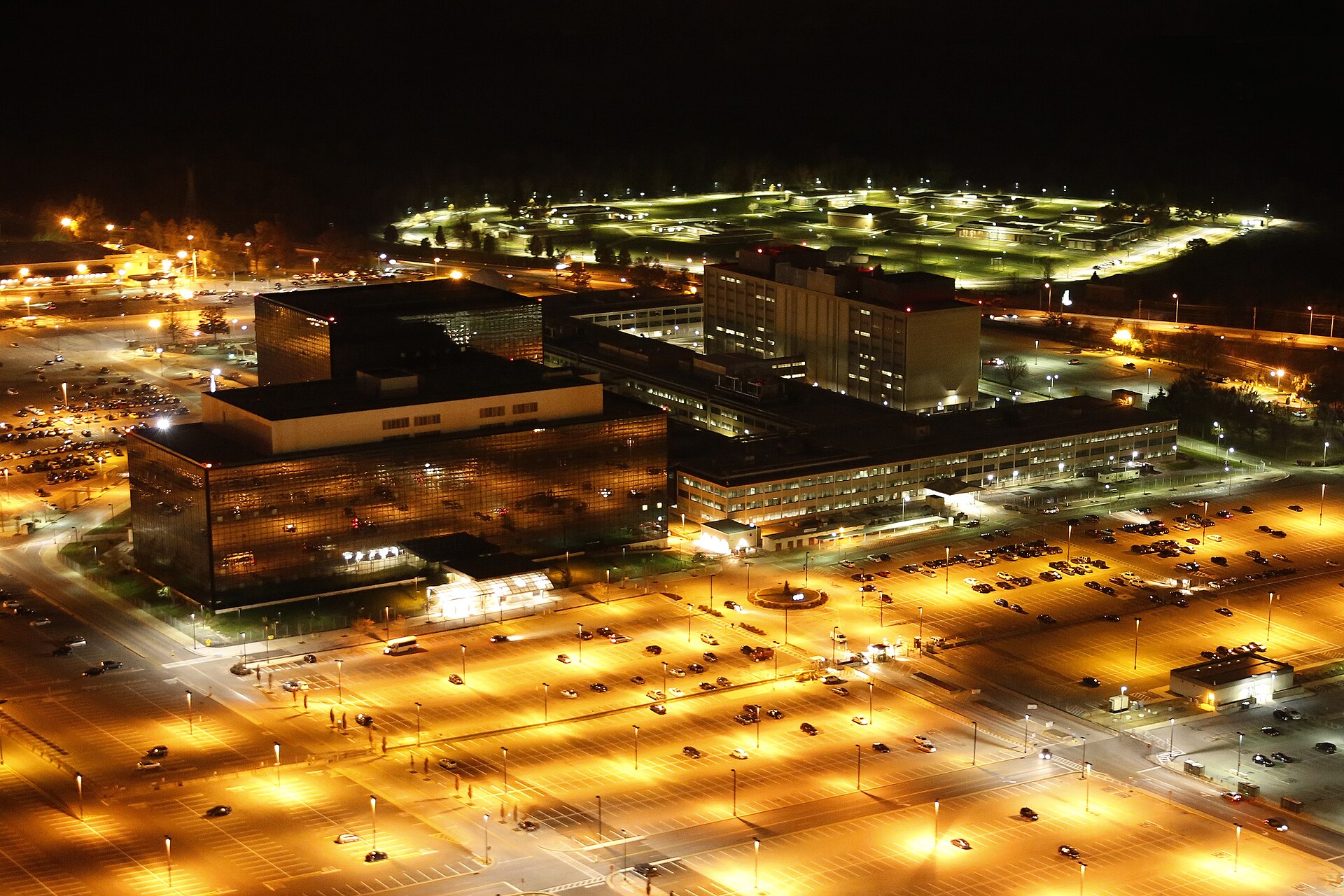
An aerial view of the National Security Agency campus at Fort Meade, Maryland, photographed in 2013. Archive photo by Trevor Paglen (CC0).
The National Security Agency acknowledged an interruption to some internal systems on November 17, describing temporary degradation during scheduled routine maintenance while saying its mission-critical capabilities remained operational. The distinction is central to understanding a story involving one of the government’s most sensitive organizations: an internal network problem is consequential, but the agency has not described a shutdown of its entire national-security mission.
Defense One reported that the classified communications network known as NSA Net was affected, disrupting analysts’ workflows. Its account cited people familiar with the matter and included the agency’s response. The NSA emphasized redundancy in its infrastructure. That response provides an official description of the incident, rather than a complete public technical investigation into what failed. Defense One’s reporting and the NSA statement.
The episode arrives amid intense attention to technology outages across American business and government. It is tempting to treat that timing as evidence of a common attacker. The reporting reviewed for this article does not establish such a connection. A failure affecting a classified system raises important questions about resilience and recovery, but the sensitivity of the organization does not determine the cause of the failure.
The useful question is therefore more precise than whether the NSA “went down.” Which activities were affected, which continued through alternatives and what would demonstrate a durable recovery? Public information may not answer every part of that question, because the systems handle classified work. It can still support a disciplined account of what the agency has acknowledged and what remains to be explained.
Why this network matters—and what the public account does not show
The NSA’s public mission combines foreign signals intelligence with cybersecurity responsibilities. Its analysts, linguists, mathematicians and engineers work on information relevant to national security, while the agency also supports military operations. That breadth makes reliable internal communications important: intelligence has operational value only when the right information can reach the people authorized to use it in time. NSA’s description of its mission.
A communications interruption can affect the pace of work without eliminating every capability an organization possesses. People may be able to perform one task while waiting for access needed for another. Alternative arrangements may preserve the most urgent functions while leaving routine work delayed. These are general possibilities in a complex institution, not a reconstruction of classified NSA operations. They help explain why the agency’s statement and reporting about staff disruption need not contradict each other.
The word “operational” also needs context. Saying a critical capability continued does not mean every employee had a normal day. Conversely, a report that employees encountered a serious problem does not establish that all intelligence collection or all military support stopped. Headlines that collapse those distinctions may communicate the drama of the event while obscuring its practical scope.
The public account does not provide a complete inventory of affected systems, the precise component that failed or a detailed chronology for every user. It does not publish an independent assessment of whether fallback arrangements met their targets. Those omissions limit the conclusions that can be drawn; they are not evidence, on their own, of a concealed breach. Classified work creates real boundaries around public disclosure, but those boundaries do not justify filling the gaps with speculation.
It is possible to take the interruption seriously without inventing consequences. The potential importance of a system is a reason to examine its resilience. It is not proof that a particular intelligence warning was missed, that information was lost or that an adversary gained access. No such claim is established by the material reviewed for this report.
Maintenance is necessary; safe maintenance is an operational responsibility
Large organizations cannot preserve reliability by refusing to change their systems. Software needs attention, equipment ages and security weaknesses require correction. The difficult task is introducing necessary changes while controlling how far an unexpected problem can spread. A maintenance window is an opportunity to manage risk, not a guarantee that the work will proceed without an interruption.
That is why the distinction between planned work and an unplanned consequence matters. An organization may schedule maintenance, yet still encounter a failure that was not intended or anticipated. Describing the work as routine identifies its purpose; it does not answer whether the disruption was acceptable, whether the testing was sufficient or whether recovery was as fast as it should have been.
NIST’s contingency-planning guidance provides a public framework for thinking about these questions. It connects recovery planning to operational priorities and resilience, rather than treating a backup as a complete strategy by itself. A plan has to address which functions matter most and how an organization will restore them when normal arrangements are unavailable. This is general guidance, not evidence about the NSA’s implementation in this incident. NIST’s federal information-system contingency-planning guidance.
Redundancy is best understood in that operational context. Having another component available is useful only if it can take over the work required of it. A fallback can preserve a crucial function while providing a slower or more limited experience. That may be a reasonable trade-off during recovery, but it should be measured against the organization’s needs rather than assumed successful because the word “redundancy” appears in a statement.
There are several concrete questions an eventual review could address without exposing sensitive technical details. Did the interruption remain within the scope anticipated for the maintenance? Were the effects recognized quickly? Could the change be reversed? Did the people responsible for urgent work know which alternatives were available? Those questions concern management and reliability as much as engineering.
The answers could also distinguish a single failed change from a structural weakness. One problem may call for a narrower correction to testing or deployment. Another may reveal that too much essential work depends on a component with inadequate alternatives. Public reporting should not choose between those explanations before evidence does, but oversight should be capable of examining both.
What would distinguish an outage from an attack
For a reader, the most important distinction is between an observed symptom and an established cause. Slow access, unavailable applications or delayed communications describe symptoms. Unauthorized access, malicious changes or evidence of an intruder would concern cause. A system does not become the target of a confirmed cyberattack merely because its owner is an intelligence agency.
The NSA’s cybersecurity mission itself is broader than the operation of its internal network. Its public overview describes work to protect national-security systems and improve the security of the defense industrial base and weapons systems. A problem in one internal environment should not be equated automatically with the failure of every organization or system that receives that support. NSA’s cybersecurity overview.
There is also a difference between a preliminary explanation and a final investigation. Early statements can accurately identify what is known while leaving unresolved technical questions. Subsequent evidence may strengthen or revise the account. The correct editorial response is to preserve the chronology: state what officials say now, identify the basis for other reporting and update the story if new evidence materially changes it.
It would be equally mistaken to demand absolute proof of a negative before acknowledging the maintenance explanation. Almost any complex event permits imaginable alternatives. Journalism becomes less informative when every unsupported possibility receives the same weight as a stated explanation supported by the available reporting. The standard should be evidence proportionate to the claim, not the intensity of online suspicion.
The connection people may feel between this episode and other recent disruptions also needs an evidentiary test. A shared date is weak evidence. A demonstrated common dependency or a documented investigative link would be much stronger. Until such evidence appears, separate incidents should retain separate explanations. That approach allows a genuine connection to be reported clearly if one is established later.
The accountability questions that remain
The immediate public interest is not satisfied by either of two sweeping statements: that nothing important happened because critical capabilities continued, or that the country was left unprotected because a network had problems. Both formulations reach beyond the information available. The more useful account recognizes an acknowledged disruption and then asks how well the agency contained it.
Congressional and internal oversight can examine consequences that may never belong in a public article. The public can still expect an explanation of the incident’s general scope, whether normal service was restored and whether lessons were incorporated into future maintenance. Protecting operational detail does not require abandoning every measure of accountability.
The episode should also encourage a more mature discussion of reliability across government. Essential systems are maintained by people working under constraints of time, complexity and mission demand. That reality explains why changes can be difficult; it does not excuse avoidable weakness. An effective review should identify decisions and dependencies that can be improved, rather than stopping at an assurance that the work was routine.
A useful recovery account would also distinguish restoration from validation. Bringing a service back is one milestone; confirming that dependent workflows function normally is another. That distinction matters for any institution handling urgent work, because a technically available application may still leave staff clearing delayed tasks. The public material reviewed does not quantify that backlog at the NSA, and no estimate should be inferred from the agency’s size or mission.
For now, the conclusion supported by the public record is specific. The NSA has acknowledged maintenance-related degradation of internal systems and says mission-critical operations continued. Reporting identifies disruption to its classified communications environment, while the detailed technical cause and full recovery account remain outside the published material reviewed here. The professional response is to scrutinize resilience and the eventual explanation—not to turn the agency’s name, or the week’s crowded outage calendar, into evidence of a cyberattack.