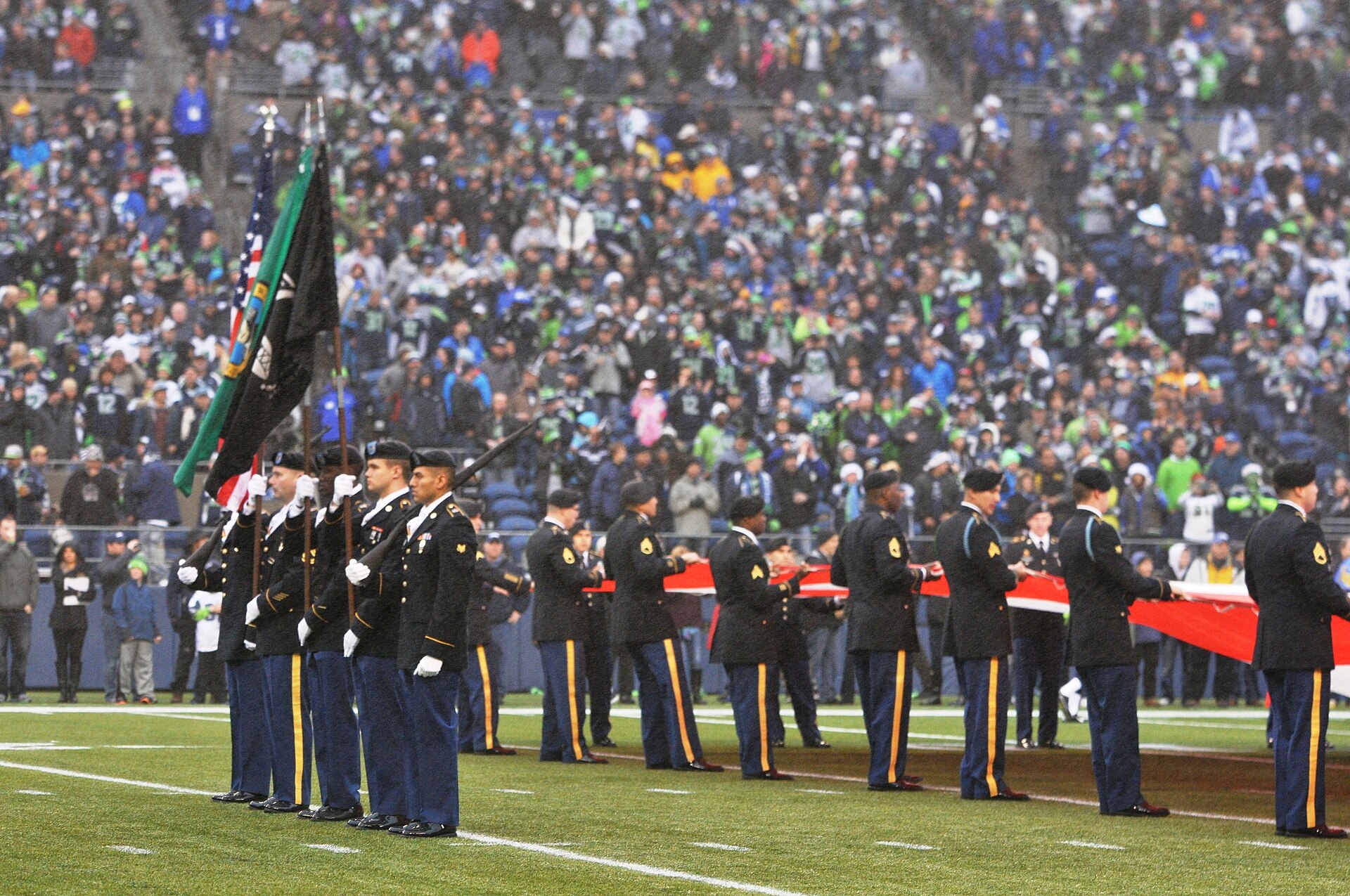
Pregame ceremonies before Seattle hosted Arizona at the venue now known as Lumen Field on Dec. 22, 2013. Archive photo by Staff Sgt. Tiffany Monnett, U.S. Army (Public domain).
Arizona went 89 yards on its first possession at Lumen Field and had three points to show for it. Its last drive reached the Seattle 2, where Nick Emmanwori broke up a fourth-down pass to Trey McBride. Between those two trips, the Seahawks took the lead on AJ Barner’s one-yard run, scored again on his seven-yard catch and built a 17–3 victory on a defense that allowed very little room for a response. The win on Sunday completed Seattle’s season sweep of its NFC West opponent. Official NFL gamebook Seattle Seahawks defensive recap
Drew Lock, starting in place of Sam Darnold, completed 19 of 28 passes for 175 yards and one touchdown. Gardner Minshew completed 21 of 30 for 166 for Arizona. The passing lines are close enough that someone seeing them alone might expect a close score. Seattle had three sacks, a 120–50 advantage in rushing yards and two touchdowns on two red-zone trips. Arizona’s two trips ended with the opening field goal and the fourth-down incompletion. Official NFL gamebook Arizona Cardinals game recap
The 89-yard drive Seattle held to three points
Arizona started at its own 1 and went to the Seattle 10 in 10 plays. Chad Ryland kicked a 28-yard field goal. From the Cardinals’ perspective, the possession showed that Minshew and his receivers could get the offense out of a dangerous starting position and create a chance to score. It also left them exposed to one efficient Seattle drive. A touchdown and extra point would have changed the game state more substantially after the amount of work it took to get there. Official NFL gamebook Arizona Cardinals game recap
The field compresses as an offense gets inside the 20. Defenders have less depth to protect, and a quarterback has less room to lead a receiver away from coverage. That effect mattered at the start and again at the end. Arizona gained 198 yards all afternoon, 89 on the opening series alone. It punted on five subsequent full possessions, according to Seattle’s recap. Without the ability to sustain the drives in the middle, it could not accumulate enough close-range chances to compensate for the first one ending in a kick. Official NFL gamebook Seattle Seahawks defensive recap
The Seahawks had entered the game with the league’s worst red-zone defense by the measure cited by the club. Their results Sunday were unusually clean in that part of the field, with a stop near the goal line on each Arizona opportunity. The small number of trips should make the performance easy to describe and difficult to project. Two good sequences mattered greatly against Arizona. They offer film for the defense to study as it tries to sustain the improvement against a different offense. Seattle Seahawks defensive recap
How AJ Barner gave Drew Lock a lead
Seattle’s first scoring drive covered 58 yards in 11 plays. Barner finished it with a one-yard run early in the second quarter. His second score came after Seattle took over with little time remaining in the half. The Seahawks drove 81 yards in 1:30, and Lock found Barner for a seven-yard touchdown with 15 seconds left. The same player finished a five-minute drive at the goal line and a drive that had to move nearly the full length of the field before halftime. Official NFL gamebook Arizona Cardinals game recap
Jaxon Smith-Njigba had seven catches for 51 yards overall. His impact in the final drive of the half was larger than that line suggests. He caught three passes and drew pass interference, accounting for 64 yards on the series when the penalty is included, according to Arizona’s recap. A receiver does not get credit for the yardage from a defensive foul in his receiving total. The offense still gets the benefit of moving the ball and, in this case, was able to give Lock a short throw for a touchdown before time ran out. Arizona Cardinals game recap Official NFL gamebook
Lock went the entire game without being sacked or throwing an interception. Seattle did not need him to take the game over with a series of throws downfield. The most valuable thing he could do once the defense settled was make the available completions and keep the offense in favorable downs. Seattle converted seven of 14 third downs. The drive before halftime also showed he could accelerate the offense when the clock demanded it. Those two jobs were both important for a team using its backup quarterback and facing a divisional defense familiar with its personnel. Official NFL gamebook Arizona Cardinals game recap
Seattle’s pass rush kept Arizona from building drives
Minshew had no interceptions and completed 70 percent of his passes. The Cardinals still averaged under three yards a rush, converted four of 13 third downs and gave up 18 yards on three sacks. That limited the return from the completions. A short catch on an early down is useful when the run game can get the rest. In a series where the team has already lost yardage or fallen behind the sticks, the offense needs a different gain to get to the same place. Seattle kept creating those tougher downs for Arizona. Official NFL gamebook
The defensive front did it without Leonard Williams and Uchenna Nwosu, according to the Seahawks. DeMarcus Lawrence had a sack and a tackle for loss on Arizona’s late red-zone possession. Seattle allowed 50 rushing yards, with Tyler Allgeier picking up 46 of those on 17 attempts. The Cardinals had fewer carries than Seattle and less room on the ones they got. The combination matters because a defense can reduce a team’s total rushing production by taking a lead and can also reduce what the opponent gains on each individual attempt. Seattle did both. Seattle Seahawks defensive recap Official NFL gamebook
Arizona coach Mike LaFleur pointed to issues before the snap, including how fast the offense was getting its calls in and how much time players had to adjust after reaching the line. That observation helps explain the limits of assigning responsibility to the quarterback from the box score. A passer can hit his target on a high percentage of attempts while the offense still struggles to find an answer to a defensive look. Minshew’s first drive and the late trip to the 2 showed some of the offense’s possibilities. Seattle repeatedly forced Arizona out of them in between. Arizona Cardinals game recap
The fourth-down stop that finished it
Jason Myers had extended the lead to 17–3 with a 45-yard field goal in the third quarter. The margin left Arizona needing two touchdowns and two extra points to tie. The Cardinals reached first-and-goal at the Seattle 4 in the fourth quarter and got to the 2. A touchdown there could have put them within one score and given their defense a reason to get the ball back. Emmanwori stayed with McBride and broke up the fourth-down pass, giving Seattle the ball with no more points required. Official NFL gamebook Seattle Seahawks defensive recap
The possession had already survived one close call. On third-and-5 near midfield, Josh Jobe intercepted a pass intended for McBride. Officials called defensive pass interference on Jobe, so the takeaway did not count and Arizona kept the ball. The penalty gave the Cardinals a first down. They still had to take advantage of it. Seattle’s response at the goal line was important precisely because the defense had already appeared to end the drive once and now needed to do it again. Official NFL gamebook Seattle Seahawks defensive recap
Seattle had given Emmanwori the assignment of covering McBride and had used him less often as a rusher in this game, coach Mike Macdonald said. That division of work matters to understanding the play. The Seahawks could get pressure from other players and still have a defender with size and range available for one of Arizona’s most important targets. At the 2, there was little room for McBride to create separation. Emmanwori’s coverage was the final expression of how the defense had handled the day’s most consequential downs. Seattle Seahawks defensive recap
The offense ran out the game after the stop. Seattle finished with 120 yards on 33 rushes, and the 45-yard field goal had come at the end of an 11-play drive that consumed 7:35. The Seahawks were able to use long possessions to protect a lead they had already built. The same approach would have been harder to sustain if Arizona had converted the last fourth down and made the margin seven. Finishing the drive on defense kept the offense in the kind of game it could manage without having to force the ball into tight coverage. Official NFL gamebook Arizona Cardinals game recap
What Seattle gained from the sweep
The Seahawks moved to 5–4 and the Cardinals fell to 3–6. Seattle held Arizona to 10 combined points in two games this season, a touchdown in the first meeting and a field goal in the second. That is stronger evidence of a favorable matchup than one stop at the goal line by itself. It also gives Arizona a specific problem to solve. Getting into scoring range twice can be enough to make a game competitive when the defense holds the other side to 17. The Cardinals needed to turn at least one of those possessions into seven and produce another opportunity before the clock made it urgent. Official game center Seattle Seahawks defensive recap
The result belonged to Seattle’s ability to finish at both ends of the field. Barner’s run and catch gave Lock the benefit of an eleven-point halftime lead. The defense did not allow Arizona to convert its two best chances into touchdowns. Those were the decisions behind a low-scoring game that Seattle controlled for most of the afternoon. By the time Minshew had the ball at the 2, the Seahawks had already shown which team was better equipped to finish the drive.