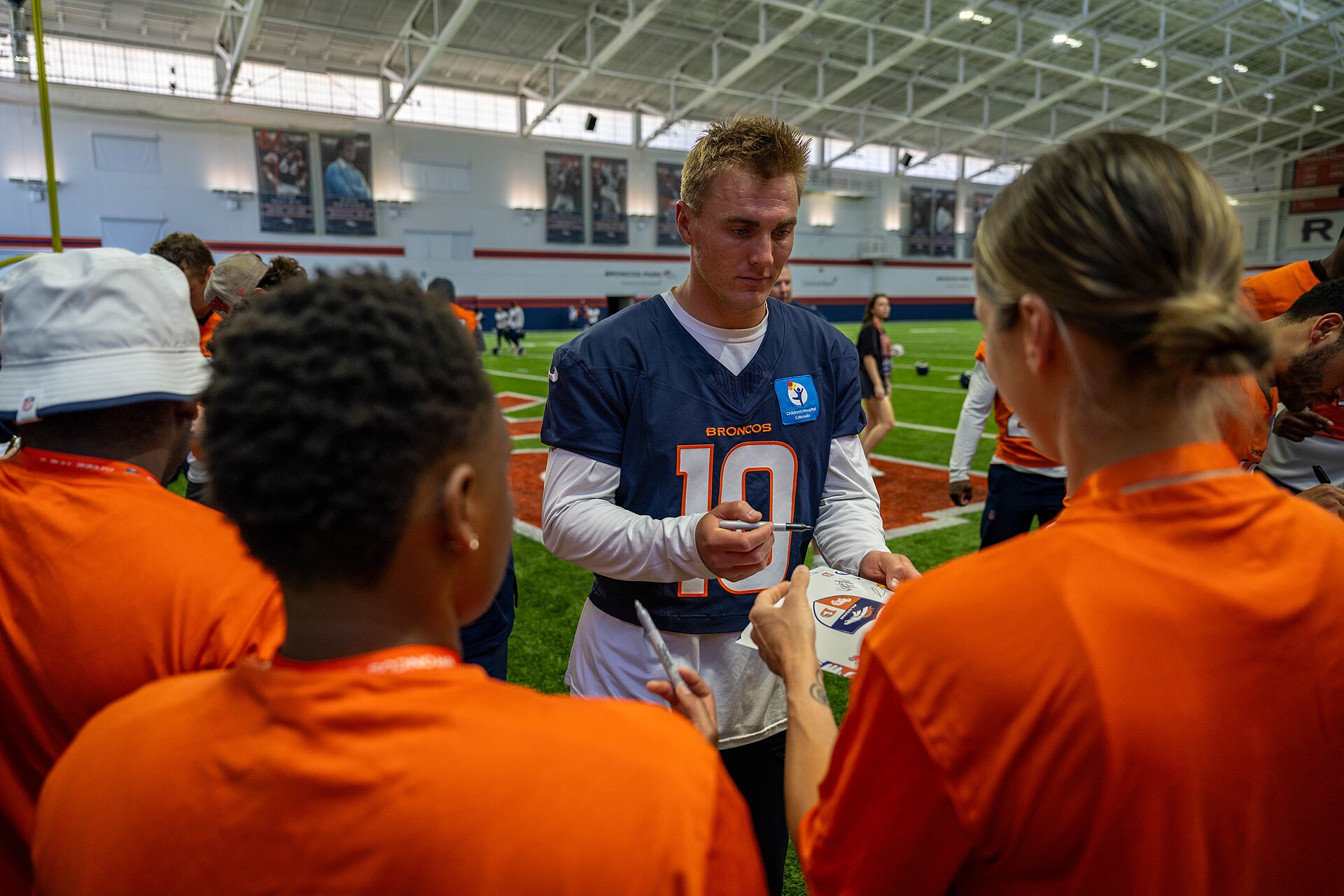
Denver quarterback Bo Nix signs autographs at Broncos Park in Englewood on Aug. 21, 2025. Archive photo by Tech. Sgt. Jordan Thompson, U.S. Space Force (Public domain).
Carolina led by a point and had the ball at Denver’s 1-yard line late in the third quarter on Sunday. The Panthers appeared to run a second-down play before officials stopped the game to consider Denver coach Sean Payton’s challenge of the first-down pass. The review turned that pass into an interception by Broncos safety Devon Key. Denver drove 80 yards for the lead, added another touchdown and escaped Charlotte with a 26–21 win when Nik Bonitto knocked the ball loose from Bryce Young with 1:24 left. Bonitto recovered it himself. Official NFL gamebook Replay explanation and officiating pool report
Denver improved to 7–2, won its fifth straight and extended its NFL record to 16 consecutive regular-season wins in games decided by one score, according to the team. Carolina, which had recovered from a 10–0 deficit to take the lead, fell to 3–5. The replay was the largest shift in the game. The Broncos still had to cover 80 yards on the next drive and stop Young after he brought the Panthers back within five. Denver Broncos game recap Carolina Panthers game recap
Why the Devon Key interception counted
Young threw toward tight end Tommy Tremble on first-and-goal. Denver linebacker Justin Strnad was in coverage. The pass was ruled incomplete on the field. On review, officials determined the ball had come off Tremble without hitting the ground and that Key controlled it in the end zone. The result was a touchback, moving the ball from the spot where Carolina had a one-yard trip to the goal line to the Denver 20 with the Broncos on offense. Official NFL gamebook Replay explanation and officiating pool report
The dispute involved two separate issues. One was whether Denver challenged in time. Carolina’s offense had gone ahead with a handoff to Chuba Hubbard, and several players believed the next snap had already happened when the challenge was taken up. NFL vice president of instant replay Mark Butterworth told the pool reporter that replay had camera angles showing Payton’s flag was out before the snap. The time when the coach threw the flag was decisive. Players could reasonably experience the stoppage as late if the handoff went ahead before they understood what the officials were reviewing. Officiating pool report and Carolina postgame interviews
The other issue was Strnad’s contact with Tremble. Tremble argued afterward that he had been interfered with. Referee Alan Eck said the officials who watched the play judged the defender to have arrived at essentially the same time as the ball. The replay addressed whether the ball was intercepted. It did not revisit the on-field judgment about pass interference. The two decisions can be evaluated separately, and the league’s explanation about the timing of the flag resolves a different question from whether a defender made contact early. Officiating pool report and Carolina postgame interviews
The field position gives the controversy its weight. A Carolina touchdown and extra point would have produced a 21–13 lead. That was a possibility with the ball at the 1, and there were still downs to play. The reversal removed the scoring chance entirely. Denver converted the takeaway into six points and went ahead 19–14 after a failed two-point attempt. A single review changed which offense had the ball, which team could play with a lead, and how much each side would have to accomplish on its next possession. Official NFL gamebook
How the Broncos turned the touchback into a lead
Denver took 14 plays and 6:13 to drive the 80 yards. Rookie Jonah Coleman ran nine yards for the touchdown with 10:17 left. It was a sustained answer from an offense that had scored 10 in the first quarter and had not scored a touchdown since. A long drive after a turnover puts the opposing defense in a different position from a short-field score. Carolina had the entire field available to get a stop. Denver kept the ball through a series of downs and made the field position it had won on the review count. Official NFL gamebook Denver Broncos game recap
Two third downs near the end of the 80-yard drive were decisive. From the Carolina 31 on third-and-6, Nix found Sutton for 12 yards. Three plays later, he needed six at the Carolina 15 and got exactly that on a pass to Troy Franklin. Coleman scored on the next snap. Those catches gave Denver a way to get ahead by more than a field goal. A stop on either play would have left a much different decision for Payton, with Carolina still leading and the Broncos close enough for Wil Lutz to consider a kick. Official NFL gamebook
The next Denver touchdown came much more quickly. The Broncos covered 61 yards in six plays, and Bo Nix found Pat Bryant for 26 yards and the score with 5:41 left. Bryant was playing his first game back from injured reserve and led the team with 56 receiving yards. With the extra point, Denver went ahead 26–14. The game had turned from a chance for Carolina to go ahead by eight to a two-score lead for Denver. The sequence required both the ruling and two different kinds of offensive production. Official NFL gamebook Denver Broncos game recap
Nix finished 25 of 37 for 237 yards, two touchdowns and an interception. He had found Courtland Sutton for a three-yard touchdown in the first quarter and later had a pass intended for Sutton intercepted by Corey Thornton inside the Carolina 10. That was another example of why the goal-line review should not be read in isolation. Carolina’s defense had already stopped a promising Denver possession with an interception. The issue late was that it could not make the next stop after its offense gave the ball back. Official NFL gamebook
Bryce Young got the Panthers back within one score
Young completed 28 of 39 passes for 276 yards and three touchdowns. He hit Tremble from 10 yards before halftime and found Darren Waller from 15 on the opening drive of the third quarter to give Carolina its 14–13 lead. The fourth-quarter pass to Tetairoa McMillan from four yards came after a 12-play, 64-yard drive. Carolina used 2:36 on that series and cut the deficit to 26–21 with 3:05 left. The pace mattered because a stop would leave time for one more possession. Official NFL gamebook Carolina Panthers game recap
Young’s fourth-quarter scoring drive almost ended before McMillan’s touchdown. Carolina faced fourth-and-18 at the Denver 34 and Young found John Metchie III for 25 yards. A roughing penalty moved the ball to the 4. Denver then had a chance to keep the ball after McMillan’s score, but an aborted snap pushed the offense back to its own 8. The Broncos punted, and Young hit McMillan for 20 yards on the first play of the final Carolina possession. Those were concrete chances to reverse the result even after the goal-line interception. Denver needed one more play on defense when the Panthers got across midfield. Official NFL gamebook
The Panthers got the ball back and reached the Denver 36. From there a touchdown could win the game, and the clock was still above a minute. Bonitto got around left tackle Rasheed Walker, reached Young and forced the fumble at the Denver 44. With Bonitto also recovering it, the outcome depended on one player doing both parts of a turnover. Getting a hand on the ball could have cost the Panthers eight yards. Getting on top of it cost them the final drive. Official NFL gamebook Carolina Panthers game recap
Carolina gained 353 yards to Denver’s 312 and averaged 4.8 yards per rush, compared with 3.0 for the Broncos. Hubbard carried 16 times for 79 yards. The Panthers scored touchdowns on three of four red-zone trips, while Denver went two of four. Denver’s edge came in keeping more drives alive on third down, converting six of 10 against Carolina’s three of 10. Those figures also explain why the Panthers came so close despite the two decisive giveaways. Their offense was dangerous when it reached scoring range, and it was still within reach of another chance when Bonitto arrived. Official NFL gamebook
What the one-score streak tells us
Sixteen consecutive regular-season wins by one score is a remarkable run because games that close can turn on a deflection, a spot or a missed kick. There is value in identifying what Denver did after the favorable replay. Its offense stayed on the field for a long drive and scored, then generated a second touchdown on a quicker series. The defense protected a lead that was still vulnerable when Carolina crossed midfield. Those are repeatable skills even if the combination that produced the chance at the 1 is unlikely to happen the same way again. Denver Broncos game recap Official NFL gamebook
Denver enters its Week 10 bye at 7–2, with three straight road wins. Carolina has lost three straight. The Panthers showed they could move the ball, get out of an early deficit and make one more drive after a difficult ruling. The work ahead is protecting the passer and converting more of the downs that determine whether a promising series continues. Young’s three touchdowns show why Carolina stayed in the game. The last sack shows the vulnerability an opponent can still exploit when it knows where he has to go. Denver Broncos game recap Carolina Panthers game recap
Key’s interception will be the play people return to because it took away the clearest scoring chance of the second half. Denver’s more useful accomplishment was what followed. It took a possession at its own 20 and turned it into the lead, then finished the game when Carolina had recovered enough to threaten again. The ruling put the game back within reach for Denver. The Broncos won it on the field in the possessions that followed.