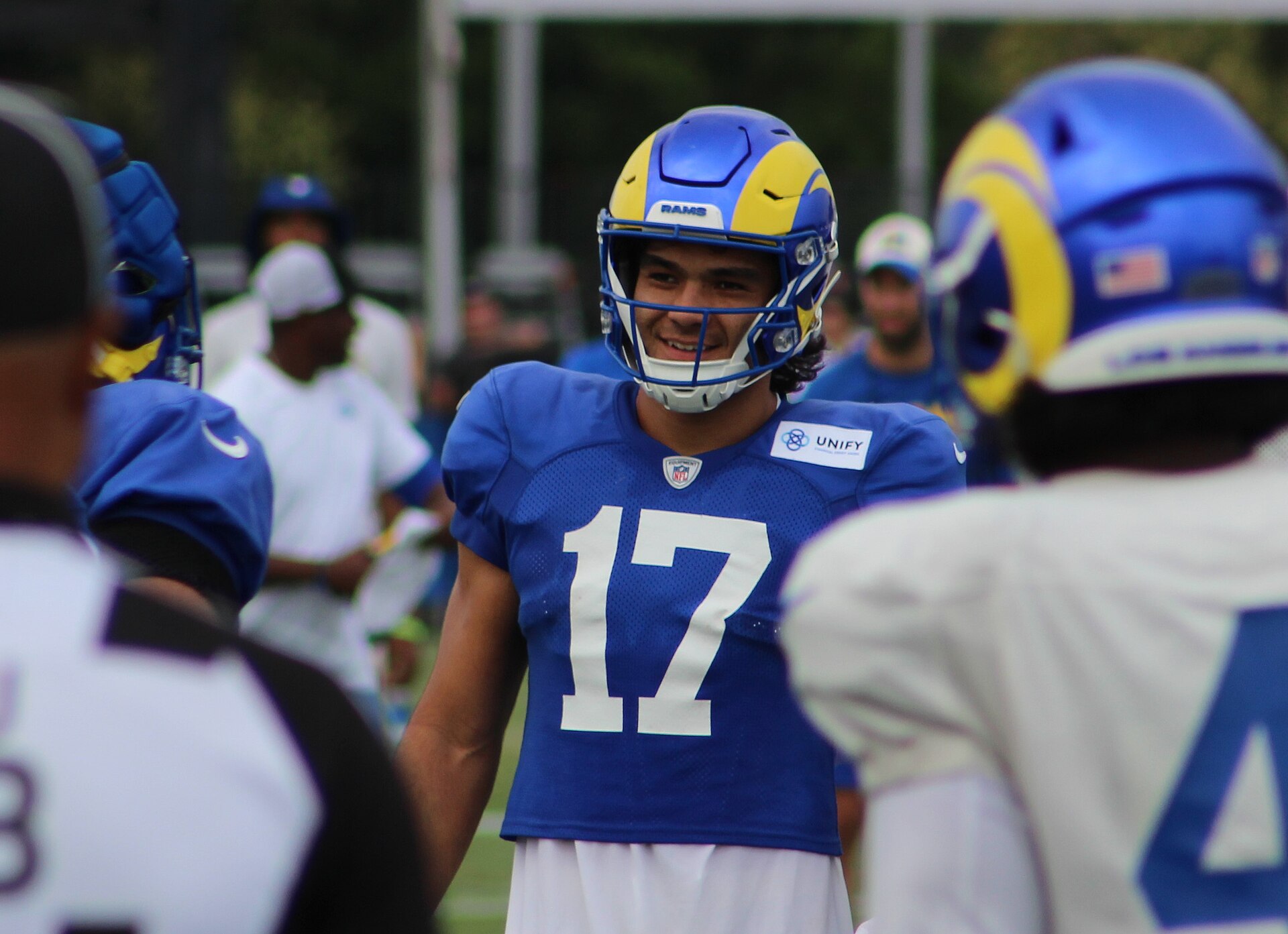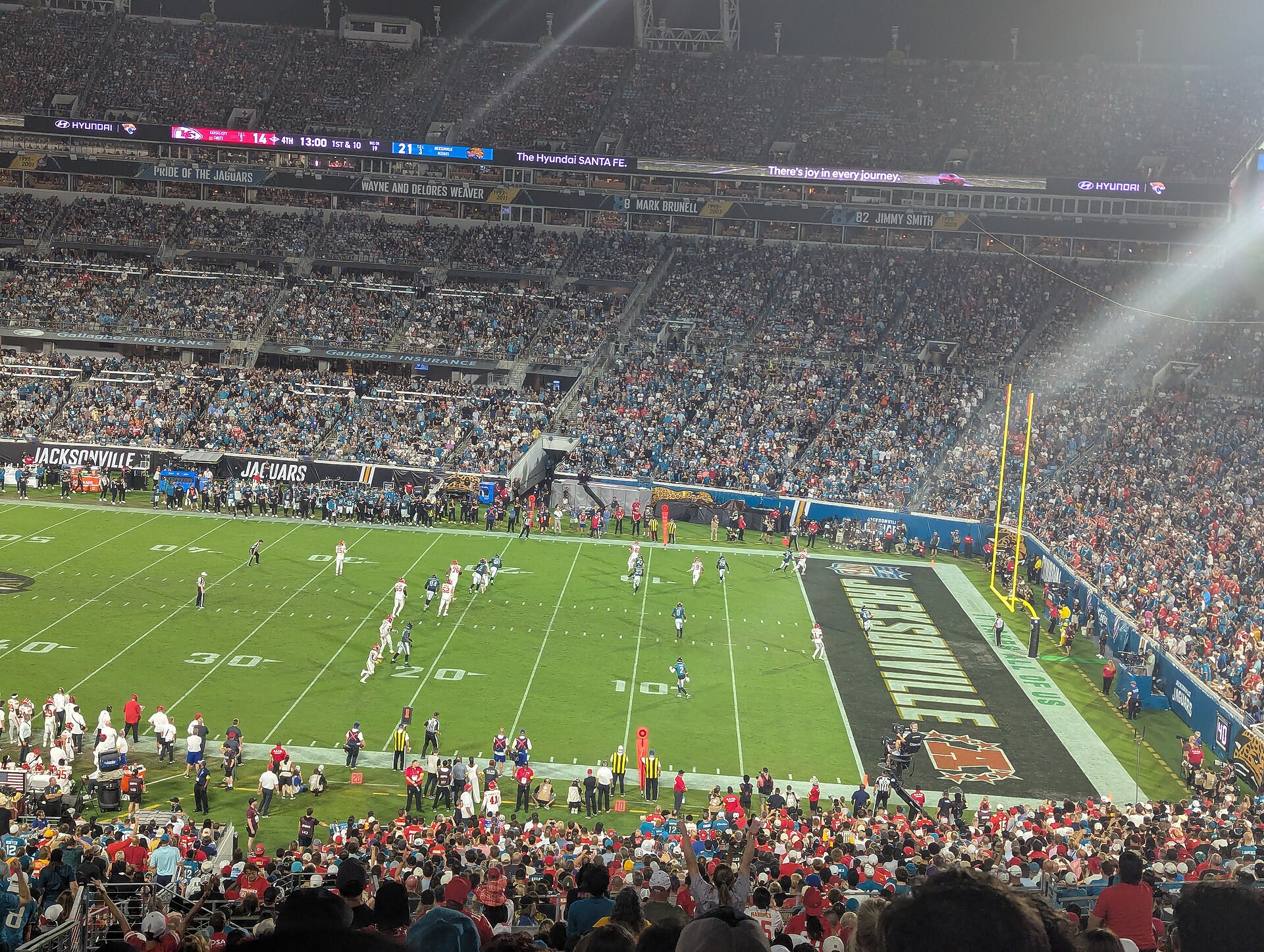
Kansas City on offense against Jacksonville at EverBank Stadium on Oct. 6, 2025. Archive photo by elisfkc2 (CC BY-SA 4.0).
The New York Jets led the Chiefs twice in the first half at Arrowhead Stadium, controlled the ball for much of that time and kept Patrick Mahomes under pressure. They still went to halftime trailing. Kenneth Walker III caught both of Mahomes’ first-half touchdown passes, then added a rushing touchdown as Kansas City pulled away for a 35–12 win on Sunday. New York got all its points from Jason Sanders. Kansas City put the ball in the end zone five times. That difference turned an unsettled first half into the Chiefs’ highest-scoring game of the season. Kansas City Chiefs game recap Official NFL gamebook
Walker had 102 rushing yards on 18 carries and 41 receiving yards, a total of 143 from scrimmage. Mahomes completed 23 of 31 passes for 242 yards and the two touchdowns. Geno Smith threw for 165 yards, but the Chiefs sacked him five times for 42 yards of losses. Kansas City improved to 6–2 and ended a two-game losing streak. The Jets fell to 2–7. Official NFL gamebook NFL team results
The Jets did enough early to make the Chiefs uncomfortable
New York opened with a 14-play drive that covered 64 yards and used 8:13. Sanders made a 23-yard field goal. A Kansas City fumble gave the Jets another possession in Chiefs territory, and Sanders made a 48-yarder for a 6–0 lead. The Jets had done two things that can make a road upset possible. They kept the opposing offense on the sideline for a long stretch, then took the ball away when it finally got a chance. The missing piece was a touchdown after either one. Official NFL gamebook New York Jets game recap
Walker’s first score came after Kansas City got a third-down completion to Travis Kelce for 17 yards. The Chiefs went 82 yards in 10 plays and finished the drive with a seven-yard Mahomes pass to Walker. Even after Sanders made a 49-yard field goal to put New York ahead 9–7, the arithmetic favored a team that could finish. The Jets had scored three times and were up two. Their defense still needed to prevent the next touchdown from undoing another long stretch of work. Kansas City Chiefs game recap Official NFL gamebook
That touchdown came after Braelon Allen lost a fumble. Kansas City needed two plays to cover 24 yards. The score came on a 25-yard pass to Walker, giving the Chiefs a 14–9 lead. The first Walker touchdown showed the offense could build a drive after a slow start. The second showed how quickly it could capitalize on the work of the defense. Sanders later made a 54-yard kick, and the Jets were within 14–12 at halftime. They had outgained Kansas City 171–134 in the half. Official NFL gamebook New York Jets game recap
Walker’s receiving work changed what New York had to defend
Walker’s two receiving scores came before his running became the central issue. A running back capable of reaching the end zone on a pass from 25 yards out creates a different assignment than one who is mainly a checkdown option. Defenders must get him on the ground in space and account for him as a route develops. That duty comes on top of watching Kelce and the outside receivers. New York’s problem was visible in the final line. Walker produced 41 receiving yards, enough to create two touchdowns, and still carried the bulk of the work in the ground game. Official NFL gamebook Kansas City Chiefs game recap
Walker averaged 5.7 yards per rush. Those gains have a different value for the play-caller with a lead than they do when an offense needs to make up two scores. The Chiefs could use runs to reduce the burden on Mahomes, leave shorter distances to convert and keep the clock moving. Walker’s two-yard touchdown late in the third quarter was the last play of an eight-play, 82-yard drive. Kansas City had moved the length of the field before asking him to finish from close range. The extra point made it 28–12. Official NFL gamebook
Kelce had already made it 21–12 by scoring on a one-yard run on the first drive of the second half. The drive covered 60 yards and used 4:40. The difference from halftime was immediate. New York needed more than one conventional touchdown and extra point to get in front. A field goal could still cut the deficit to six, but the Jets first needed to keep the Chiefs from putting together another long possession. Walker and the Kansas City offensive line made that difficult. Official NFL gamebook Kansas City Chiefs game recap
How Kansas City took away the second half
The Chiefs won the second half 21–0. The gamebook records 229 net yards for New York, including 171 in the first half. Kansas City went from 134 in the first half to 391 for the game. More important than the raw totals was what happened on third down. The Jets were two of 12 for the afternoon. The Chiefs converted six of 11. Kansas City could keep sending its offense back out with fresh downs while New York had to decide whether to punt or take more risk on fourth down. Official NFL gamebook New York Jets game recap
Chris Jones and George Karlaftis each had multiple sacks. Karlaftis finished with two and three tackles for loss, according to Kansas City. The pass rush cut Smith’s gross 165 yards to 123 net. Some of those losses came at moments when the Jets could least afford to give up a down and distance. A sack makes an offense use another successful play merely to get back to where it began, and New York had little time for that once Kansas City was ahead by two scores. Kansas City Chiefs game recap Official NFL gamebook
New York still had useful work from Breece Hall in his return. He ran 15 times for 61 yards and finished with 87 yards from scrimmage. The Jets rushed for 99 yards in the first half and 106 overall. Hall had 13 of his 15 carries before halftime, according to the club. The difference shows how much the scoring environment changed. The offense could run frequently while the game was close and had to lean elsewhere while trying to come back. That shift gave the Chiefs more chances to pressure Smith on predictable passing downs. New York Jets game recap Official NFL gamebook
David Bailey’s pressure kept the first half close
There was a substantial performance on the New York side that the final score obscures. Rookie edge rusher David Bailey sacked Mahomes twice and forced a fumble on each sack on the same late first-half drive. The Jets recovered the second, and Mahomes briefly left with an elbow injury before returning. Kansas City reported that he planned to have further testing. The sacks are evidence that New York could disrupt the Chiefs’ protection. The recovery also shows how close the Jets came to taking a lead into the break. New York Jets game recap Kansas City Chiefs game recap Official NFL gamebook
New York’s defense had a chance to benefit from its work if the offense could score touchdowns. The 48-yard field goal after the first Chiefs fumble was a worthwhile result given where that possession stalled. The third and fourth kicks both came from close to 50 yards or beyond. An offense can use long field goals to stay in range, particularly with a kicker having a good day. At some point it needs drives that take the ball closer, because the opponent can erase two field goals with a touchdown and extra point. Kansas City demonstrated that with its first scoring possession. Official NFL gamebook
After Bailey’s second forced fumble, New York got the ball at the Kansas City 30 and moved backward on net. The drive chart records 10 yards gained and 15 lost to penalties, leaving Sanders with a 53-yard attempt that missed. Kansas City then moved into position for a 51-yard attempt by Harrison Butker, which also missed. Those exchanges were an opportunity for either team to change the halftime margin. The Jets had the better starting position and ended up asking more of their kicker than a turnover that close to the end zone initially suggested. Official NFL gamebook
The division of possession time tells a similar story. The Jets finished with 31:06, more than Kansas City, after controlling 20:26 of the first half. The Chiefs held the ball for 19:20 after halftime. The half-by-half numbers help explain why the full-game total can be deceptive. New York’s longest drives came when it had the chance to build a lead and produced field goals. Kansas City’s long possessions came after it had moved ahead and produced touchdowns that made the score harder to chase. The Jets’ early edge on the clock had real value only while they still had time to turn it into a larger lead. Official NFL gamebook
What 35–12 says about both teams
Kansas City finished four of four on red-zone trips and added Walker’s 25-yard touchdown from outside the 20. Emmett Johnson’s six-yard fourth-quarter run closed the scoring. The Chiefs next visit Atlanta, according to the NFL schedule. They can take a clear idea into that game about how to get Walker involved when the offense is facing an aggressive front. He can be the player who gets the team out of trouble on a pass and the player who keeps the offense moving when there is a lead to protect. Official NFL gamebook NFL Chiefs schedule
The Jets played a first half that gave them a credible chance to win. They came away with four field goals and a defense that still had to hold a quarterback and running back capable of erasing that work quickly. Kansas City finished drives when the field shortened, then made the field feel longer for New York with sacks and third-down stops. Walker’s touchdowns made the difference visible on the scoreboard. The second half showed why New York could never get close enough to answer them.