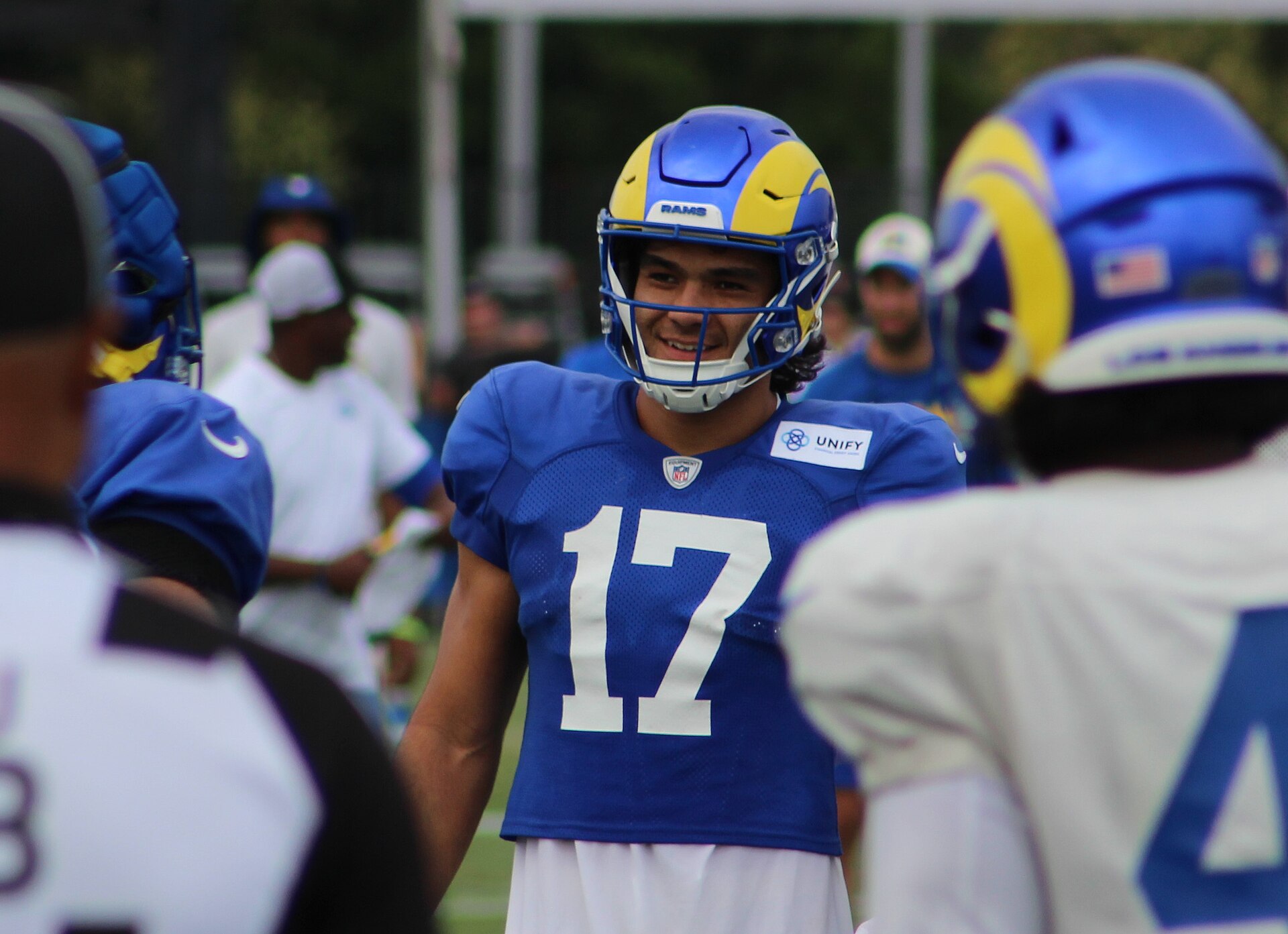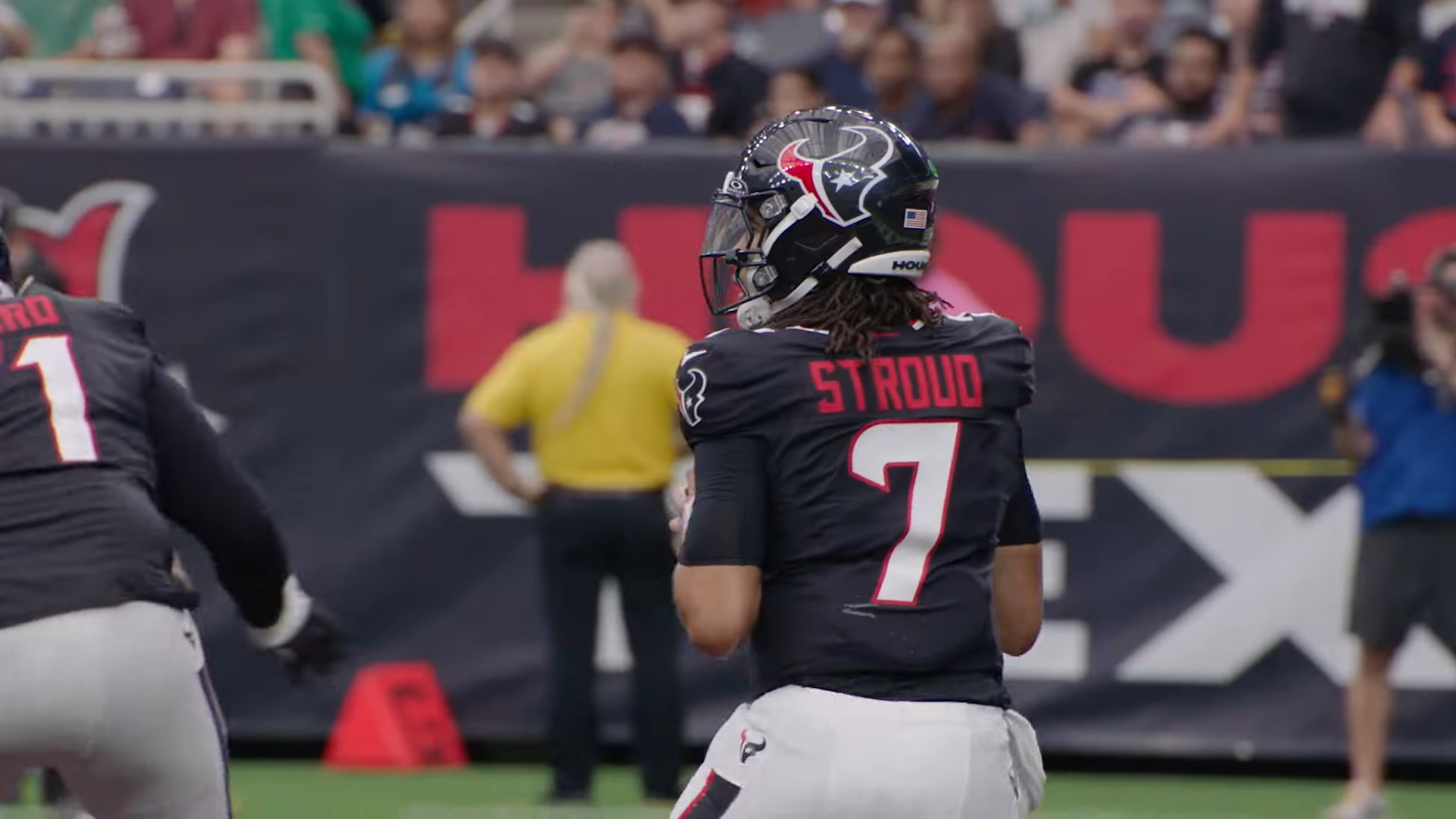
Houston quarterback C.J. Stroud against Tennessee at NRG Stadium on Nov. 24, 2024. Archive photo by Tennessee Titans (CC BY 3.0).
The Los Angeles Chargers had the ball at Houston’s 38 in the second quarter with a chance to take the lead. They got a field goal. On the next Houston possession, C.J. Stroud hit Tank Dell for a 63-yard touchdown. Stroud then took the Texans 76 yards in 34 seconds for another score before halftime. A one-point game was a 15-point game at the break, and Houston went on to win 44–22 at SoFi Stadium on Sunday. Stroud threw five touchdown passes, and the Texans sacked Justin Herbert eight times. Official NFL gamebook Los Angeles Chargers game recap
Stroud completed 21 of 35 passes for 384 yards, five scores and one interception. He threw touchdowns to four receivers, with Kayshon Boutte getting two. Houston improved to 3–5 and the Chargers fell to 0–8. The score gives an accurate sense of how far apart the teams finished. It takes a closer look at the second quarter to see how long Los Angeles had a chance to keep the game within reach, and how quickly the Texans took that chance away. Official NFL gamebook Houston Texans postgame analysis Los Angeles Chargers game recap
Why 10–9 was the pivotal score
Houston started with a 73-yard drive that ended in a 17-yard touchdown to Xavier Hutchinson. Ka’imi Fairbairn made a 56-yard field goal later in the first quarter. The Chargers were still in the game because Cameron Dicker answered with three field goals. The first came from 52 yards. The second was a 33-yarder after the offense reached first-and-goal at the Houston 9. The offense lost ground from there, and what might have been a tying touchdown became a kick that cut the deficit to four. Official NFL gamebook Los Angeles Chargers game recap
Linebacker Daiyan Henley then intercepted Stroud and gave the Chargers possession in Houston territory. Los Angeles moved the chains once and Dicker made a 43-yard kick to pull within 10–9. There was still time to take the lead before halftime, but the offense had just spent two of its best starting situations producing six points. On a day when Houston could score on a single pass from its side of midfield, those missed opportunities placed a heavy burden on the Los Angeles defense. Los Angeles Chargers game recap Official NFL gamebook
Houston needed two plays for the response. Dell’s catch and run gave the Texans a touchdown with 4:28 left in the half. The Chargers had gained enough field position to threaten on two straight possessions and were now down eight. Houston’s defense then forced two three-and-outs before halftime. That gave Stroud the time he needed for a seven-play drive that ended with a 12-yard pass to Boutte with 31 seconds left. Houston turned a narrow lead into a 24–9 advantage in less than five minutes of game time. Official NFL gamebook Los Angeles Chargers game recap
The 34-second scoring drive is worth a closer look. Stroud started at his 24 and missed his first two throws. Facing third-and-10, he hit Dalton Schultz for 14 yards and then found Marvin Harrison Jr. for 15. Both got out of bounds. The largest gain was a 35-yard throw to Boutte, who then caught the 12-yard touchdown. Houston gained 76 yards on four completions. The first two preserved the time Stroud would need for the deeper pass. The Chargers were a third-down stop away from having the rest of the half look entirely different. Official NFL gamebook
Stroud’s five touchdowns came in different ways
Stroud’s longest two touchdown passes both went for 63 yards. The other three came from 17, 12 and 13 yards. Houston scored three touchdowns on four red-zone opportunities and got its two longest scores without having to play a snap inside the 20 on those drives. That is a difficult combination to defend. A team can succeed at keeping an opponent out of the end zone on short throws and still lose ground on long ones. The Chargers spent much of the game facing both problems. Official NFL gamebook
Boutte caught four passes for 125 yards and two touchdowns, including the 63-yarder early in the fourth. Dell caught four for 105 and a score. Together, they supplied 230 of Stroud’s 384 yards. Nico Collins caught all four of his targets for 55 yards and a touchdown. Hutchinson caught three for 29, including the game’s first score. Stroud’s 60 percent completion rate is only part of his story. He averaged almost 11 yards per attempt because of how much Houston gained on several of the throws that connected. Official NFL gamebook C.J. Stroud official game logs
Collins’ touchdown came on a 10-play, 80-yard drive in the third quarter. That series gave Houston a 31–9 lead and showed how the offense could keep control even when it needed to build a conventional drive. The Texans did not have to depend exclusively on a short field or a long completion. They sustained possessions, converted eight of 14 third downs and still found two ways to score from more than 60 yards out. Those different routes to the end zone made it hard for Los Angeles to design its response around taking away a single player. Official NFL gamebook Houston Texans postgame analysis
Eight sacks made every missed chance more expensive
Will Anderson Jr. and Sheldon Rankins each had two sacks. The Texans matched a team high with eight and took the ball away twice, according to Houston. The gamebook credited the eight sacks of Herbert with 40 lost yards. Pressure from the edge and the interior tests different parts of the protection. A quarterback can sometimes step into a pocket when the edge breaks down. That option gets harder when rushers are also closing from in front of him. Los Angeles found fewer ways to get the ball away as Houston’s lead gave its front more obvious passing situations. Houston Texans postgame analysis Official NFL gamebook
The Chargers opened the third quarter with two runs that gained 13 yards. A sack by Anderson, an incompletion and a false start then left Herbert facing third-and-16. Derek Stingley Jr. intercepted the next throw, and the Texans turned that takeaway into the drive that ended with Collins’ touchdown. Later in the third quarter, Henry To’oTo’o forced a fumble and Calen Bullock recovered it. The takeaways mattered even though the game was moving away from Los Angeles. They ended opportunities for the Chargers to score before Houston’s longest remaining touchdown made the margin 29. Official NFL gamebook
Herbert finished 13 of 23 for 193 yards, with one touchdown and one interception. His 58-yard touchdown to Quentin Johnston in the fourth quarter was evidence that Los Angeles still had the ability to hit downfield. It came after Houston already led 38–9. DJ Uiagalelei later threw a 15-yard touchdown to Derius Davis. Those scores brought the Chargers to 22 points without ever putting the outcome within one possession. The fourth-quarter offense had better results once the gap was already large enough for Houston to protect it with long possessions and field goals. Official NFL gamebook
Los Angeles actually outrushed Houston 138–104. The detail matters because an offense that can gain yards on the ground might be expected to get more manageable downs. The Chargers still converted only five of 17 third downs, and their early red-zone trip ended in a field goal. Houston’s yards through the air were worth more because they came with the conversions and touchdowns necessary to put points on the board. The total-yardage gap finished at 485–315. Official NFL gamebook
What Houston can take into its next game
The Texans arrived in California at 2–5. The team’s postgame analysis counted four losses in which Houston had remained in the game into the last possession. Sunday gave the Texans an answer to what it looks like when their offense creates enough separation for their defense to dictate the next set of downs. The touchdown to Dell ended the immediate threat from the Chargers’ field goals. The touchdown to Boutte before halftime made it harder for Los Angeles to stick with its preferred mix of runs and passes. The pass rush made that change in circumstances count. Houston Texans postgame analysis Official NFL gamebook
Fairbairn also converted each of his three field-goal attempts and all five extra points. His first kick, from 56, kept Houston moving even before the decisive sequence. His two later field goals made the margin larger on possessions when a touchdown was no longer necessary. That is a secondary part of the result beside five passing touchdowns and eight sacks. It still matters to explaining how a team gets to 44 points. The Texans scored on drives that stalled outside the end zone as well as the ones Stroud finished himself. Official NFL gamebook
For the Chargers, the clearest opportunities came while the deficit was still small. A touchdown on the early goal-to-go trip or after Henley’s interception would have changed what the Texans had to do when they got the ball back. It would also have given the defense more margin against a long pass. Los Angeles reached the fourth quarter needing several scores because it had used its best early field position on short drives. Pass protection and better finishes near the goal line remain the concrete problems exposed by the loss. Los Angeles Chargers game recap Official NFL gamebook
Houston’s best work on Sunday came when the game was still close. Stroud turned one throw into a touchdown, moved the ball downfield with seconds to spare on the next scoring drive, and had four different receivers finish drives. The defense then made the Chargers pay for having to catch up. The two units gave each other a better set of circumstances, and the 44–22 final was the result.