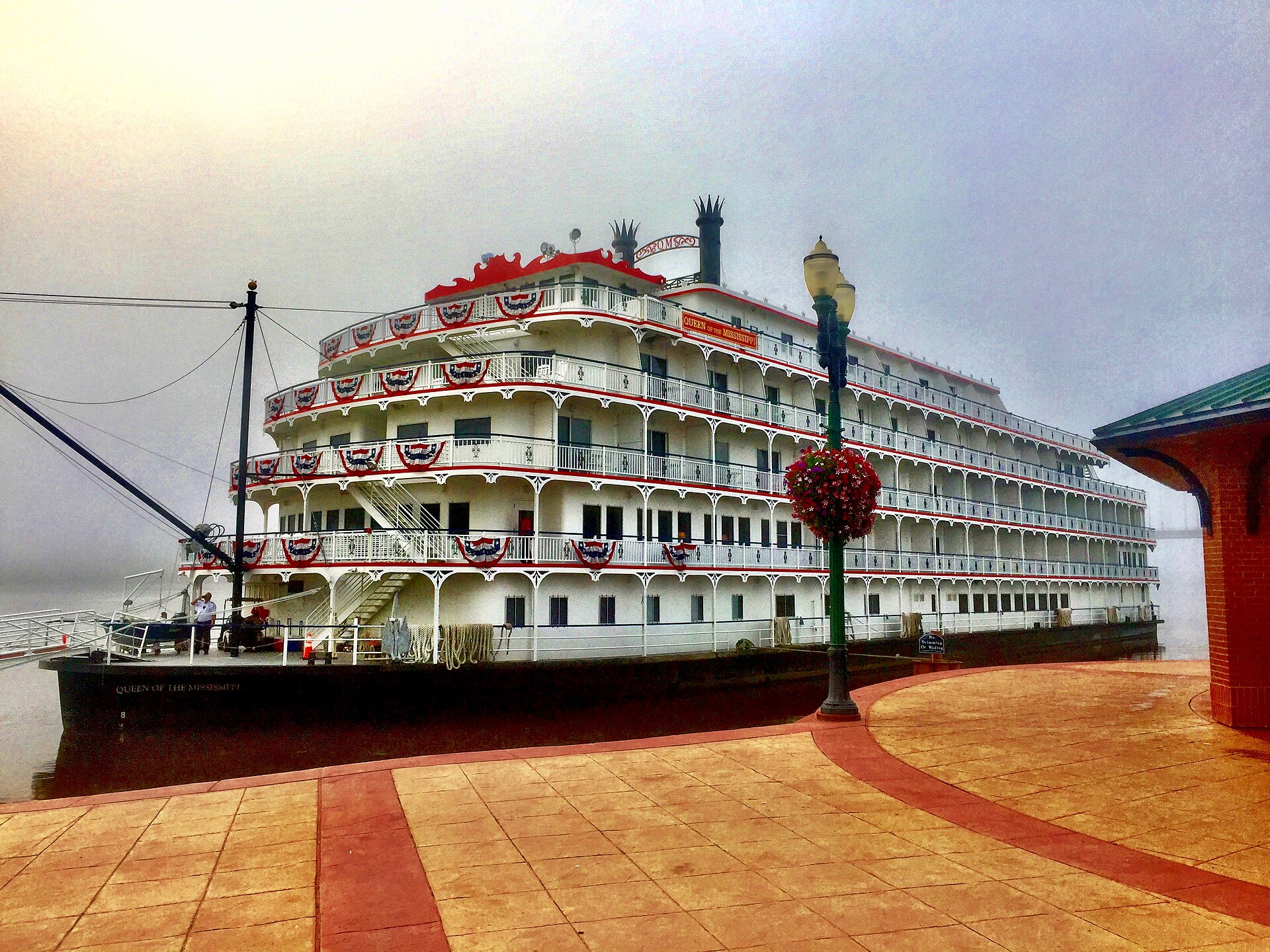
American Heritage, then named Queen of the Mississippi, at Dubuque, Iowa, on Aug. 3, 2016. This archive photograph shows the vessel before the November 2026 collision. Archive photo by Benroethig (CC BY-SA 4.0).
All passengers and crew were accounted for after a tanker struck the American Heritage river cruise ship in New Orleans on Friday, Nov. 13, sending 32 people to local hospitals, according to officials’ afternoon update reported by Axios. The collision left the paddlewheeler partly submerged beside the Mississippi River waterfront and triggered a rescue involving people in the water. The improved accounting of those aboard marked a significant development after the first reports described an unfolding search with the condition of passengers still unclear. Read the latest reported passenger and hospital update.
The vessels involved were the Atlantic Asphalt tanker and American Cruise Lines’ American Heritage. The passenger ship was docked when it was struck, according to the Port of New Orleans account cited in the reporting. Earlier reports identified 129 passengers; the later official briefing referred to approximately 180 people aboard when crew were included. Those figures describe different groups and should not be treated as competing passenger counts.
New Orleans Mayor Helena Moreno praised the rescue at the afternoon briefing, describing a “miracle on the Mississippi.” The words reflected the relief surrounding the accounting of everyone aboard. The hospital figure still makes this a serious casualty, and the update does not supply a complete account of each person’s injuries or recovery. The immediate story has moved from locating people to caring for them, securing the vessels and establishing what caused the collision.
What the first reports and later update establish
Video described by the Associated Press showed the much larger tanker making contact with the paddlewheeler as metal and glass gave way. The American Heritage listed into the river, and people wearing lifejackets were pulled toward nearby vessels. Port worker Devon Flanagan told the AP that workers rushed toward the dock as other boats joined the response. The scene combined a damaged passenger ship, people in the water and an urgent effort to reach them. Read the AP’s account of the collision and rescue.
The later announcement that all passengers and crew were accounted for answers one of the most urgent questions raised by those images. A visible rescue is not automatically a complete accounting: responders have to match people recovered or found ashore with the people who were actually aboard. The passenger manifest, crew roster and information from receiving hospitals all become important to closing that gap.
Likewise, the number transported to hospitals is a point-in-time measure of the response. It does not establish how long every person will remain hospitalized or how the injuries will develop. Friday’s reporting should therefore preserve the sequence: an initial emergency with uncertain numbers, followed by a briefing reporting everyone accounted for and 32 people in local hospitals. Later medical updates can refine that account without making the earlier rescue reports contradictory.
The reported dockside location is also central. American Heritage was not described as approaching the tanker in open water; it was alongside the waterfront when struck. That establishes the passenger vessel’s reported position. It does not yet explain the tanker’s course, the commands given aboard it or the condition of its navigation and propulsion systems. Those questions require a documented reconstruction.
American Heritage is a modern river cruise ship with a traditional profile
American Cruise Lines’ own ship profile lists American Heritage as a paddlewheeler built in 2015 with a capacity of 150 guests. It describes several passenger decks, lounges, a glass-enclosed restaurant and elevator access. The traditional paddlewheel appearance is part of its identity, but the vessel belongs to the modern domestic river-cruise business. Its passenger capacity should not be confused with the total number of people aboard when crew members are included. Read the operator’s published American Heritage specifications.
The profile helps explain the environment responders encountered: accommodation decks and public rooms arranged vertically within a relatively compact overnight vessel. A ship that lists changes the angle of floors, stairs and access points. Even when it remains near a dock, movement from accommodation spaces to a safe exit can become difficult. The precise condition of the interior during Friday’s evacuation will have to be established through accounts from those aboard and the subsequent examination of the vessel.
The American Heritage previously operated under the Queen of the Mississippi name. That history matters when readers encounter archive photographs showing the older lettering. The cover photograph accompanying this report shows the vessel at Dubuque, Iowa, in August 2016, before its later renaming. It is an image of the ship before the casualty, clearly dated, rather than a recreation of Friday’s collision. See the vessel’s name and service history.
Atlantic Asphalt is a different kind of working vessel. The tanker’s identity is established in the incident reporting, but its name alone cannot establish the contents or quantity of its cargo at the moment of the collision. Environmental assessment has to consider the vessel’s actual cargo and fuel records, the damage and any confirmed release. A report of a tanker collision should not be expanded into an unverified claim of a major chemical or oil spill.
The rescue depended on coordination across the waterfront
A casualty beside a working port can bring assistance from several directions at once: emergency services on land, professional responders on the river and nearby crews who see people in immediate danger. The AP account described other vessels helping at the scene. That response also creates a coordination challenge, because rescuers must reach people while preserving space for boats, medical transfers and the stabilization of damaged vessels.
The Coast Guard describes maritime response as a combination of search and rescue, incident coordination and the mitigation of environmental harm. Those functions explain why the work continues after the last missing person has been located. A vessel may still be unstable, access routes may still be restricted and the riverfront may still require controlled movement around the casualty. Read the Coast Guard’s maritime-response responsibilities.
Accounting for everyone also creates a transition in the information families need. During the search, the urgent question is whether a relative has been found. Afterward, the useful information concerns where the person was taken, whether medical care is continuing and how belongings and travel arrangements will be handled. The operator and the responding authorities are the appropriate sources for those individual details; a circulating video cannot provide them.
For people nearby, the practical task is to preserve access for emergency crews and follow current directions from officials. A riverfront incident can affect a sidewalk, a terminal approach and navigation space at the same time. The end of an active rescue does not automatically mean every surrounding area is open. Restrictions should be checked against the latest local announcement rather than an earlier photograph of the scene.
The investigation must connect movement, machinery and decisions
The central question is how Atlantic Asphalt came into contact with a docked passenger ship. A reconstruction should connect the vessels’ positions, movements and relevant decisions in a single chronology. Video can show the final approach and impact, but a complete account may also require navigation records, communications, machinery information and testimony from the people responsible for operating the vessels. Those sources answer different parts of the same question.
The Coast Guard’s investigations program exists to identify causes, protect life and property and prevent similar casualties. Its published guidance distinguishes a safety investigation from the resolution of private civil-liability disputes. That distinction is useful here: findings about an equipment failure, a maneuver or a procedure can inform safety action, while compensation and other legal claims follow their own processes. Read the Coast Guard’s explanation of marine investigations.
The examination should establish the tanker’s operational condition and the sequence of commands before contact. It should also document how the passenger vessel was secured, where people were located and how the evacuation unfolded. These are investigative subjects, not findings of fault. Identifying a question worth asking does not establish that the corresponding system or person failed.
Stability and structural damage require specialist assessment as well. The Coast Guard’s Salvage Engineering Response Team describes support for collisions, capsizings and sinkings, including analysis of vessel stability and structural integrity. That published role illustrates the expertise needed in the aftermath of this kind of casualty; it does not establish that the team has been assigned to this particular incident. See the Coast Guard’s salvage-engineering capabilities.
A sound public account will explain both the cause of the impact and the factors that shaped survival and injury. The location of the damage, the ship’s subsequent movement, the availability of exits and the speed of rescue can all be consequential. The most useful findings will connect those factors to specific evidence and identify measures that could reduce the consequences of a similar event.
A passenger emergency on a major working river
The New Orleans waterfront serves tourism and industrial commerce in close proximity. Port NOLA’s published cargo profile describes a deepwater port handling containers, breakbulk and other freight; its terminal information lists 40 berths across its facilities. The same river is a destination for overnight passenger cruising. Friday’s collision brought those different uses into one emergency without, by itself, establishing anything about the safety of every other vessel operating there. Read Port NOLA’s overview; see the port’s terminal information.
For booked cruise passengers, the next practical information must come from the operator: assistance for the affected travelers and verified arrangements for any subsequent sailing. A previously published schedule or sales page may not immediately reflect a casualty. Travelers should confirm the status of their specific reservation before assuming that a listed departure represents a current operational commitment.
The immediate conclusion is one of relief qualified by the scale of the emergency. Officials reported everyone aboard accounted for, while 32 people were taken to hospitals after a collision that left a passenger vessel partly submerged. The next test is a clear account of their condition, a safe stabilization and recovery effort, and an evidence-based explanation of how a tanker struck the docked American Heritage.