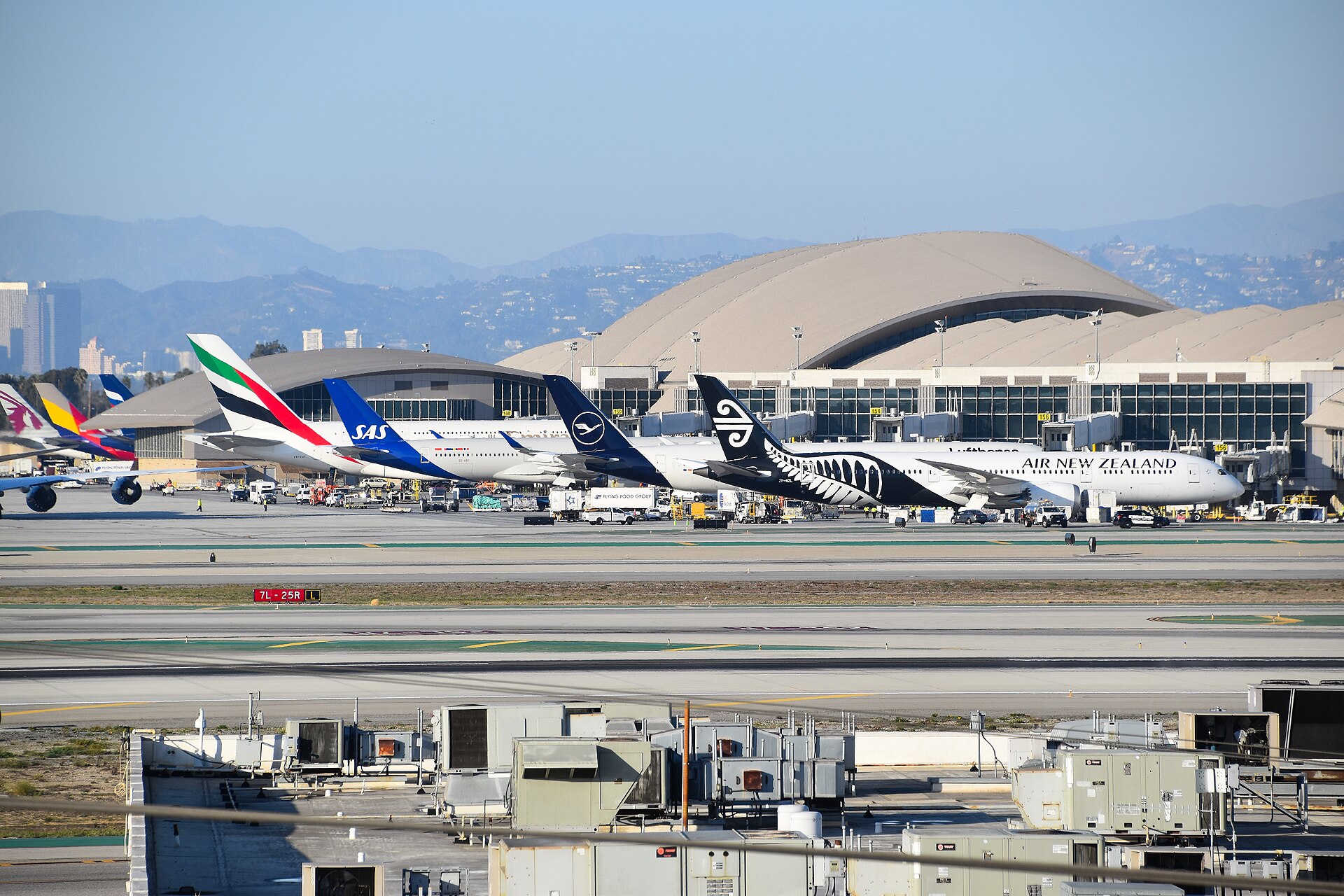
Aircraft at Los Angeles International Airport’s Tom Bradley International Terminal on Nov. 24, 2021. This archive photograph does not show the Nov. 13, 2026, disruption. Archive photo by Charles, from Port Chester, New York (CC BY 2.0).
A nationwide FAA ground stop halted departing flights across the United States on Friday, Nov. 13, after communications problems disrupted the air traffic control system. The agency said the action followed communication issues affecting multiple Air Route Traffic Control Centers. Transportation Secretary Sean Duffy said technicians were investigating a problem involving the regional centers that direct aircraft between airports. The disruption turned an ordinary Friday departure schedule into a national operational emergency, with travelers needing both a clear account of the problem and reliable information about their own flights. Read the FAA statement reported by Axios; read the Associated Press report.
The central distinction is between stopping departures and ending every flight already in progress. A ground stop holds aircraft covered by the restriction at their departure airports. It allows controllers to manage the traffic already in the system while additional demand is held back. The phrase does not, by itself, mean that every aircraft in the sky has been ordered to make an emergency landing. The scope of the FAA’s instructions and any subsequent updates govern individual operations. See the FAA’s explanation of ground stops.
In the reporting reviewed Friday afternoon, the communications failure was under investigation. The public statements did not establish a technical root cause or a guaranteed time for normal service to resume. A proposed end time on a traffic-management notice is an operational estimate that can change. Passengers should therefore distinguish an airline’s current departure estimate from a promise that the national restriction will end at a particular hour.
Why a communications problem can halt departures nationwide
Air traffic control is a coordinated network, rather than a collection of airport towers operating independently. Towers manage movements around airports, while approach facilities and en-route centers handle other parts of a flight. Aircraft must pass between those areas of responsibility as they travel. A reliable exchange of information is essential to keeping that movement predictable, especially when traffic crosses several regions during one journey. Read the FAA’s air traffic terminology.
The regional-center problem described Friday therefore reaches beyond the airport where a traveler is standing. An aircraft may be ready, its crew may be present and the runway may be usable, yet its planned route can still depend on airspace that cannot accept additional traffic at the usual rate. Holding the aircraft before takeoff reduces the need to absorb that demand in the air. It also preserves options while controllers and technicians determine what capacity is safely available.
A ground stop is one of several traffic-management tools. A ground delay program generally meters demand by assigning departure delays, while a ground stop temporarily holds covered departures. The FAA’s glossary describes both as ways to manage traffic against available capacity. The distinction matters because a later transition from a stop to a delay program can represent progress without an immediate return to the original timetable. Compare the FAA’s ground-stop and ground-delay definitions.
The nationwide scope makes Friday’s event particularly disruptive. An airline’s schedule links successive flights through the same aircraft and crew. An aircraft held at one airport may be needed for a later departure elsewhere; a missed connection can affect passengers whose first flight was never canceled. Those dependencies mean the effect of a national pause is not measured only by the number of airplanes waiting at the moment the order is issued.
The FAA’s routine Friday weather report also identified wind, low clouds and other potential delays at several major airports. Those forecasts are a separate layer of operating conditions. Weather can complicate recovery, but the reported reason for the national action was the communications problem. Combining every delay into a single technical explanation would overstate what officials had established. Check the FAA’s dated daily air traffic report.
What travelers should check before changing plans
The airline’s flight-status page or app is the most useful starting point for an individual reservation. Check the flight number, operating carrier, departure airport and date, particularly on a codeshare booking where the marketing airline differs from the company flying the aircraft. A national headline establishes the scale of the disruption; the carrier’s record establishes whether a particular flight is delayed, canceled, boarding or being moved to another gate.
Keep a record of the itinerary and any cancellation, rebooking or refund notice. If a connection is involved, review the entire journey rather than only the first departure. An alternative flight that leaves earlier may not be useful if the onward connection is unavailable. Ask the airline whether it can protect the remaining itinerary and whether a proposed change affects the return trip or other segments on the reservation.
Before buying a replacement ticket independently, establish what the original carrier is offering and what it has agreed to reimburse. A traveler may reasonably choose another airline or another mode of transport, but reimbursement for a newly purchased alternative should not be assumed merely because the disruption is nationwide. The practical difference between a carrier-arranged change and an independently purchased replacement can be substantial, especially for a family or a long-distance itinerary.
For travelers entitled to a refund under U.S. rules, the cause of an airline’s cancellation does not remove that right. The Department of Transportation says a passenger whose flight is canceled is entitled to a refund when the passenger chooses not to travel or accept the offered alternatives. Its guidance also covers significant delays or changes, with the traveler’s choice about whether to continue the journey remaining central. Read the Department of Transportation’s refund guidance.
DOT defines significant timing changes using thresholds that include three hours for domestic itineraries and six hours for international itineraries, alongside other qualifying changes. A passenger who accepts and uses an alternative flight is in a different position from someone who declines it and seeks a refund. Read the actual offer before accepting a credit or voucher. A travel credit may be useful, but it should not be confused with a refund to the original payment method when that refund is owed.
Meals, hotels and other assistance require a separate check of the airline’s commitments and the circumstances of the disruption. The existence of a refund entitlement does not automatically answer every question about an overnight stay or a replacement ticket. DOT’s broader passenger guide explains the difference between legal protections and assistance that depends on a carrier’s policy. Keep receipts and ask for the applicable terms in writing where possible. Review DOT’s passenger-rights guide.
The 2023 comparison explains the scale, not Friday’s cause
The United States last experienced a comparable nationwide departure pause in January 2023, when the FAA’s Notice to Air Missions system failed. That system distributes important operational information to flight crews. FAA’s historical chronology records that the ground stop was lifted during the morning, but airline disruption continued through the day. The episode illustrates why permission to resume departures and recovery of a national airline schedule are different milestones. Read the FAA’s account of the January 2023 disruption.
The agency’s subsequent 2023 statement said its preliminary review found that contract personnel had unintentionally deleted files while correcting synchronization between a primary database and a backup. That was the explanation developed for that specific outage. It should not be imported into Friday’s communications failure without evidence. The similarity lies in the national operational response, not in a demonstrated identity of technical causes. Read the FAA’s published findings on the 2023 NOTAM outage.
The historical comparison also shows why investigators need to separate a visible symptom from the failure mechanism. Travelers experience a departure halt. Controllers experience a loss or limitation of a particular capability. Technicians then have to establish which component, connection or process produced that limitation and whether backup arrangements worked as intended. A sound explanation connects those levels with evidence rather than jumping directly from a delayed flight to a preferred theory.
Modernization is already a major federal commitment
Friday’s disruption arrives during a large federal effort to replace aging air traffic control infrastructure. In December 2025, the FAA announced Peraton as the prime integrator for its modernization program and described an initial $12.5 billion investment approved by Congress. The agency said the work would include core telecommunications, radar, software and hardware. That published plan supplies concrete context for the renewed attention to the system’s reliability. Read the FAA’s modernization announcement.
The accompanying fact sheet sets an end-of-2028 implementation goal and identifies communications, surveillance, automation, facilities and Alaska-specific improvements as major work areas. Its planned equipment includes thousands of network connections and radios, as well as digital voice switches and radar replacements. Those are program commitments, not evidence that a particular new or old component caused Friday’s failure. Determining that connection requires the investigation now underway. See the FAA’s modernization scope and timetable.
For the public, the relevant accountability questions are practical: which capability failed, what redundancy was available, how quickly the problem was identified and how safely normal capacity can be restored. A large investment figure does not answer those questions by itself. Neither does a national outage establish that every part of the system failed. The eventual technical account should explain the specific chain of events and the corrective work it requires.
What recovery will mean
The first milestone is a verified FAA update changing or ending the restriction. Airlines then have to reposition aircraft, rebuild departure sequences and check crew availability. Airport gates and runway capacity limit how much accumulated demand can move at once. A flight may therefore remain delayed after the national stop ends, and a later cancellation can reflect the consequences of the earlier pause rather than a newly announced nationwide failure.
Use current, timestamped information throughout that process. The FAA’s National Airspace System status page provides operational notices, while the airline supplies reservation-specific information. A screenshot or search result captured before Friday afternoon may describe an earlier airport event. Check the date, time and scope of a notice before treating it as the status of the national disruption. Visit the FAA’s operational status page.
Friday’s confirmed story is a nationwide departure stop prompted by air traffic control communications problems, with the technical explanation still being established. The immediate priority is safe management of the system; the passenger priority is an informed choice about continuing, rebooking or seeking an owed refund. The lasting test will be whether officials explain the failure precisely and translate that explanation into a more reliable network.