Published November 6, 2026 · Taken Social Editorial
A vast trail of dust around Beta Pictoris is back in the scientific spotlight after astronomers detected its faint counterpart in Hubble observations. The feature, nicknamed the Cat's Tail, may extend roughly 1,000 times the Earth–Sun distance—about 93 billion miles—and offers evidence of a violent collision in a young planetary system 63 light-years away.
The new work is a follow-up to the James Webb Space Telescope's discovery, not the discovery of a solid object stretching across space. Researchers led by Arin Avsar at the University of Arizona combined observations across different wavelengths to investigate the dust's composition, geometry and possible origin.
The university announced the findings on October 28. Renewed coverage in early November has drawn attention to the extraordinary size. The more interesting result is what the difficult-to-see dust may reveal about collisions between large bodies and the way young planetary systems rearrange themselves.
What Hubble added to Webb's discovery
Webb revealed the Cat's Tail through its mid-infrared emission. Hubble's contribution concerns light scattered by the same material at shorter wavelengths. Comparing those signals gives astronomers more information than either view provides alone: the dust can be relatively conspicuous in thermal emission while remaining extremely faint in reflected starlight.
In the research paper, accepted for The Astrophysical Journal Letters, the team describes combining six observing epochs from 2012 through 2025 with Hubble's Space Telescope Imaging Spectrograph. Its analysis identifies the scattered-light component and compares it with the earlier MIRI measurements.
The reported scattered-light flux is only 0.1% to 0.4% of the flux in the Webb F1550C measurement. This is an instrumental comparison at different wavelengths, not a statement that Hubble photographed a fixed fraction of all the dust. It helps constrain models of what the grains are made of and how they scatter light.
The faintness explains why the result required more than noticing an obvious streak in one photograph. Combining observations and testing how an injected model would appear in the data helped the researchers evaluate a weak signal near a much brighter star and disk.
Where the 93-billion-mile figure comes from
An astronomical unit, or AU, is approximately the average distance between Earth and the Sun: about 93 million miles. Multiplying that distance by 1,000 gives about 93 billion miles. The university's description uses that possible extent to communicate the scale of the feature.
The conversion should not be mistaken for a precise measurement to the nearest mile. An estimated length expressed as roughly 1,000 AU remains an estimate after conversion into a much larger-looking number. Changing units does not improve the underlying certainty of the measurement or model.
For perspective, Neptune orbits at about 30 AU from the Sun, a comparison also used in NASA's description of the Webb image. A 1,000-AU extent would be more than 30 times that orbital distance. This comparison concerns lengths, rather than an assertion that the dust contains a solar system of the same shape.
There is another distinction between projected appearance and three-dimensional extent. A structure viewed at an angle can appear shorter than its actual length. The university reports that the new analysis favors a tail lying largely across the plane of the sky, changing how the team interprets the feature's geometry.
The two distance units in this story also describe different scales. The system’s distance from Earth is given in light-years, while the dust feature’s size is expressed in astronomical units. A light-year is a distance, not the age of the material. Knowing that the star is 63 light-years away does not mean the dust is 63 years old or that the inferred collision occurred at that time.
Dark, porous grains are the central clue
The models favor highly porous grains rich in organic refractory material. In this context, “organic” refers to carbon-based chemistry. It is not a report of organisms, vegetation or evidence that life has been detected around Beta Pictoris. The terminology describes a possible material composition.
A dark grain absorbs visible light rather than reflecting much of it toward a telescope. It can nevertheless warm and emit infrared radiation. This gives researchers a way to connect the weak Hubble signal with Webb's more prominent thermal view without assuming that the feature disappeared between observations.
The word “porous” also carries physical meaning. A fluffy aggregate can have a large area relative to its mass compared with a compact grain. That affects how it responds to radiation and how it interacts with light. The appearance of a dust cloud therefore depends on microscopic properties as well as the amount of material present.
Exactly how the grains acquired those properties remains an open question. The university describes vaporization and later recondensation after a high-speed collision as a possible explanation. It is a proposed process to investigate, rather than an event that a telescope directly watched unfold.
A collision hypothesis with substantial parent bodies
The paper estimates minimum masses for the possible colliding parent bodies of approximately one to three times 10 to the power of 21 kilograms each, comparable in scale to Charon and Makemake. These are model-dependent estimates based partly on the carbon-rich material available, not measurements of two intact objects seen crashing together.
The comparison is more informative than calling the event a collision between ordinary small asteroids. Producing the inferred dust population may require substantial original bodies. The model must account for the material budget as well as for the feature's shape and brightness.
NASA's 2024 discovery account already presented a collision-related dust-production event as a leading explanation. It described radiation pressure pushing the smallest, lightest grains outward more effectively than larger material. The later Hubble work adds another observational constraint to that evolving interpretation.
A successful model must satisfy several requirements at once. It has to reproduce where the dust appears, how bright it is at different wavelengths and whether the required source material is plausible. Agreement with one attractive image is less persuasive than agreement across those independent kinds of evidence.
Why two telescopes see different aspects of the same system
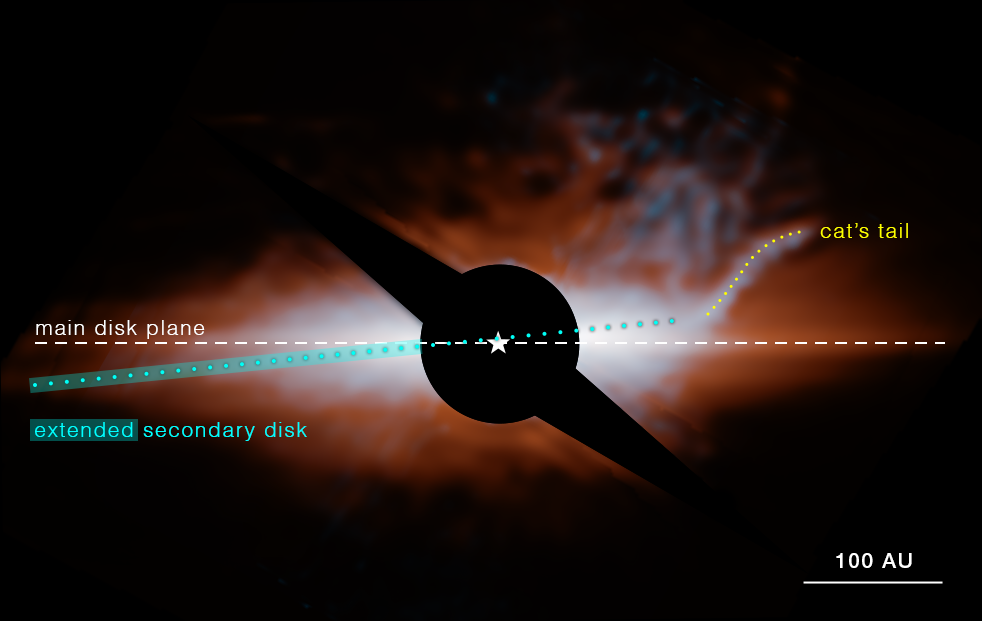
Webb's Mid-Infrared Instrument combines imaging and spectroscopy across the mid-infrared, where relatively cool dust emits light. NASA explains that MIRI also uses coronagraphs to suppress bright starlight, making nearby faint features easier to detect.
A coronagraph does not remove the star from the physical system. It blocks or suppresses its light in the observation so that surrounding material can be studied. The black central region in a published image is therefore an instrumental feature, not a hole in the star or an empty region discovered in space.
The colors in Webb's published image also encode infrared measurements. NASA identifies cyan with the 15.5-micron observation and orange with the 23-micron observation. They make wavelength differences visible to readers whose eyes cannot directly see that infrared light. The scientific image is real data presented through an assigned color scheme.
Hubble's shorter-wavelength measurements complement that information. The comparison is especially useful when different materials can produce similar-looking structures in one band. A second kind of measurement can rule out some interpretations or show which additional assumptions are needed.
A young system provides a view of planetary upheaval
Beta Pictoris is young on stellar timescales, with the research paper citing an age of approximately 18.5 million years. Our solar system began forming around 4.6 billion years ago. The difference is a reason astronomers study young systems as laboratories for processes that shaped older ones.
NASA's overview of planetary-system formation explains how rocky and icy grains collide, merge into larger bodies and continue interacting after much of the original gas disperses. Debris does not represent a static decoration around a star. Its distribution can preserve signs of collisions and gravitational disturbances.
The comparison with our own past has limits. Beta Pictoris is not an exact replay of the solar system, and observations of another star cannot reconstruct every event that occurred here. They can test the physical processes that a theory of planet formation must explain across different systems.
The team also reports an asymmetry and warp in the outer dust halo, which it examines in relation to interactions between planets and disk material. That is another way the shape of dust can become evidence about larger bodies whose gravity influences the system.
What the discovery establishes—and what remains open
The strongest result is the detection of the Cat's Tail's faint scattered-light component and the additional constraints it supplies on dust models. The proposed collision, the original bodies' sizes and the exact three-dimensional arrangement remain interpretations tested against that evidence.
Future observations can examine whether the feature changes, whether the same grain model works at more wavelengths and how its geometry fits the wider disk. A more detailed answer may refine the current explanation rather than overturn the existence of the dust itself.
The headline scale is arresting, but the discovery's value lies in the connection between a microscopic grain and a planetary system. By comparing how dust absorbs, emits and scatters light, astronomers are using a faint trail tens of billions of miles long to investigate how much larger worlds can be built—and broken.
Annotated Webb/MIRI image of Beta Pictoris released January 10, 2024, showing the Cat’s Tail in infrared data with assigned colors. This is the earlier Webb observation, not the new Hubble image. Credit: NASA, ESA, CSA, STScI, C. Stark and K. Lawson (NASA GSFC), J. Kammerer (ESO), and M. Perrin (STScI). Source: Wikimedia Commons.