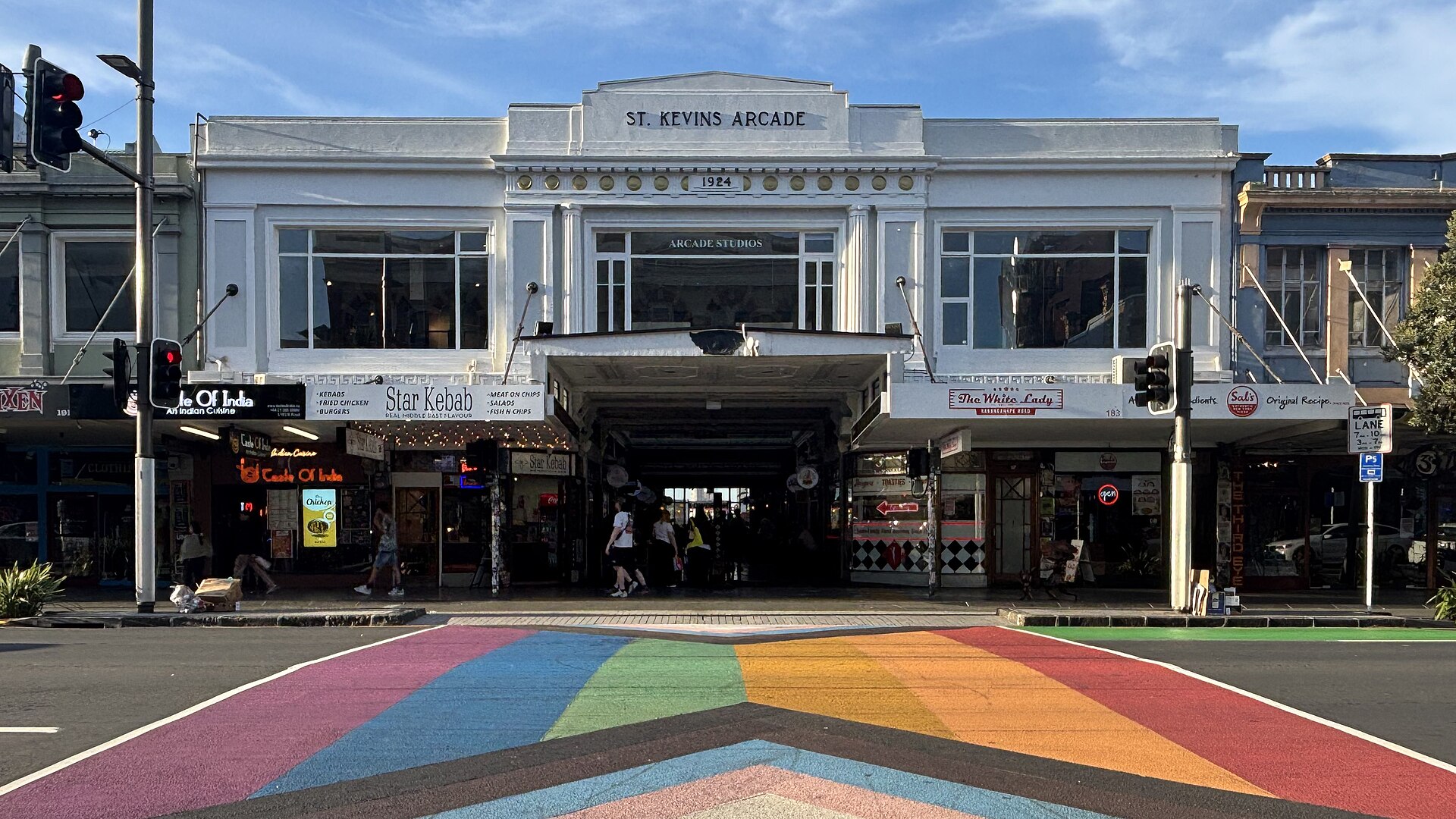
St Kevins Arcade and the Karangahape Road crossing in Auckland, photographed in March 2026. Archive photo by Paora (CC0).
New Zealand’s main cities are on New Zealand Daylight Time, or NZDT, in November: 13 hours ahead of Coordinated Universal Time. Auckland, Wellington, Christchurch and Queenstown therefore share the same local clock. The Chatham Islands are another 45 minutes ahead, using a separate time zone that can matter when making a specific travel or telephone arrangement.
For Americans, the date is often the more surprising part. During the current November combination of daylight-saving rules, New Zealand’s main cities are 18 hours ahead of New York and 21 hours ahead of Los Angeles. When it is 8 p.m. Tuesday, November 17, in New York, it is already 2 p.m. Wednesday, November 18, in Auckland. That conversion includes a new calendar day, not just a different hour.
The display below uses your browser’s clock and named time zones to show the current time. It updates automatically while the page is open. Its accuracy depends on the device having the correct time; for an official time-standard reference, New Zealand’s Measurement Standards Laboratory maintains the national standard and publishes information about its time services. New Zealand’s official time-standard services.
How New Zealand time works
New Zealand Standard Time is UTC+12. During daylight saving, the main islands move one hour ahead to UTC+13. The government’s explanation of the governing legislation also identifies the Chatham Islands’ separate clock, 45 minutes ahead of the rest of the country. Those rules explain why a single answer to “New Zealand time” is useful for most destinations but incomplete for every destination. The government’s explanation of the time legislation.
Auckland and Wellington do not have different time zones merely because they are separate cities. A traveler connecting between them can keep the same clock setting. Christchurch and Queenstown use that same mainland zone. The distinction to check is the destination’s actual time zone, rather than its distance from the largest city or its position on a domestic itinerary.
UTC is a reference used to compare clocks around the world. A positive offset means the local clock is ahead of that reference. At 01:00 UTC, adding 13 hours gives 14:00, or 2 p.m., in a place on UTC+13. The arithmetic becomes slightly more involved when it crosses midnight, because the calendar date changes as well.
The Chatham Islands illustrate why rounding to a whole hour can create a real scheduling mistake. If a mainland appointment is at 2 p.m., the simultaneous Chatham clock reads 2:45 p.m. A person who assumes every New Zealand location shares Auckland’s exact time can therefore be late even while using the correct country. For a specific booking, use the destination’s named zone in the calendar.
Named zones are more useful than permanently stored offsets. “Pacific/Auckland” describes a location’s time rules, allowing a supported calendar or browser to account for daylight saving. “UTC+13” describes an offset that is correct only while that location is observing it. The first is usually the better choice for a recurring meeting or a future travel plan.
The U.S. difference changes during the year
In the November period covered by this article, an evening call from the U.S. East Coast reaches New Zealand during the following afternoon. An 8 p.m. New York call corresponds to 2 p.m. the next day in Auckland; an 8 p.m. Los Angeles call corresponds to 5 p.m. the next day. The same American clock time produces a different New Zealand appointment depending on the U.S. city.
| U.S. city | Auckland / Wellington |
|---|---|
| New York | 2 p.m. the following day |
| Chicago | 3 p.m. the following day |
| Denver | 4 p.m. the following day |
| Los Angeles | 5 p.m. the following day |
| Anchorage | 6 p.m. the following day |
| Honolulu | 7 p.m. the following day |
The offset does not stay constant all year because the two countries change clocks on different schedules. New Zealand’s daylight-saving period runs through its warmer months, while most of the United States observes daylight saving during the opposite part of the year. There are also short transition periods when one country has changed and the other has not.
NIST’s explanation of U.S. rules places the beginning of daylight saving on the second Sunday in March and its end on the first Sunday in November in locations that observe it. The rules are not universal across every U.S. jurisdiction. A caller in Hawaii, for example, should use the actual local zone rather than borrowing an East Coast or Pacific Coast conversion. NIST’s U.S. daylight-saving explanation.
Once the U.S. has moved to daylight time in March 2027 but before New Zealand changes back in April, Auckland will be 17 hours ahead of New York and 20 ahead of Los Angeles. Once New Zealand returns to standard time, those differences become 16 and 19 hours respectively. The figures describe those combinations of time standards; the transition dates themselves should be checked for the exact appointment hour.
This is why a meeting that feels reliably placed for several months can shift in one participant’s calendar. A recurring invitation anchored to an Auckland time should preserve the Auckland organizer’s hour while the U.S. display changes as local rules change. If both parties simply promise to call at the same numeric hour each week without specifying a zone, they can end up describing different instants.
The next New Zealand clock change
The New Zealand government lists the current daylight-saving period as beginning September 27, 2026, and ending April 4, 2027. On the main islands, the April change occurs at 3 a.m., when clocks move back to 2 a.m. The next start is September 26, 2027, when the main-island clock advances at 2 a.m. Official daylight-saving dates.
The change is easy to overlook because most phones adjust automatically. Automatic adjustment solves the device setting; it does not always solve the human plan. A written itinerary, a paper appointment card or a meeting time copied into a message may still contain an old assumption about the difference from another country.
A particularly useful habit is to include both local dates when arranging an important call. “Tuesday evening in New York, Wednesday afternoon in Auckland” conveys more than “8 p.m.” It makes the date-line effect visible before anybody adds the event to a calendar. The habit is useful for interviews, family calls and remote work, especially when a deadline falls close to midnight for one participant.
For a recurring arrangement, agree which location anchors the appointment. A New Zealand business may need the meeting to remain at 10 a.m. Auckland time throughout the year. An American organization may instead need it to remain fixed to New York business hours. Both choices are workable, but they produce different seasonal changes for the other participant.
The repeated hour when clocks move backward deserves particular care for an event scheduled overnight. A time label without a zone or offset can be ambiguous during that interval. Ordinary daytime appointments are usually simpler, but systems handling travel, operations or overnight work should record the full date and time zone rather than relying on a clock face alone.
Making travel, calls and deadlines easier
Airline itineraries normally present departure and arrival in the local times of the relevant airports. A long international flight can therefore appear to jump ahead dramatically on the calendar when traveling toward New Zealand. Read the arrival date as carefully as the arrival hour before arranging accommodation, airport pickup or a domestic connection.
The reverse journey can be equally counterintuitive. A traveler may arrive in the United States on a calendar date that looks unexpectedly early compared with the New Zealand departure date. That does not mean the flight had a negative duration. The displayed local clocks sit on opposite sides of a date difference, so elapsed travel time and the labels on an itinerary answer different questions.
For a hotel or tour, confirm the provider’s local date rather than mentally carrying the date from the place where the booking is made. An American evening can already be the following working day in New Zealand. The same issue can affect customer-service hours: a business may be open there while the caller is still thinking in terms of yesterday’s American calendar.
Travelers who prefer a 24-hour clock can make the same conversions without using a.m. or p.m. Two in the afternoon is 14:00; five in the afternoon is 17:00. Writing the date beside either format is still essential. A 24-hour display removes ambiguity between morning and evening, but it does not remove the day change between countries. For a shared itinerary, consistency of format and a visible local date help everyone read the same plan.
Families can make the difference less abstract by choosing a predictable overlap. During November, an early U.S. evening can work well with a New Zealand afternoon, while an American morning may correspond to the early hours there. The best arrangement depends on work and sleep schedules, but beginning with both local clocks avoids a series of missed calls.
For deadlines, copy the exact time zone supplied by the organizer. “Midnight Friday” is incomplete when people are in several countries, and “New Zealand time” should be clarified if the Chatham Islands are relevant. A deadline stored as an exact instant in a calendar is easier to verify than a hand-calculated note that assumes the same offset will apply months later.
The conclusion is that New Zealand time is simple once the date and daylight-saving rules are included. The main cities currently use UTC+13, the Chathams are 45 minutes ahead, and November’s U.S. differences are 18 hours from New York and 21 from Los Angeles. Use the live display for the present moment and a named-zone calendar for future plans. That combination keeps both the hour and the day where they belong.