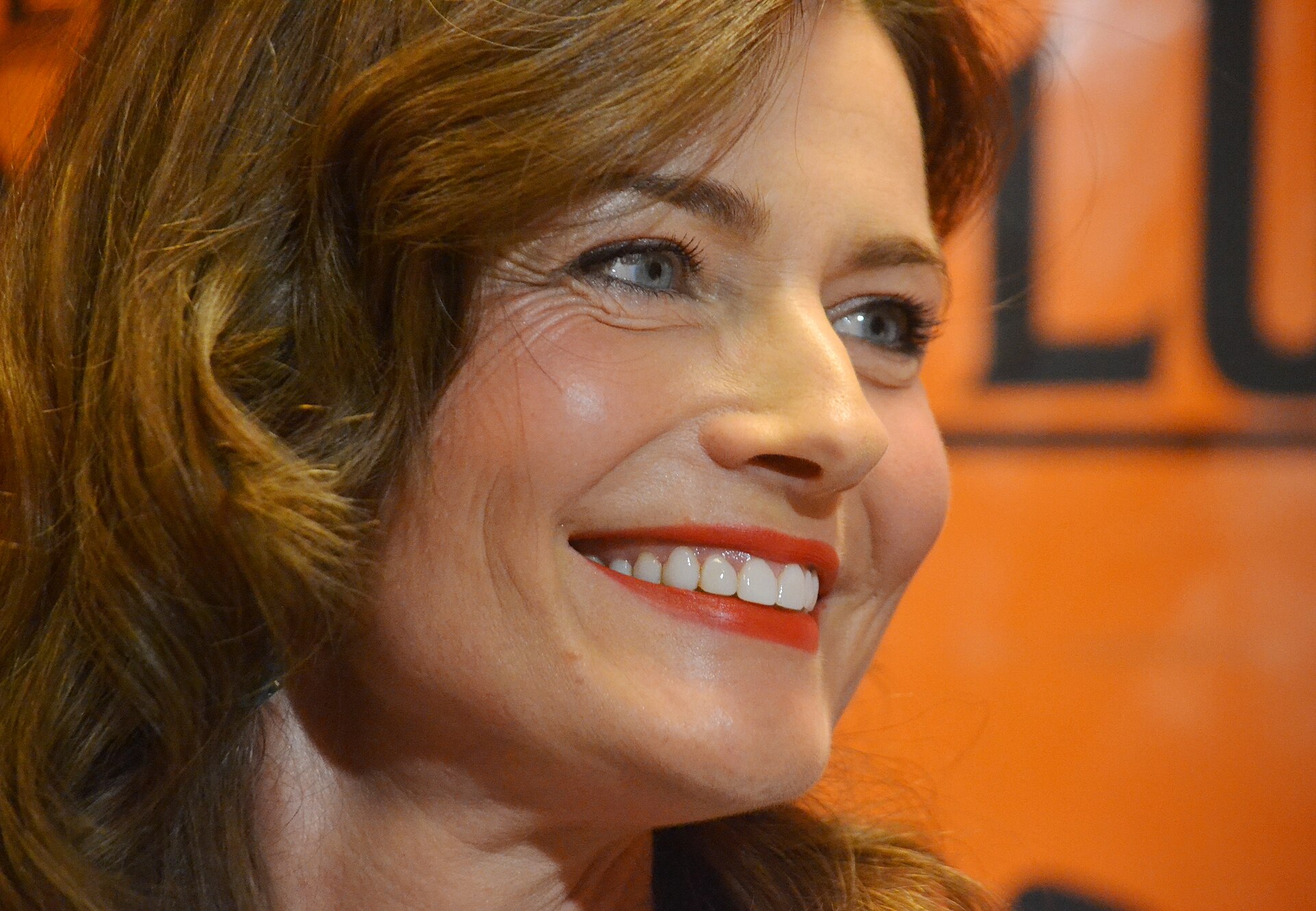
Paulina Porizkova photographed in Prague in October 2014. Archive photo by David Sedlecký (CC BY-SA 4.0).
Paulina Porizkova has a question for an industry that spent decades making her face familiar. What would a gray hair mean if people had spent their lives seeing older women admired for how they looked? In an Instagram video that drew fresh attention after Upworthy covered it on Nov. 8, the model and writer asked viewers to imagine wrinkles associated with confidence and experience. At 61, she is posing the question from inside the beauty business. Estée Lauder, whose campaigns once made her one of the most recognizable young models in the United States, brought her back as a global ambassador in 2025. Upworthy’s Nov. 8 report Porizkova’s Instagram video Estée Lauder’s announcement
The video works because its examples are ordinary. A woman notices a first gray strand. Someone looks at the lines that appear when she smiles. Neither moment arrives with instructions. The instructions come from years of advertising, family conversations, photographs and examples of who gets celebrated. Porizkova reverses the response people might expect and asks them to picture excitement where they have learned to anticipate dread. The point is about the meaning assigned to a feature many people will eventually see in the mirror. Upworthy’s account of the video
The argument behind Porizkova’s video
Porizkova asks what would happen if women were shown a broader idea of beauty early in life, one that could change as they age. She uses a deliberately unlikely example, imagining younger women drawing on wrinkles because wrinkles had become desirable. The example gets to the problem quickly. A line on a face is visible. Whether people see it as a sign of character or as something that should be hidden depends partly on what they have been taught to associate with it. An altered convention could produce an altered response. Upworthy’s account of the video Porizkova’s Instagram video
Those associations have consequences before a person ever buys a product. They shape who expects to see a face like theirs in a campaign, who feels comfortable appearing in an unposed photograph, and how a younger person thinks about the years ahead. The video is aimed at that set of expectations. It allows people to notice how rapidly a judgment can follow the sight of a gray hair, and how little the hair itself can tell them about the person in front of them.
The timing of the renewed interest matters. Upworthy’s Nov. 8 story brought the Reel to readers outside Porizkova’s following. It is the latest round of attention for an argument she has been making in public for years. In January 2020, for example, Vogue reported on a makeup-free selfie in which she discussed her own ambivalence about gray hair and the beauty expectations that accompanied it. The earlier account is useful because it makes room for a person to understand a social rule and still feel its pull. That is a more believable account of change than a sudden conversion to complete self-assurance. Upworthy’s Nov. 8 report Vogue’s 2020 coverage
The model who learned how images get made
Born in what was then Czechoslovakia, Porizkova reached a mass American audience through the Sports Illustrated Swimsuit Issue. She appeared on the cover in 1984 and again in 1985. Estée Lauder made her a spokesmodel in 1988, a role the company says she held through 1995. Those images circulated in a different media environment, where covers and campaigns were among the few places a reader could see a model of her stature. Editors, photographers, brands and art directors decided when she appeared and which version of the picture the audience received. Sports Illustrated Swimsuit’s Porizkova profile Estée Lauder’s career timeline
That history is part of why her current work travels. A short video made for followers has the benefit of the recognition that the old system created. It also lets her speak at the length and in the tone she chooses. A campaign still has a photographer, a commission and a purpose. A Reel has its own pressures, including what earns attention in a feed. Porizkova can use both forms and talk about the differences between them. People know how she was presented at the beginning of her career. They now get to hear how she describes the experience of being looked at over time.
Modeling also gave her material for writing. Her first novel, A Model Summer, appeared in 2007. Her 2022 collection No Filter: The Good, the Bad, and the Beautiful ranges across childhood, modeling, grief, relationships and the experience of becoming less visible as a woman grows older. The publisher describes essays rooted in her own experiences. The book has room for memories, contradictions and difficult feelings that a brief social post cannot hold. Read alongside the video, it explains why the conversation is about a life lived in public as much as it is about beauty. Penguin Random House’s description of No Filter Sports Illustrated Swimsuit’s Porizkova profile
What changed when Estée Lauder brought her back
The company announced Porizkova’s return on Jan. 30, 2025, and said she would appear in a spring campaign for a skincare line. It explicitly linked the partnership to her public work on aging. In its announcement, Porizkova said she felt the company had approached her because of the opinions and sense of self she had developed. Her original job made her a recognizable representative of the brand. The new agreement made the perspective she brought to the job part of the reason she was hired. Estée Lauder’s ambassador announcement Vogue’s interview with Porizkova
The arrangement puts a real tension on display. A brand can show a woman in her sixties as a desirable customer and a central figure in a campaign. It also sells products in a market built around promises about appearance. Both facts matter. Readers can see whether the imagery and the language give older women more choices about how to look, or whether the same old ideal has simply been presented with a new face. A widely distributed campaign has the potential to normalize a face that would once have been rare in that position. The particulars of what the company shows and says determine how far it gets. Estée Lauder’s ambassador announcement
Porizkova has been willing to let different kinds of public images coexist. Vogue’s coverage of her 2026 wedding to writer Jeff Greenstein showed the care she put into a dress and jewelry. The video asks people to reconsider what they see in wrinkles. Dressing up for a chosen occasion and being comfortable with a feature a person sees every day can belong to the same life. That range is part of the appeal. One image can be carefully composed for a celebration while another can have value because it feels ordinary. Vogue’s interview and wedding coverage Upworthy’s Nov. 8 report
The question reaches beyond a beauty campaign
Ageism has a wider reach than casting or skin care. The World Health Organization uses the term for stereotypes, prejudice and discrimination based on age. Its global report found that ageist attitudes toward older people are widespread and documents effects in settings far removed from advertising. A video about a face cannot measure those effects or establish a remedy for them. It can make one piece of the problem recognizable. Familiar expectations about how an older person looks can influence the assumptions people make about what she can do and whether she should be heard. World Health Organization report on ageism
Representation is easiest to notice when it has been missing. If a reader mostly sees older women in ads for a narrowly defined set of products, the scope of their lives can feel smaller on screen than it is in a neighborhood or a workplace. Showing people at different ages as people who are working, falling in love, learning, competing or enjoying a night out changes the range of possibilities an audience gets to see. It can also make the visual reality of age less surprising, which is a modest but important part of seeing it clearly.
The Geena Davis Institute and Next50 have proposed a way to make that question more specific for film and television. Their Next Fifty Test looks at whether women over 50 are present in meaningful roles, including whether a character’s age becomes a punchline. A head count tells viewers how often older women appear. The nature of those roles tells them something about what an audience is invited to expect. Porizkova’s video makes a similar distinction about beauty. Seeing a gray-haired woman regularly can change what a viewer considers familiar. Seeing her be the person the camera came to hear can change what that viewer considers important. Geena Davis Institute and Next50’s screen representation criteria
There are limits to what a famous model can stand in for. Porizkova has professional access to photography, clothes and an audience that few people share. Her account is most useful when it is understood as a specific one. A woman who spent decades being paid to be looked at describes what the experience taught her about when attention arrives and when it disappears. There is something concrete to examine in that account. A business that once wanted one kind of image from her came back asking her to appear with more years and more to say. Estée Lauder’s career timeline and return announcement Penguin Random House’s description of No Filter
The Reel is likely to remain recognizable after this week’s search interest fades because it begins with something people already experience. A face changes, and someone has to decide what the change means. Porizkova asks who made the earlier decision and why it should be accepted as a rule. For a model who became famous in an industry that sells images of what to aspire to, that question is the most consequential thing she is putting in front of the camera.