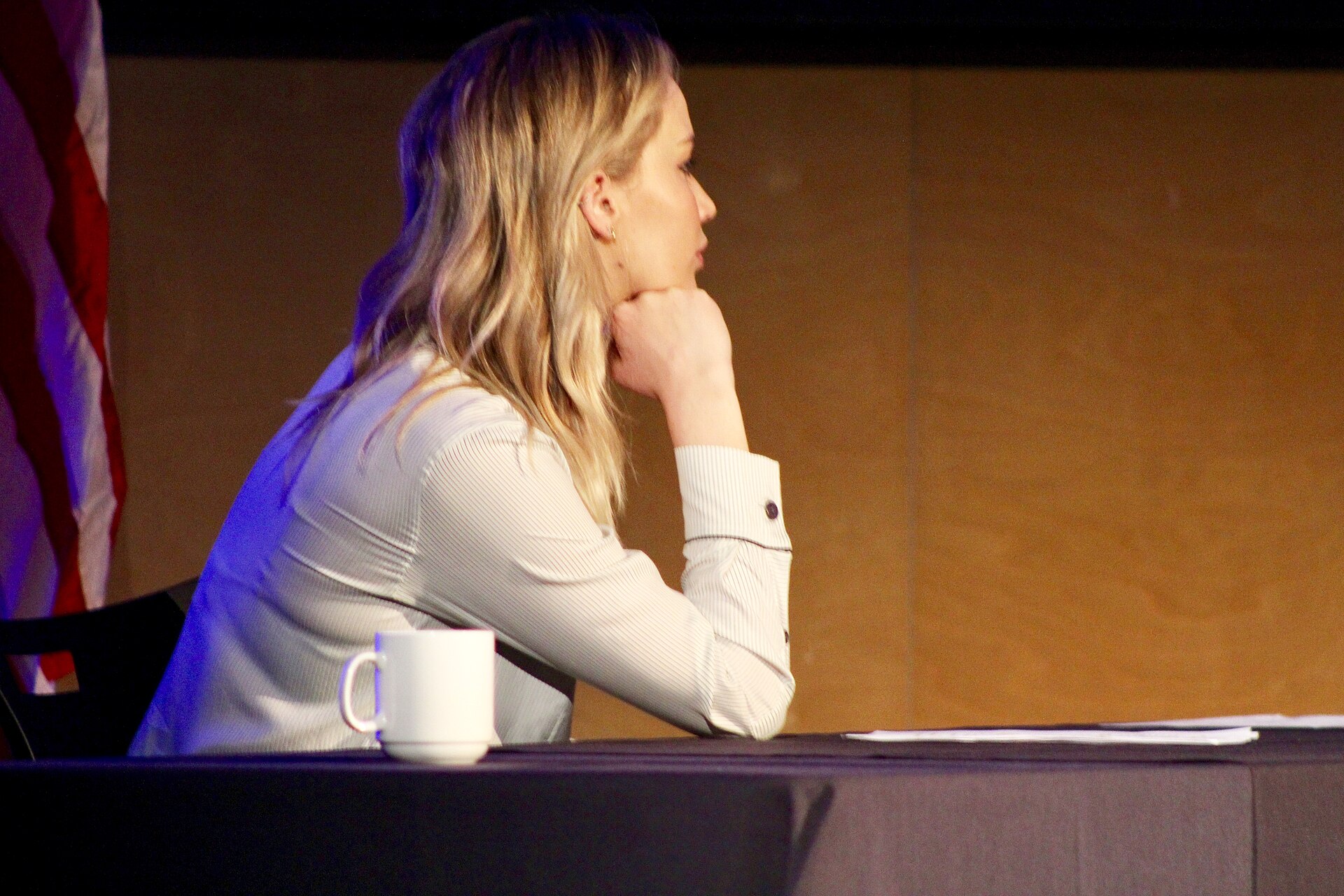
Jennifer Lawrence during a Tulane University appearance in February 2018; this is an archive photograph, not the November 2026 premiere. Archive photo by IVN News (CC BY 2.0).
Jennifer Lawrence’s return to the Hunger Games conversation now has a public reunion to match the anticipation. Lawrence and Josh Hutcherson appeared together at the New York premiere of The Hunger Games: Sunrise on the Reaping on November 16, reconnecting the faces of Katniss Everdeen and Peeta Mellark with a franchise that first brought them to audiences in 2012.
The premiere comes ahead of the new film’s November 20 theatrical release. ABC News reported that Lawrence had confirmed her return as Katniss in an October interview, describing the experience of working again with familiar collaborators. The new film centers on a younger Haymitch Abernathy, played by Joseph Zada, rather than continuing the original films’ story as a conventional next chapter. ABC News on the premiere and Lawrence’s return.
That combination gives the reunion its emotional force. The returning performers connect the new production to the audience’s memory, while a different generation carries the main story. For longtime fans, the red carpet offers the pleasure of recognition. For the film, the larger challenge is turning that recognition into renewed interest in a world whose most famous heroine is no longer the central figure of the main timeline.
Variety’s premiere coverage describes a gathering that extended beyond Lawrence and Hutcherson, with actors from different Hunger Games productions attending. The event brought several eras of the franchise into one place. Its report also notes Lawrence’s throwback social-media photographs with former co-stars, another reminder of how strongly the original press-tour years remain associated with the series. Variety’s premiere report.
A reunion fourteen years after the first Hunger Games
The original film introduced Lawrence’s Katniss to cinema audiences in 2012. Catching Fire followed in 2013, then Mockingjay – Part 1 in 2014 and Mockingjay – Part 2 in 2015. That four-film run gave viewers years in which to follow the characters and the actors associated with them. The new premiere arrives fourteen years after the first release and eleven years after the original screen story concluded.
In the October Call Her Daddy interview cited by ABC News, Lawrence called the return “unbelievable” and “so beautiful.” She described working again with familiar camera personnel and an assistant director, as well as Hutcherson and Harrelson. Those details locate the emotion in a working environment, not only in the fictional reunion. The production brought back people and routines associated with years of shared professional experience.
Those intervals help explain why the reunion registers as more than an ordinary promotional appearance. A franchise encountered during adolescence can become attached to a period of personal history. Returning actors bring back the memory of first readings, cinema visits and conversations about the characters. The new film can benefit from that familiarity even as it asks viewers to engage with a different central story.
Lawrence’s place in the series is particularly distinctive because Katniss carried the original narrative’s point of view. The audience experienced much of Panem through her fear, judgment and uncertainty. Her importance was not only that she became a recognizable symbol inside the story; she was also the person through whom viewers learned how the fictional world worked.
That creates an opportunity and a constraint for a return. A familiar presence can give a new production continuity, but too much emphasis on the returning star can obscure the new protagonist. The premiere naturally foregrounds the reunion because it is visually and emotionally immediate. The film’s main dramatic work belongs elsewhere, in the earlier life of a character audiences previously encountered as a damaged adult mentor.
The distinction is useful for setting expectations. People buying a ticket because Lawrence is returning should understand the announced focus on young Haymitch. A connection to Katniss does not make the prequel a fifth installment centered on her original journey. The interest lies partly in seeing the past that helped create the world she later entered.
Why Haymitch’s earlier story changes the perspective
Sunrise on the Reaping takes place twenty-four years before the original Hunger Games story and returns to the fiftieth Games, the Second Quarter Quell. That earlier setting gives Haymitch a life before the role through which many viewers know him. Woody Harrelson’s older character arrived with bitterness, survival knowledge and a history that the original films could only partly explain.
A prequel has a different kind of suspense from a story with an entirely unknown future. Audiences may know where a central character eventually ends up, but they do not necessarily know the decisions, relationships and losses that shaped the route. The dramatic question becomes how a person changes and what the audience previously misunderstood about that person.
That can deepen an existing story when it changes the meaning of familiar behavior. A mentor’s impatience or cynicism may look different when the audience understands the experience behind it. The value of the earlier chapter is therefore more than filling a gap in chronology. It can make the later story harder, richer or more emotionally specific to revisit.
The cast itself makes the generational change visible. Alongside Zada’s Haymitch, the film includes new performers in roles associated with familiar names in Panem, including Ralph Fiennes as President Snow, Jesse Plemons as Plutarch Heavensbee and Elle Fanning as Effie Trinket. AP’s reporting on the production describes a cast taking on earlier versions of established characters. AP’s report on the new film and cast.
That approach asks actors to balance recognition with independence. A younger version has to make sense as a person in the present of the new story, rather than exist only as a collection of gestures pointing toward another performance. For viewers, the most rewarding comparison may be the distance between the two versions: what has not happened yet, what has already begun and what the older character has learned to conceal.
The story beneath the nostalgia is about who controls the account
The source novel gives the return to Panem a larger purpose. In her discussion of Sunrise on the Reaping with Scholastic editor David Levithan, Suzanne Collins describes an interest in propaganda and the relationship between those who govern and those who submit to government. The book looks at a familiar fictional event through questions about how its public account is shaped. Collins’ interview about the novel.
That concern is built into the premise of the Hunger Games world. Violence is not only carried out; it is presented to an audience, interpreted and used to communicate power. A story returning to an earlier competition can therefore ask what viewers inside that world were allowed to see and what their memories may have left out. The subject is not simply survival in an arena but the authority to explain what happened there.
For a contemporary audience, that theme gives the franchise a reason to remain discussable beyond its familiar imagery. The series invites questions about spectacle, persuasion and the difference between a public narrative and an individual’s experience. Those questions can resonate without requiring a one-to-one equation between a fictional character and a current political figure.
The commercial strength of the underlying book also suggests that interest extends beyond a reunion photograph. Scholastic announced that the novel sold more than 1.5 million World English copies in its first week in March 2025, across print, digital and audio formats in several markets. That is a publisher-reported opening-week measure, not a forecast of the film’s ticket sales. It nevertheless demonstrates an audience willing to return to the story in another medium. Scholastic’s publication-week announcement.
Adaptation then becomes a question of emphasis. A film has to translate a reader’s access to thought, memory and interpretation into images, performances and editing. The most meaningful discussion after release will concern how effectively the production does that work. A premiere can establish excitement and connection; the film itself must establish its dramatic argument.
What the November 20 release means for longtime fans and new viewers
For returning fans, the most useful preparation is to remember where Haymitch fits in the original story, while allowing the younger character room to be different. Revisiting a familiar film can restore context, but an earlier chapter should also have its own movement and emotional logic. The pleasure of recognizing names is only one part of the experience.
For new viewers, the central premise offers a direct way into the world: a young person faces a coercive public competition inside an unequal society. Previous familiarity may enrich the connections, but a prequel also has an opportunity to introduce its setting from an earlier point. The quality of that introduction will matter more than the number of references a newcomer can identify.
Lawrence’s reunion with Hutcherson gives the release a human bridge between those audiences. Their professional history is visible even before the new film begins. It reminds viewers that a franchise is sustained not only through intellectual property and release dates but through performances people continue to associate with particular relationships and emotions.
The premiere also creates an occasion to look at how the series has expanded. The Ballad of Songbirds and Snakes arrived in 2023 as a separate prequel, while Sunrise on the Reaping moves to another generation and another center of attention. Panem has become a setting capable of supporting more than the original sequence, but each return still needs a reason to add to the audience’s understanding.
The conclusion is that Jennifer Lawrence’s Hunger Games reunion is both an effective moment of recognition and a reminder of what the new film must accomplish. The return of familiar actors connects Sunrise on the Reaping to a lasting screen legacy. Its deeper opportunity lies in Haymitch’s story and Collins’ questions about power and the control of public memory. When the film opens November 20, those qualities—not the reunion alone—will determine what the return to Panem adds.