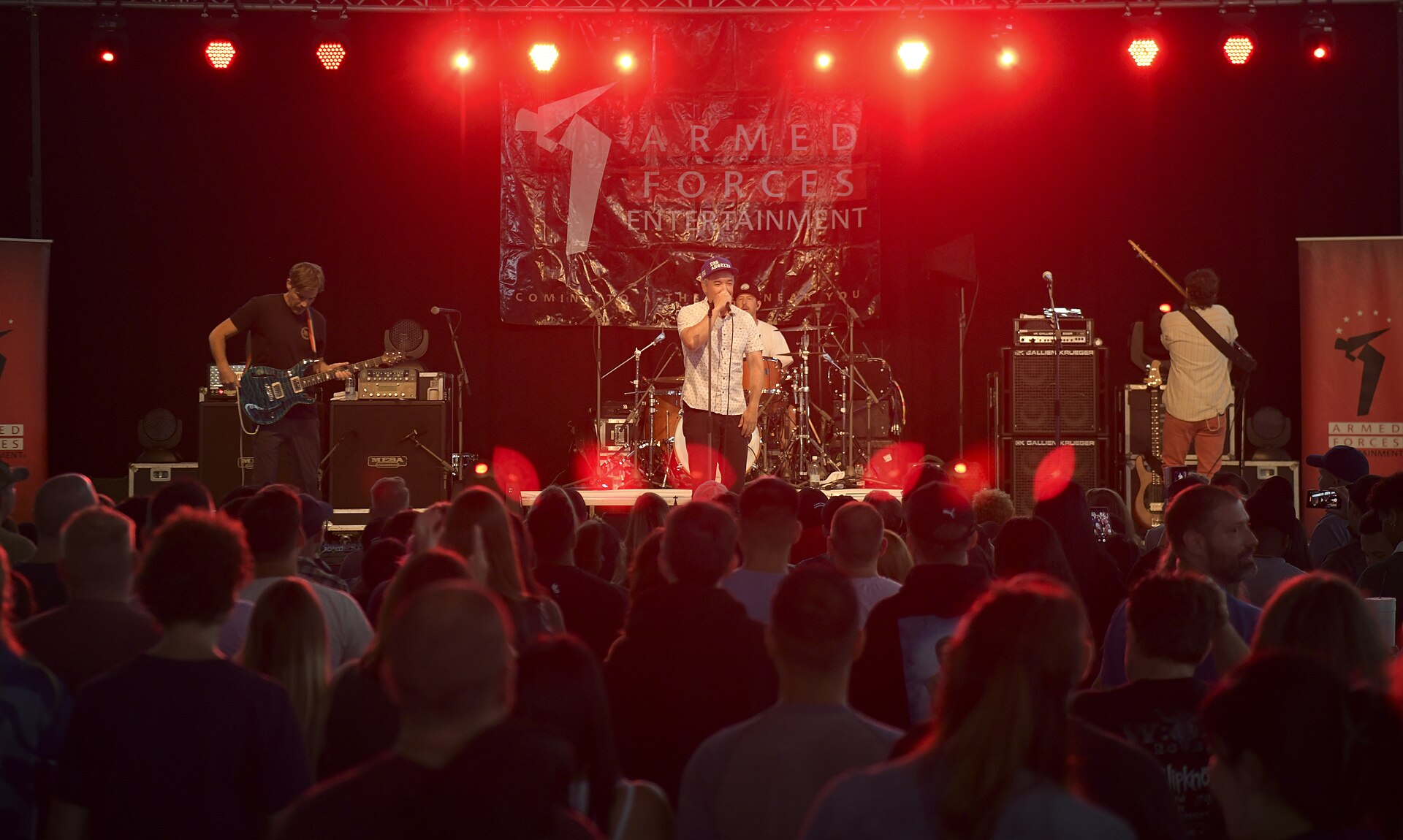
Hoobastank performs at Ramstein Air Base in Germany on August 4, 2023. Archive concert photograph; not the November 2026 Southwest flight. Archive photo by Airman 1st Class Norman D. Enriquez / U.S. Air Force (Public domain).
Hoobastank supplied one of the weekend’s most unexpected concert settings: the aisle of a Southwest flight. Videos of the band performing “The Reason” alongside appearances by Simple Plan and the Used spread on Saturday, giving an ordinary journey from Los Angeles to Orlando the feel of a traveling early-2000s rock festival.
The three bands were heading to the final stop of the 2026 Vans Warped Tour, scheduled for November 14–15 at Camping World Stadium in Orlando. According to Consequence’s report from the passenger videos, their flight left before Friday’s nationwide FAA ground stop. That timing matters. The footage shows an in-flight musical encounter, rather than a concert performed for passengers stranded on the ground.
For Hoobastank, the renewed attention is attached to a song that has already survived several changes in the way people discover music. “The Reason” became a major radio hit in 2004, later reached new audiences through television and social media, and now works as an instantly recognizable communal singalong. Its latest appearance is a small event with a larger story behind it: the difference between an old hit and a song people still know how to inhabit.
What happened on the Southwest flight
The reported performances included Hoobastank’s “The Reason,” Simple Plan’s “Perfect” and “I’m Just a Kid,” and the Used’s “The Taste of Ink.” The cabin setting stripped away the scale of a festival stage. Instead of a distant frontman framed by lighting and screens, passengers encountered musicians performing at close range while people joined from their seats.
That proximity is the central attraction of the clips. The songs already carry associations for many listeners, but hearing one in an unexpected place changes the experience. An airplane aisle is a passage between rows, not a venue designed around a performer. For a few minutes, a familiar recording becomes a shared event among people who happen to be traveling together.
The practical connection among the bands was Warped Tour’s Orlando weekend. Their presence on the same route makes sense within that touring schedule, even if the resulting footage feels improbable to someone encountering it without context. A music festival gathers performers in one city; the journey there can briefly gather them in a much smaller space.
The videos also illustrate the difference between attending a concert and recognizing a chorus. A passenger does not have to follow every album in a band’s catalog to respond to its best-known song. That low barrier to participation helps explain why this particular combination of musicians and material translated so well into short clips.
Why “The Reason” remains immediately recognizable
The song’s original reach was substantial. In a 2023 interview with Doug Robb and Dan Estrin, the Recording Academy documented its rise to No. 2 on the Billboard Hot 100 and No. 1 on the Adult Pop Airplay and Alternative Airplay charts in 2004. Those results show why the song reached beyond a single rock audience and became familiar in several listening environments.
Its emotional proposition is also unusually direct. The title introduces an explanation for change, and the song places regret and the desire to improve at its center. Listeners do not need specialized knowledge of a musical scene to understand that combination. The appeal is personal enough to invite identification and broad enough to survive outside the circumstances in which it was written.
That accessibility can become a commercial advantage and an artistic complication. A hugely recognizable song draws people toward a band, but it can also narrow the public’s understanding of everything else the band does. Hoobastank’s harder material and wider catalog exist alongside the ballad. A short viral performance naturally favors the song that the greatest number of people can identify immediately.
The awards record captures another useful distinction. The Recording Academy’s song entry lists 2005 nominations associated with “The Reason,” including Song of the Year for its writers and the vocal duo-or-group pop-performance category for the recording. A nomination is an achievement in its own right; it should be described as a nomination rather than quietly converted into a Grammy win.
Commercial performance and awards do not explain every listener’s response. They establish the scale of the original audience. The more interesting question is why recognition remains available decades later. A melody heard repeatedly during a particular period can become attached to relationships, places and stages of life. When it returns unexpectedly, the response often includes those memories as well as the music itself.
A band with more history than one viral chorus
Hoobastank’s roots stretch back to the 1990s in Southern California. Its major-label debut arrived in 2001 and included “Crawling in the Dark,” before The Reason followed in 2003. The title track’s enormous crossover success subsequently became the most visible part of the band’s identity, but it did not mark the beginning or the end of its work.
Robb and Estrin’s Recording Academy conversation described the pressure that followed that breakthrough and the difficulty of being defined by a single song. It also addressed the band’s ability to laugh at its place in popular culture. That perspective is useful when an older recording becomes a meme or a surprise singalong: renewed attention can be enjoyed without requiring the artists to pretend time has stopped.
The group’s official website and tour listings provide a more practical measure of continuity. Hoobastank remains a performing band with current dates and audience contact, rather than simply a name preserved in an old chart archive. A viral clip can revive interest overnight, but the musicians’ ongoing work supplies the infrastructure that allows people to encounter them beyond the clip.
A public-domain U.S. military photograph of its August 2023 concert at Ramstein Air Base offers another example of that live history. The setting differs radically from an airline cabin or a Florida festival, yet the underlying activity is the same: a band carrying a catalog into a room, or an outdoor audience, and discovering which songs people bring back to it.
Why these three bands fit the same traveling audience
Hoobastank, Simple Plan and the Used are not interchangeable acts. Their music reaches across different parts of alternative rock, pop punk and emo. What connects the reported cabin selections is the ability to make an emotion legible very quickly. Regret, insecurity and the desire to escape an unsatisfying situation are themes that can survive the removal of a full concert production.
The Used’s “The Taste of Ink,” for example, comes from the band’s 2002 self-titled debut, as the Apple Music album record confirms. Its presence beside the other songs brings a different energy to the same generational memory. The connection is not that every song sounds alike. It is that many listeners encountered them during overlapping years and still associate them with discovering their own tastes.
In a Kerrang! interview about writing “The Taste of Ink”, Bert McCracken discussed the desire to leave Utah and make something of his life. That account supplies a concrete history behind a song often absorbed as a familiar anthem. Music that later feels like nostalgia began as somebody’s attempt to express an immediate need.
Simple Plan’s selections add another version of that openness. Even their titles communicate emotional stakes without explanation. In a casual performance, that directness is an asset: listeners can find the song quickly, remember their own connection to it and participate without the formal attention that a complete album might ask of them.
There is also a difference between remembering a recording and hearing a voice in the same space. A familiar studio track can feel fixed and finished. A live rendition introduces breath, variation and the reactions of the people nearby. Even when a phone compresses that experience into a short video, the visible participation gives the performance an immediacy that a playlist cannot quite reproduce.
What the clips say about live music in 2026
The cabin performance is interesting partly because it sits between private experience and public entertainment. Only the people on the flight shared the physical setting. Everyone else encountered selected moments through a phone screen. The smallness of the original audience is part of what makes the larger online audience curious: the event appears both intimate and unusually shareable.
That does not make an airline aisle a substitute for a concert. A festival allows a band to build a set, control dynamics and develop a relationship with an audience over time. A short clip favors immediacy. The two experiences can complement each other, but they offer different kinds of attention and different opportunities for discovery.
For established acts, the useful outcome is a bridge between them. Someone who recognizes one song may look up a current tour date, revisit an album or discover material that radio did not make equally familiar. The challenge is to let the hit open the door without allowing it to describe the whole house. Hoobastank’s continued touring makes that a practical possibility.
The enduring story is therefore larger than an amusing flight video. “The Reason” still works when the stage disappears because recognition, melody and emotional clarity do not depend entirely on production. The Orlando-bound performances gave those qualities an unexpected setting. They also offered a reminder that songs become durable through repeated encounters with people, including encounters that nobody could have planned as a major cultural event.
Hoobastank is trending because a familiar chorus found a surprising new room. The professional significance is that the band remains able to turn familiarity into participation. Decades after its breakthrough, that is a meaningful kind of relevance: people still recognize the song, still respond to it and still have reasons to follow the musicians beyond a few seconds of footage.