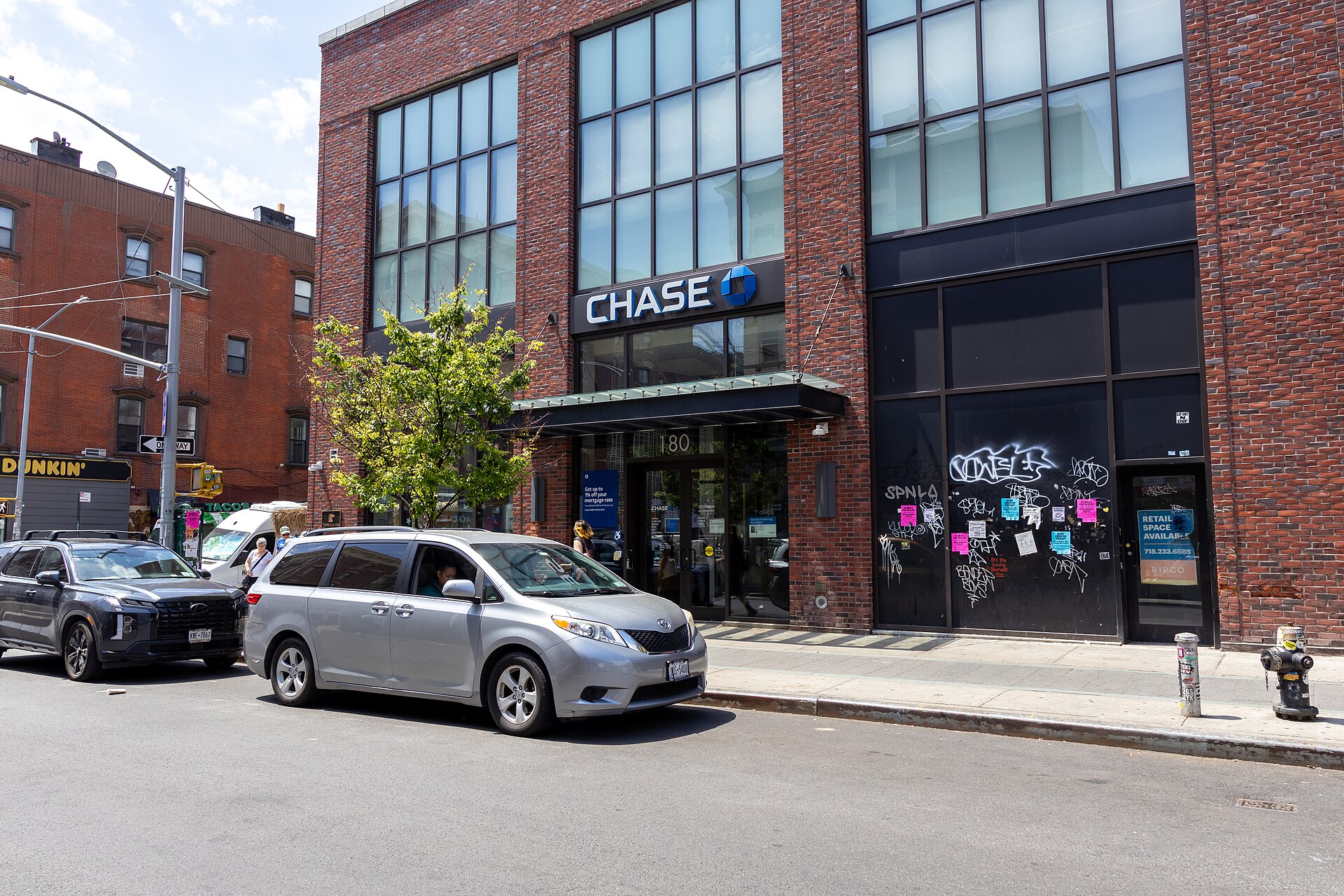
A Chase branch in Williamsburg, Brooklyn, photographed on May 13, 2026. Archive photograph; it does not depict customers affected by the November disruption. Archive photo by Nielsoncaetanosalmeron (CC BY 4.0).
Chase customers encountered delays and difficulty using some banking services on Monday, November 16, as a technical problem at JPMorgan Chase disrupted transactions and affected people trying to move money between financial institutions. The bank described the problem as a technical issue and said it was working to restore normal service. It said the disruption was not a cyberattack.
The most consequential distinction in the developing story is between a bank experiencing a fault and a customer at another bank being unable to complete a payment involving it. Reports of problems across several banking brands do not, by themselves, establish that every institution has suffered its own outage. The Associated Press reported that Bank of America and Citigroup were not experiencing problems with their own banking services, while U.S. Bank said customers could encounter delays in Zelle transfers involving another financial institution.
Chase told CNN that customers retained access to their accounts and funds even though some transactions were taking longer than usual. “We are working to resolve this as quickly as possible,” a spokesperson said in the statement carried by CNN's report. That assurance addresses the availability of customers' money; it does not mean every affected customer could complete every transaction immediately.
This report reflects the statements available on November 16. The accounts reviewed for this article did not establish a universal restoration time, a complete count of affected customers or a detailed technical explanation of the fault. Those limits matter when a failed transfer or an inaccessible balance can quickly turn a service problem into a frightening personal experience.
Why a Chase problem can appear in another bank's app
A payment between two people is an interaction among more systems than the two screens they see. The sending bank must recognise the instruction, the receiving institution must accept and post the funds, and the payment service must coordinate the exchange. A problem at one participant can therefore become visible to a customer whose own bank is otherwise functioning.
Zelle illustrates that distinction. Early Warning Services, which operates the network, told AP that Zelle itself was fully operational and that problems at financial institutions could delay payments. A functioning network and an unsuccessful customer transaction can both be true. Neither statement should be used to erase the other.
For someone waiting for money, the important question is not simply whether a large outage tracker shows a spike. It is which part of the intended action failed. Was the user unable to sign in, unable to initiate a payment, or able to send a payment that the recipient had not yet received? Those situations produce different records and require different follow-up. A description that identifies the stage of the failure is more useful to support staff than a general report that everything is down.
Public outage trackers are useful early indicators because many people can report a similar problem quickly. They are not a census of every customer or a technical diagnosis. One person may make several attempts, while another may never submit a report. A spike can demonstrate an unusual volume of complaints without establishing a percentage of customers affected or proving that every service at the institution has stopped.
The sequence also makes apparently contradictory experiences unsurprising. One person may be able to view a balance while another cannot complete a transfer. A card transaction and an online banking session do not necessarily depend on precisely the same path through an institution's technology. The reports available Monday should not be stretched into a blanket promise that all cards worked, or a blanket assertion that all cards failed.
The immediate task is to establish what happened to a payment
The most useful first step for an affected customer is to preserve the details of the attempted transaction: the time, amount, intended recipient, confirmation number if one was issued, and the exact status displayed. A screenshot can help record an error message, but it should be kept private if it contains balances, account numbers or other identifying information. A public social-media complaint does not need those details.
Before sending the same payment again, establish whether the original instruction is pending, completed, rejected or absent from the account's activity. An error message alone may not explain what happened after a customer pressed the final confirmation button. Repeating an instruction without checking creates a second question—whether two payments were submitted—on top of the first.
Zelle's official payment guidance says a payment to an already enrolled recipient cannot ordinarily be cancelled after the money has been sent to that person's bank account. Cancellation is available when the intended recipient has not yet enrolled. Its FAQ directs customers who are uncertain about a payment's status to their bank or credit union. Those general rules should not be mistaken for a diagnosis of any particular delayed transaction during Monday's disruption.
Chase's customer-service directory lists support for online and mobile banking, personal accounts, cards, mortgages and other products. For personal banking, it lists 1-800-935-9935. The number on the back of a customer's card or a genuine account statement is another established route. Someone contacting the bank should say whether the problem concerns access, a specific transfer or a possible unauthorised transaction; the distinction helps route the question correctly.
A payment deadline creates a separate practical problem. A customer who cannot establish whether a bill was paid can contact the recipient through an existing, trusted channel and explain the interruption. The useful request is for a clear account of what the recipient has received and what options are available. An outage does not automatically guarantee that a creditor will waive a fee or extend a deadline, and no bank statement reviewed for this story promises blanket compensation.
For a small business, the same discipline applies to receipts and outgoing payments. Keep a record of what customers say they sent, reconcile it against the bank's actual transaction history when available, and distinguish a promise of payment from money received. A screenshot supplied by another person is supporting information, not a substitute for confirmation in the receiving account.
Access problems, fraud and deposit insurance are different issues
A temporary inability to complete an online transaction is not evidence, on its own, that a bank is insolvent or that a customer's deposit has disappeared. Operational availability, the accuracy of an account record and the financial condition of an institution are related aspects of banking, but they are not interchangeable. Monday's public explanation concerns a technical disruption.
The Federal Deposit Insurance Corporation describes standard deposit insurance as $250,000 per depositor, per insured bank, for each account ownership category. Coverage depends on the type and ownership of deposits, and the FDIC provides tools for checking individual arrangements. Its purpose is protection against the failure of an insured bank. It is not an assurance that an app will never be unavailable, nor a general reimbursement program for every form of fraud or transaction inconvenience.
Fraud, in turn, requires its own response. A customer who sees an unfamiliar withdrawal should not assume it is merely an effect of an outage. Chase's fraud-reporting guidance directs customers to contact the bank promptly when they identify an unauthorised charge or believe an account has been compromised. The bank provides different reporting routes for personal deposits, business accounts and cards.
Consumer protection rules can apply to electronic-transfer errors, but an individual's rights and deadlines depend on the circumstances. The Consumer Financial Protection Bureau's Regulation E error-resolution guidance explains the process for notifying an institution of an alleged error. Its consumer explanation of unauthorised transactions emphasises prompt reporting. A customer should not wait for a general outage announcement to be resolved before reporting a separate transaction they believe was unauthorised.
Service disruptions also create an opening for impersonators offering to fix an account. A message that uses the name of a real bank can still be fraudulent. Contacting support through the bank's established website, an existing app or the number on a genuine card avoids relying on a phone number supplied in an unexpected message. Passwords and one-time security codes should not be posted publicly or handed to someone who unexpectedly offers assistance.
The standard for recovery is more than a working login screen
For the bank, restoring the ability to sign in is only one part of recovering customer confidence. People need to know whether previously attempted instructions were processed, whether balances reflect those instructions and how disputed or delayed items will be handled. Clear transaction-level answers are especially important for customers facing rent, payroll or other time-sensitive obligations.
For journalists, the corresponding obligation is to report the scope accurately. The fact that several financial brands appear in customer complaints does not justify calling the entire banking system unavailable. Equally, a statement that a network is operational does not resolve the experience of someone whose transfer remains delayed. Reporting both facts gives readers a more useful account than either a sweeping alarm or an overly reassuring headline.
The available evidence supports a specific conclusion: Chase experienced a technical disruption that delayed some transactions and produced effects beyond its own customers. The bank denied a cyberattack, and Zelle said its network was operating. The immediate priority for affected customers is to establish the status of individual transactions through trusted channels. The next meaningful development will be a documented account of restoration and the handling of any unresolved payments, rather than an assumption drawn from a changing outage graph.