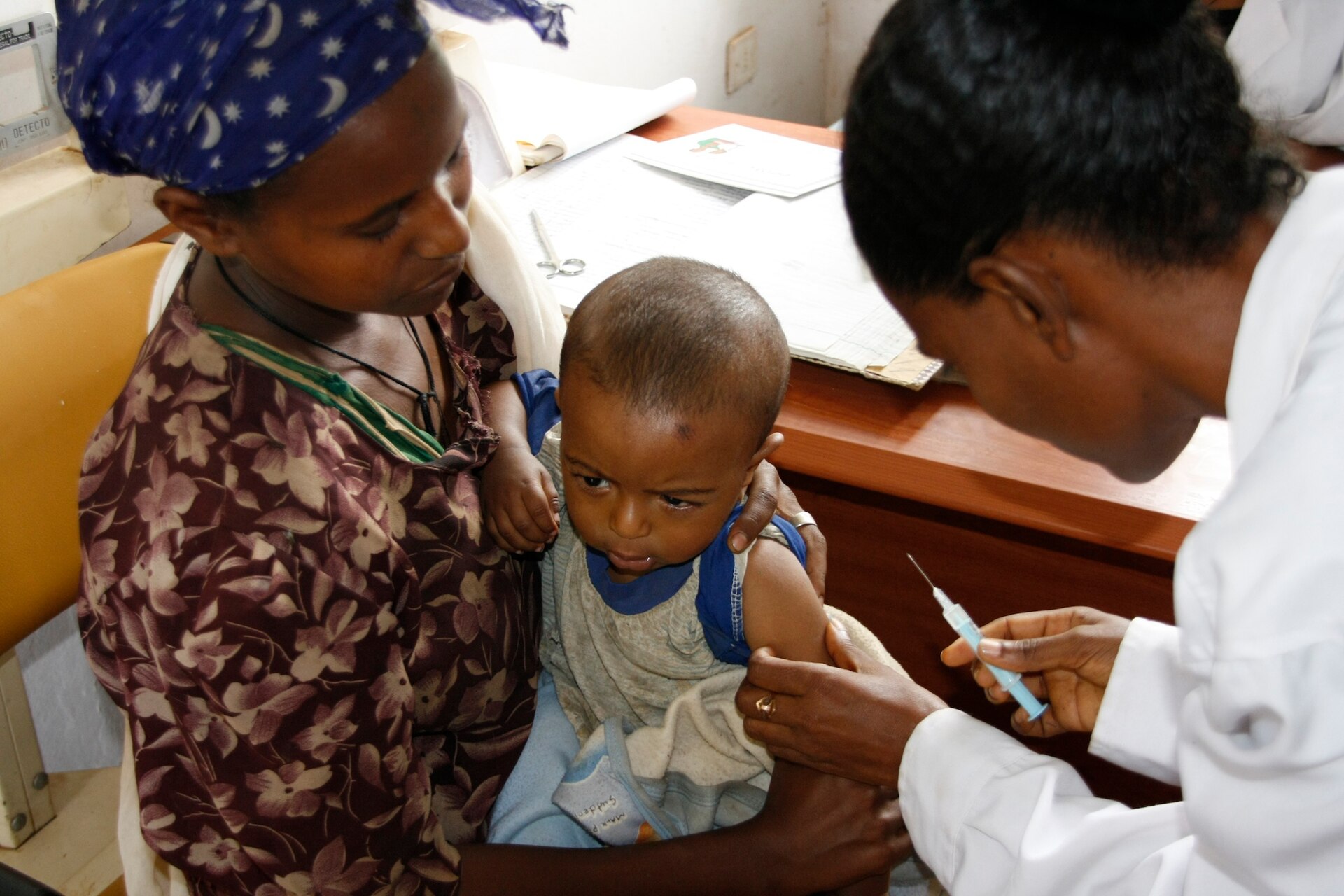
A child receives a measles vaccination in Merawi, Ethiopia, in May 2011. This archive photograph illustrates immunization; it does not show the current U.S. outbreak. Archive photo by Pete Lewis / UK Department for International Development (CC BY 2.0).
The United States has lost its measles elimination status, researchers with direct knowledge of an international health review told KFF Health News on Saturday, November 14. The finding marks the loss of a public-health milestone achieved in 2000 and shifts attention to a practical question for families: how to recognize the disease, check protection and respond promptly to a possible exposure.
KFF Health News reported that the Pan American Health Organization reached the determination during deliberations this week and had planned a public announcement for November 17. That reporting is the basis for the new status account; it should be distinguished from an already published PAHO announcement. The finding concerns sustained transmission, rather than a conclusion that vaccines have stopped working or that every community faces the same immediate risk.
The latest national case figures help explain the significance. CDC reported 5,412 confirmed U.S. measles cases in 2026 through November 12, in its update published November 13. Those numbers describe a preventable disease spreading extensively enough to strain the boundary between imported outbreaks and continuing domestic transmission. They also make clear why recognizing early symptoms matters before a familiar rash appears.
What losing measles elimination status actually means
Elimination does not mean that a country can never have another measles case. People can arrive with infections acquired abroad, and an imported case can start an outbreak. The distinction is whether transmission continues long enough to become reestablished. WHO’s elimination framework defines endemic transmission in terms of a chain persisting for at least 12 months within a geographical area, supported by effective surveillance.
A country can therefore report sporadic imported cases while retaining elimination, provided transmission chains are interrupted. Conversely, a large number of separate short outbreaks and one sustained chain are not interchangeable descriptions. The status assessment asks about the pattern and continuity of spread, using epidemiological investigation and laboratory evidence rather than simply applying a threshold to the year’s total case count.
In its March explanation of the review process, PAHO said the United States and Mexico would be assessed during the regional verification commission’s November meeting. It described analysis that includes viral sequencing and the investigation of transmission chains. The scheduled review was therefore part of an established verification process, rather than an improvised response to a single alarming week of headlines.
The practical implication is that the country needs to interrupt transmission again. A status label does not alter the biology of the virus or erase an individual’s existing immunity. It does, however, signal that the systems intended to prevent sustained spread have not achieved that objective. The response still depends on vaccination, timely detection, contact investigation and access to accurate local information.
The case numbers and vaccination coverage show different parts of the problem
CDC’s current case dashboard places the 2026 count at 5,412 as of its November 12 cutoff. A national total is useful for showing scale, but it cannot tell a reader whether a specific school, clinic or neighborhood has an active exposure. State and local health departments are the appropriate sources for the most current notices affecting particular communities.
Coverage data describe another layer. CDC’s SchoolVaxView estimates put MMR coverage among U.S. kindergartners at 92.4 percent in the 2025–2026 school year. The agency notes that state collection methods differ. This is a measure for a defined school-age population, not a direct estimate of immunity among every person in the country or an assurance that coverage is distributed evenly.
The distribution matters because people mix locally. A national average can combine well-protected communities with places where many susceptible children attend the same schools or share the same social networks. The public-health task is to find those gaps and close them. Reading the national figure alongside local outbreak notices is more informative than treating either one as a complete account of personal risk.
Measles symptoms often begin before the rash
According to CDC’s symptom guidance, the first signs usually appear seven to 14 days after infection. They typically include fever, cough, a runny nose and red, watery eyes. Those symptoms can resemble other illnesses, which is one reason an exposure history is important. A person does not have to wait for a rash before contacting a clinician about a possible case.
Small white spots inside the mouth, called Koplik spots, may appear two to three days after symptoms begin. The rash commonly follows three to five days after the initial symptoms, beginning around the face and hairline and spreading downward. These are useful features for recognizing a possible illness pattern, but they are not a substitute for professional evaluation or laboratory confirmation.
Measles can cause serious complications, including pneumonia and encephalitis, or swelling of the brain. CDC estimates that one to three of every 1,000 infected children die from respiratory or neurological complications. Babies and young children are particularly vulnerable. The point of those figures is to describe the disease’s potential severity, rather than imply that every infected person will have the same course.
The timing of infectiousness makes early action especially important. CDC’s transmission guidance says an infected person can spread measles from four days before the rash through four days afterward. The virus can remain in the air for up to two hours after the person leaves a space. Someone may therefore expose others before realizing that the illness is measles.
A photograph of a rash cannot resolve that uncertainty. Other illnesses can produce rashes, and early measles may present without one. The relevant information for a medical conversation includes symptoms, vaccination history, recent travel and whether a health department has identified an exposure. Bringing those details together helps the clinician assess the situation more effectively than matching a skin image online.
Call ahead after a suspected exposure
The immediate step after a possible exposure is to contact a health care provider. CDC’s guidance for people who are sick or exposed recommends calling before arriving at a medical office or hospital so staff can make arrangements that reduce risk to other patients. This is particularly relevant to waiting rooms, where infants and people with medical vulnerabilities may be present.
Tell the practice when and where the exposure may have occurred, what symptoms are present and what you know about vaccination or previous immunity. A health department notice may supply a specific location and time window. Keep that notice available during the call. The purpose is to help the provider connect your circumstances to the actual exposure investigation, rather than assume every visit to the same building carried equal risk.
For some exposed people without immunity, a clinician may consider MMR vaccination or immune globulin, depending on timing and eligibility. That makes prompt contact useful even before symptoms develop. These are individual clinical decisions; a general news article cannot determine which option applies to a pregnant person, an infant or someone with a weakened immune system.
If emergency care is needed, seek it promptly and have someone notify the receiving facility about the possible measles illness before arrival when possible. Calling ahead is an infection-control step, not a reason to delay urgent treatment. Follow the clinician’s and local health department’s instructions about isolation, monitoring and contact with others while the evaluation proceeds.
Vaccination remains the central protection
CDC’s vaccine recommendations describe two doses of measles-containing vaccine as about 97 percent effective at preventing measles, compared with about 93 percent for one dose. The routine childhood MMR schedule begins with a dose at 12–15 months and a second at four to six years. A clinician can assess whether a person’s documented doses or other evidence establish protection.
Infants and travel create additional questions. CDC’s clinical guidance says an early dose given before the first birthday does not replace the two routine doses later. Recommendations can also change for a particular outbreak or international trip. Families planning travel should discuss the destination, departure date and child’s age with a clinician rather than assume that the ordinary timetable answers every situation.
For adults, checking records is more useful than guessing from memory. A provider can consider vaccination documentation, age and laboratory or disease history when assessing evidence of immunity. People who cannot receive a live vaccine need individual advice and benefit from reduced transmission around them. Community protection is therefore part of the story, alongside the protection an eligible person gains from vaccination.
Cost and access can be part of a family’s difficulty keeping vaccinations current. The federal Vaccines for Children program supplies vaccines for eligible children aged 18 or younger, including those who are uninsured, Medicaid-eligible or enrolled, American Indian or Alaska Native, or underinsured. Eligibility is assessed by participating providers. Underinsured children generally receive program vaccines through specified health centers, rural clinics or approved arrangements, so the location of care matters as well as insurance status.
Ask a pediatric practice or local health department where an eligible child can receive program vaccines and what information the provider needs. That conversation can turn an intention to catch up into an appointment with the appropriate clinic. For a child who has moved between practices, bring available records so the provider can determine what has already been given. Access to vaccination and reliable documentation are complementary parts of maintaining protection.
The conclusion is that the reported loss of elimination is a serious warning about sustained spread, with practical responses that remain well established. Check vaccination records, pay attention to local exposure notices and call ahead if measles is suspected. The country’s status can describe the scale of the setback; the work of reversing it takes place in clinics, households, schools and the public-health teams connecting them.