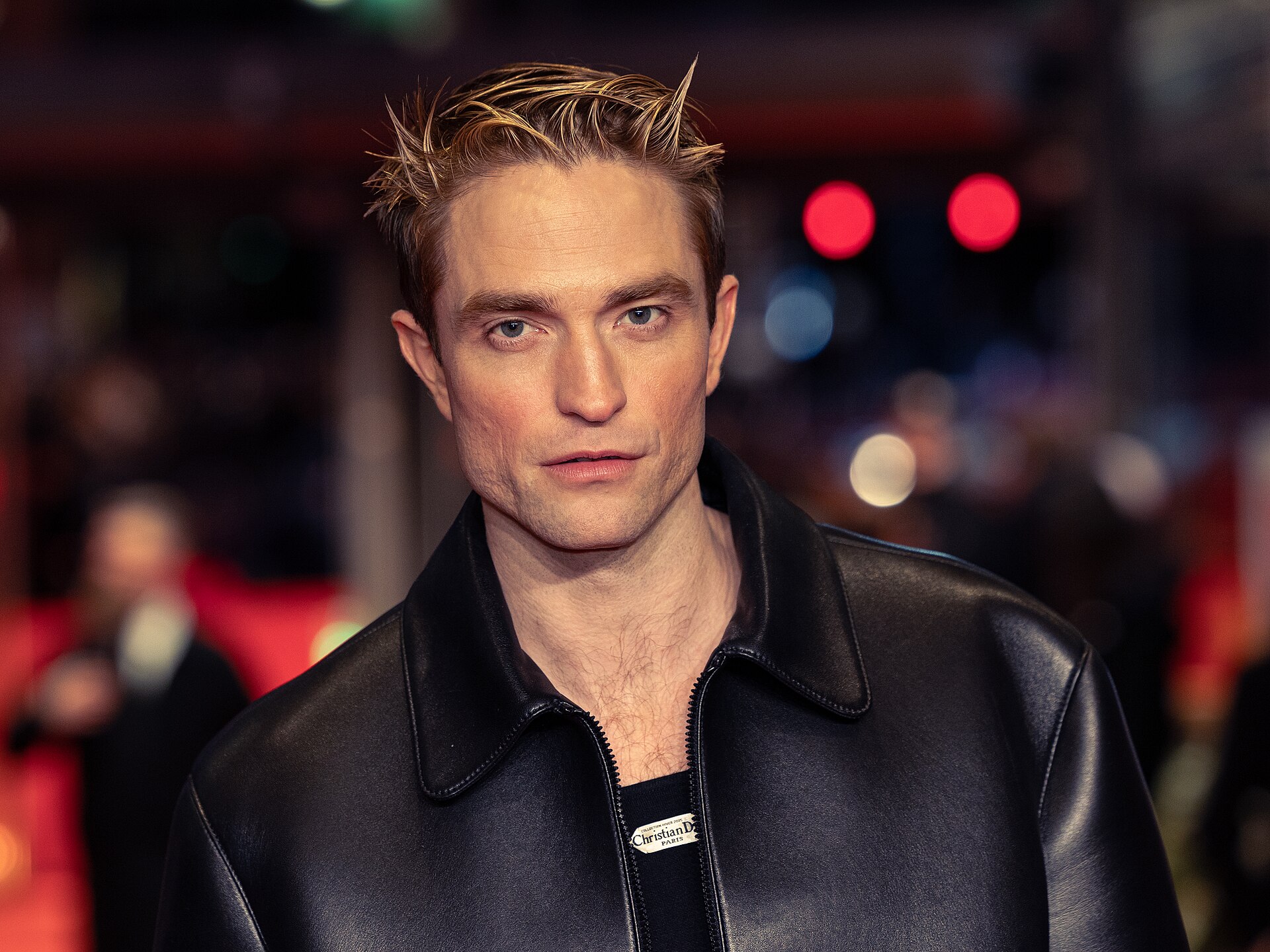
Robert Pattinson at the 75th Berlin International Film Festival on February 15, 2025. Archive portrait; not a photograph from the new Bond film. Archive photo by Harald Krichel (CC BY-SA 4.0).
Robert Pattinson is the new James Bond. Amazon MGM Studios confirmed the casting on Monday, November 16, ending a search that had become an entertainment story in its own right and placing one of the world’s most recognisable actors at the centre of a much larger reinvention of 007.
The announcement brings together Pattinson and director Denis Villeneuve, with Steven Knight writing and Amy Pascal and David Heyman producing. Tanya Lapointe is executive producer. Pattinson called being entrusted with Bond “the honour of a lifetime” in the studio’s announcement. The choice settles the identity of the leading man while leaving the next film’s title, story and release date to be announced.
It is an unusually revealing casting decision. Pattinson arrives with blockbuster recognition, an established relationship with filmmakers who favour difficult material and a career built partly on resisting the image that first made him famous. He is not an unknown performer waiting for Bond to supply an identity. He brings several competing identities with him.
That could be an advantage for a character who has always depended on controlled contradictions: elegance and violence, confidence and secrecy, professional competence and personal damage. The prospect of Pattinson playing those tensions is more interesting than the idea of finding somebody who simply resembles a familiar publicity photograph.
Monday also closes a chapter of speculation involving Callum Turner, Jack Lowden, Nicholas Hoult and other actors. The Associated Press reported that Turner, Lowden, Hoult and Josh O’Connor had been among the names in the casting conversation. Long-running fan interest in Henry Cavill, Idris Elba and Theo James belonged to a broader debate, rather than an official announcement that each was a finalist.
The distinction matters because Bond casting can turn every interview, suit and red-carpet appearance into supposed evidence. The new fact is straightforward: the studio has chosen Pattinson. What that choice will mean artistically requires a closer look at the actor, the filmmakers and the franchise they are inheriting.
Contract speculation continues around the announcement. AP cited Puck’s reporting of a three-film deal, while noting that Amazon MGM declined to comment on the terms. That remains a reported arrangement, rather than an officially disclosed contract, and it supplies neither a release calendar nor a guarantee about the stories those films would tell.
The career behind the new 007
Pattinson became internationally familiar through Harry Potter and the Goblet of Fire and The Twilight Saga. The studio’s account of his career also connects him to Tenet, The Batman, Mickey 17 and his work with Villeneuve on Dune: Part Three. Those credits establish familiarity with the demands of large productions, but they do not tell the whole story of why he is an intriguing Bond.
The smaller films are essential to that assessment. In the Safdie brothers’ <em>Good Time</em>, Pattinson plays a man whose urgency and manipulation drive a desperate night through New York. The role makes charisma uncomfortable: the character’s ability to talk and improvise does not make him trustworthy. That is a useful quality in an actor taking on a secret agent whose charm should never entirely remove the sense of danger.
<em>The Lighthouse</em>, with Willem Dafoe, offers a different demonstration. Robert Eggers places the actors inside an increasingly unstable struggle of personality and power. Pattinson is willing to look strained, ridiculous and frightened. His screen presence does not depend on remaining immaculate, which gives a filmmaker more options than the conventional image of a leading man who must look composed in every scene.
These are observations about the work already released, rather than predictions of the next Bond film’s plot. A performance that succeeds in an intimate psychological drama does not automatically succeed in a global action franchise. It does suggest that Pattinson has more to offer than the external requirements of the part.
The challenge will be proportion. Bond needs vulnerability without losing momentum, humour without becoming a parody and physical danger without turning into a character who merely endures punishment. An actor comfortable with extremes still needs a director and script capable of deciding when to hold back.
Pattinson’s existing fame adds another complication. Audiences will inevitably bring Batman, Edward Cullen and other performances into the cinema with them. The first film must give his Bond a sufficiently distinct rhythm, voice and attitude that recognition becomes an entry point rather than a distraction. Casting starts that process; the writing, design and performance complete it.
A new creative structure, not just a new face
The institutional change is as important as the actor. Amazon MGM’s joint venture with Barbara Broccoli and Michael G. Wilson closed in March 2025, giving the studio creative control while the parties remained co-owners of the franchise. The arrangement followed Amazon’s earlier acquisition of MGM. It altered who would guide future Bond productions, rather than simply changing the distributor’s name on a poster.
That creates both freedom and scrutiny. Bond is valuable because audiences recognise it, but familiarity can become a constraint when every new choice is judged against a composite memory of earlier films. The next production needs enough confidence to establish its own character while showing that the people making it understand what made the series endure.
Villeneuve’s appointment, announced in June 2025, provides a strong indication of the studio’s ambitions. His credits include Arrival, Blade Runner 2049, Sicario and the Dune films. They involve different kinds of storytelling, but all demonstrate a concern with atmosphere, scale and the relationship between an individual and a larger system.
Those qualities fit espionage, where information can be more important than an explosion and a room can become threatening before anybody draws a weapon. They do not establish that his Bond will resemble any particular previous film. The productive question is how his visual control and Pattinson’s unpredictability will work together inside an adventure that must also entertain.
Knight’s appointment as writer adds another distinctive background. The creator of Peaky Blinders has also written films including Eastern Promises and Spencer. His work gives the project an association with character, class and institutions, although the studio has not disclosed which themes will shape Bond’s next mission.
It would be premature to announce a darker, lighter or politically specific 007 on the strength of those names alone. What can be said is that the creative team has experience beyond maintaining a single brand. That is encouraging for a franchise whose next film must justify a fresh beginning, rather than merely demonstrate that the machinery can restart.
Why Turner, Lowden, Cavill and the other names mattered
The alternative names were compelling partly because they offered different ideas of Bond. Turner’s leading role in <em>Masters of the Air</em> connected him with the physical and emotional demands of a major historical drama. Lowden’s work in <em>Slow Horses</em> placed him inside a popular British intelligence series with a markedly less glamorous view of the profession.
For viewers exploring that contrast, Apple’s official <em>Slow Horses</em> trailer on YouTube is useful viewing. It shows the series’ world and ensemble without pretending to be an audition reel for Bond. Lowden’s existing association with espionage explains why his name fitted the conversation; it does not mean the two fictional worlds are interchangeable.
Hoult has moved between large-scale productions and smaller character work, and his role as Lex Luthor appears in Warner Bros.’ official <em>Superman</em> trailer. His reported presence in the Bond search belongs to a continuing career, rather than a public verdict on whether he can carry a major film. The same is true of the other actors discussed during the process.
Cavill’s history of playing Geralt in <em>The Witcher</em> and Elba’s long association with John Luther gave each an established action or thriller identity. James’s Eddie Horniman in <em>The Gentlemen</em> supplied another combination of composure, privilege and dangerous company. Those are reasons audiences might imagine them as 007, not evidence that their schedules, interests or casting circumstances were identical.
The studio has not published a ranked list of actors who lost. Its announcement instead included Villeneuve’s thanks to the performers involved in the search. That is the more sensible frame for the next chapter: a choice among talented actors, with Pattinson selected for this particular production.
Search interest in the other names may continue because fans do not immediately abandon the version of a film they imagined. That is part of Bond’s cultural power. The debate allows audiences to describe what they want from the character before a new film exists, even when those preferences reveal more about earlier performances than about the eventual script.
What Pattinson’s Bond must deliver
The official film chronology runs from Dr. No in 1962 through Daniel Craig’s No Time to Die in 2021. Sean Connery, George Lazenby, Roger Moore, Timothy Dalton, Pierce Brosnan and Craig each gave the role a different balance. Pattinson becomes the seventh actor in that official film lineage, and his first outing will be the 26th entry.
The series has survived because a replacement can be recognisable as Bond without behaving like a photocopy. Craig’s five-film run began with Casino Royale and established its own emotional continuity. The next film has an opportunity to make another clear beginning, with its own supporting relationships and dramatic stakes.
For now, the strongest conclusion is one of informed anticipation. Pattinson has the range to make the casting interesting, and the filmmaking team has the experience to turn that interest into a distinctive movie. Neither guarantees the result. The real test will be whether the finished film makes audiences stop comparing hypothetical Bonds and start believing in the one on screen.