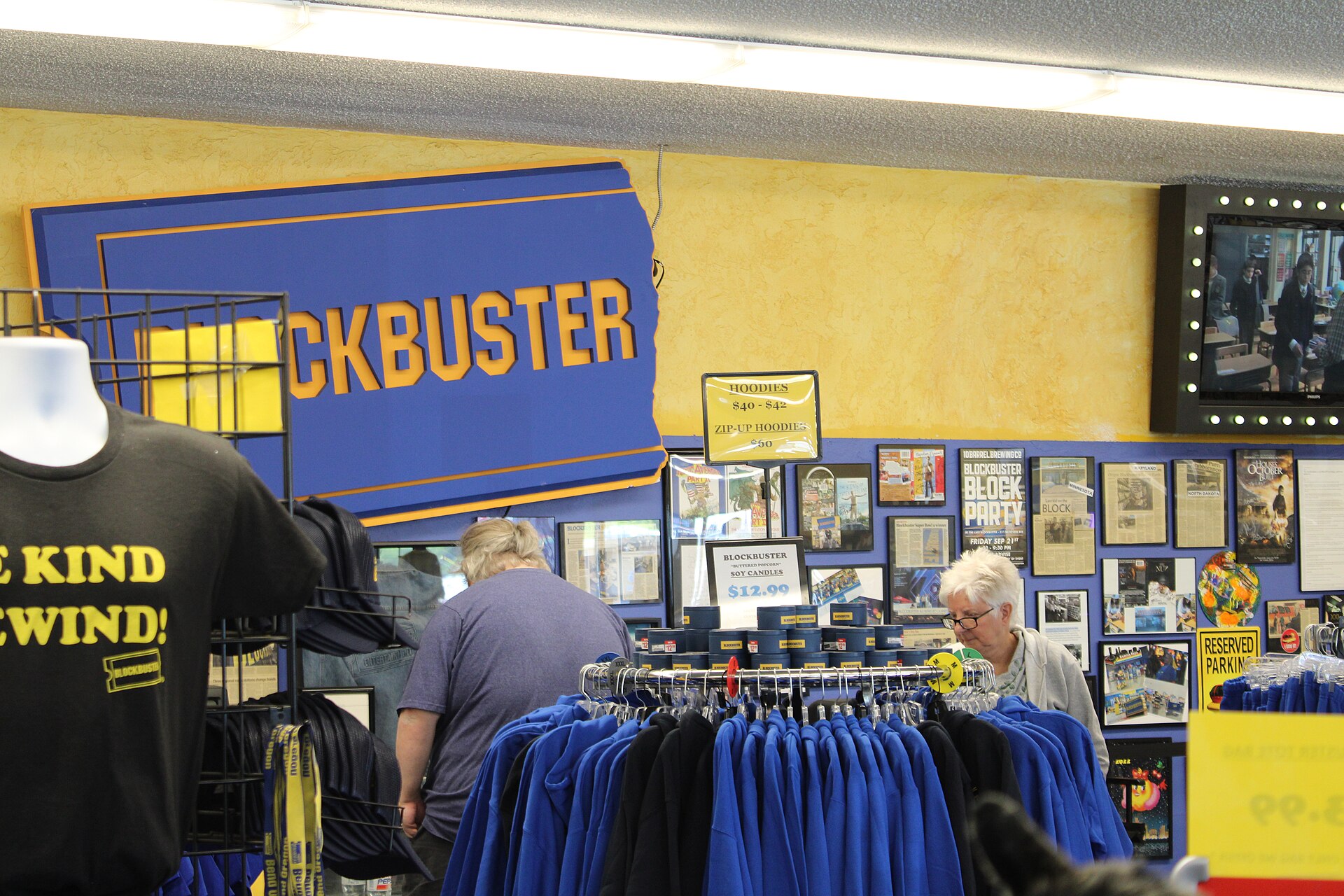
Inside the surviving commercial Blockbuster store in Bend, Oregon, on May 21, 2024. The store is distinct from the volunteer FreeBlockbuster sharing boxes. Archive photo by Chris Light (CC BY-SA 4.0).
Blockbuster is turning up in American neighborhoods again, sometimes inside a repurposed newspaper box rather than a shopping-center storefront. The small blue-and-yellow cabinets offer a straightforward invitation: take a movie, leave a movie and give a disc or tape another audience. They are community sharing libraries, built around the pleasures of browsing and discovery that a familiar name still evokes.
The renewed attention follows a November 15 Pocket-lint feature about FreeBlockbuster and a recent Pittsburgh profile of a volunteer who has maintained a movie box for more than three years. Neither report announces the return of the former national rental chain. Instead, they describe people adapting the video-store idea to a different purpose: free access to entertainment that neighbors already own and are willing to share.
There is still a commercial Blockbuster in Bend, Oregon, and its survival is a separate story. Understanding that distinction makes the current moment more interesting. A neighborhood box cannot reproduce a large store’s inventory or guarantee the latest release. What it can provide is a small, tangible alternative to paying for another service or spending an evening deciding what to watch on a screen.
A Pittsburgh movie box makes the idea personal
In a November 7 TribLive profile by Ben Schmitt, South Side resident Kathi Radock described the Free Blockbuster she opened in April 2023. She transformed a former newspaper box into an outdoor collection on Jane Street, stocked largely with DVDs alongside some Blu-rays and VHS tapes. Radock had worked in a movie theater as a teenager and retained her enthusiasm for film even as her working life took another direction.
“We needed a Blockbuster in the neighborhood,” she told TribLive. Her version is deliberately modest: a collection she estimated at roughly 30 movies, discovered by pedestrians and people who stop after noticing the cabinet. She checks donations and has registered the location with FreeBlockbuster’s map. The report describes an attraction supported by ordinary acts of attention, rather than a complicated membership system or a commercial launch campaign.
Radock’s box captures an important feature of the model. Its selection reflects what people have available and what someone is willing to maintain. A movie that has been sitting on one person’s shelf can become another person’s unexpected choice for the evening. The collection does not need to be comprehensive to be useful; its smallness can make choosing feel manageable.
There is a social difference, too, between a recommendation generated from viewing history and a film left by a neighbor. The latter comes without a guarantee that it will match a viewer’s taste. That uncertainty is part of the appeal. Someone may encounter a comedy, a documentary or an older thriller they would never have typed into a search box. The encounter is shaped by the surrounding community, even when the donor and borrower never meet.
The effect should not be exaggerated into evidence of a nationwide transformation in viewing habits. A well-loved cabinet is still one cabinet. But specific examples such as Radock’s are more revealing than sweeping declarations that everyone is abandoning streaming. They show a use for physical media that can coexist with the convenience of digital services, and a way for enthusiasm about movies to become something other people can use.
How FreeBlockbuster works—and what the name means
FreeBlockbuster describes its project as a place where people leave movies for others to borrow, following the general idea of a neighborhood book-sharing library. Its website provides a location map and instructions for people who want to create a box. The organization’s stated mission emphasizes making entertainment available without payment, which puts the sharing project on a different footing from the original rental business.
The project’s beginnings go back to Los Angeles in 2019, according to the recent Pocket-lint account. The repurposed newspaper dispenser was a practical starting point: a recognizable street fixture could become a cabinet for discs and tapes. Subsequent volunteers have used the idea in other communities. The principle is adaptable, since a functioning movie box depends more on a suitable location, donated material and maintenance than on a particular piece of hardware.
The organization’s frequently asked questions says volunteers build, stock and maintain the boxes, often near their homes or businesses. It welcomes a range of entertainment media and operates on trust. That is an invitation to share material one is comfortable giving away, rather than a promise that every borrowed copy will be returned on a schedule or replaced if it disappears.
Its language sometimes uses the word “franchise,” but readers should not infer that a cabinet is a newly opened commercial Blockbuster outlet. The FAQ also says the project received a letter from Blockbuster LLC and requested a trademark license. That statement should not be recast as proof that the request was approved. The cultural reference is obvious; the practical operation is a volunteer sharing arrangement.
For someone considering a box, the project’s setup guide explains the basic sequence: create a suitable container, decorate it, add entertainment media and ask to be included on the map. In practice, permission to use the location and continued care are as important as the launch. A cabinet that is accessible, orderly and protected from weather is more likely to remain useful than one that merely looks good in its first photograph.
None of this makes public libraries obsolete. In Pittsburgh, the Carnegie Library’s borrowing information explicitly includes DVDs among materials available through an Allegheny County library card. A formal library can offer a searchable collection, reservations and staff assistance that a street cabinet cannot. The community box adds a different kind of access and discovery, rather than replacing those services.
The surviving Bend store tells a different story
The Bend Blockbuster’s own website still advertises more than 21,000 movies to choose from. That is an operating rental store with a substantial collection, not a cabinet of donated discs. Its website also sells merchandise and introduces the documentary about manager Sandi Harding and the challenge of keeping a video store open in a streaming-centered market.
The store’s account of its history traces its origins to the Tisher family’s locally owned Pacific Video business, which opened in Bend in 1990 and became a Blockbuster franchise in 2000. It says the location became the last remaining Blockbuster in March 2019. This history is a reminder that a familiar corporate sign can sit above a business sustained by local owners, employees and customers.
The difference between Bend and the sharing boxes is therefore more than size. One has to support an ongoing retail operation; the other draws on voluntary contributions. Both depend on people finding value in a physical place associated with movies, but they solve different problems. A paying customer may expect a particular release and a functioning rental system. A person opening a sharing cabinet is accepting a much more informal exchange.
For readers interested in the store’s history, the official trailer for the 2020 documentary The Last Blockbuster, linked from the Bend store’s website, offers a useful introduction. It is a documentary about the surviving business, not an announcement that the national chain is reopening. Keeping those stories separate gives each its proper significance without turning nostalgia into a misleading retail headline.
There is a reason the imagery remains effective. A case on a shelf presents a movie as a bounded choice: a cover, a title, a synopsis and a running time. A row of cases makes the available collection visible in a way that an effectively endless scrolling interface does not. That does not automatically make the older system better, but it explains why people can miss the act of browsing even while enjoying modern delivery.
What a disc offers, and what it still requires
A physical copy gives a viewer a particular edition that can be watched again without finding the title in a subscription catalog. It may also include a commentary, deleted scenes or other extras, depending on the release. Those details should be checked on the individual package: a disc is not inherently a premium restoration, and an older DVD should not be mistaken for a newly mastered 4K edition simply because both are physical products.
Equipment remains a real limitation. Someone needs a compatible player, not only a television. Sony’s specifications for its BDP-S1700U, for example, distinguish a standard Blu-ray player from an Ultra HD model: it supports Full HD playback but does not play 4K Ultra HD Blu-ray discs. The sensible approach to a donated movie is to check the format and the player’s manual before assuming it will work at home.
Condition matters as well. A missing disc, a damaged case or an unusable copy can turn a generous donation into someone else’s disposal problem. Volunteers can make a collection more welcoming by keeping editions identifiable, checking what arrives and leaving enough room for people to browse. These are small tasks, but an informal system relies on them because there is no paid counter staff handling each exchange.
The strongest argument for the boxes is therefore practical rather than grand. Existing movies can circulate again, a person can try physical media without building an expensive collection, and a neighborhood can gain a small point of shared interest. That is valuable without a forecast that DVDs will overtake streaming or that a volunteer cabinet will revive a collapsed retail model.
What is returning is a habit: choosing a film from a visible collection and allowing a copy to pass from one household to another. Bend preserves the experience through a surviving store. FreeBlockbuster volunteers reinterpret it through sharing. Together, they show that the video-store era left behind something more durable than a logo—the idea that finding a movie can itself be a small, enjoyable part of watching it.