Published November 5, 2026 · Taken Social Editorial
SACRAMENTO — Gov. Gavin Newsom moved Thursday to replace every death sentence in California with life imprisonment without the possibility of parole, taking a sweeping step against capital punishment that would affect 548 prisoners and outlast the execution moratorium he imposed during his first year in office.
The announcement does not release the prisoners or erase their convictions. It changes the punishment Newsom is seeking to impose. It also does not, by itself, remove California’s death penalty from state law. For hundreds of prisoners with more than one felony conviction, the California Supreme Court must approve the exercise of clemency before the reduction can take effect.
The Associated Press reports that 382 cases require that approval, according to the governor’s office. That distinction is essential to understanding Thursday’s action: Newsom has announced an across-the-board decision, but the legal steps necessary to complete it differ among individual cases.
In the letter reported by CNN, Newsom presented the move as the culmination of his longstanding opposition to executions. He acted as California approaches a gubernatorial transition and as his own political future attracts national attention. The immediate consequences, however, concern the sentences of people already convicted, the families of their victims and the institutions responsible for administering the law.
A permanent sentence change beyond the execution pause
The difference between a moratorium and a commutation is substantial. A moratorium suspends the carrying out of a death sentence while leaving the sentence in place. A commutation substitutes a lesser sentence through executive clemency. Life without parole remains an exceptionally severe punishment, but it removes execution as the sentence to be carried out in a completed individual commutation.
The governor’s official clemency guidance describes commutation as a reduction of a prison sentence. A pardon is a separate form of relief. Calling Thursday’s announcement a mass pardon would therefore misstate both its legal character and its practical effect. The prisoners are not being declared innocent, and the underlying criminal judgments are not being set aside by this announcement.
California has not executed a prisoner since 2006. Newsom imposed an execution moratorium in 2019. Even against that background, replacing a death sentence changes an individual prisoner’s legal position in a way a temporary pause does not. It reduces the ability of a future administration to resume executions against people whose sentences have been validly commuted, while leaving separate questions about the state’s capital sentencing statute.
The state constitution places an additional check on the governor in cases involving a person convicted of a felony more than once. As LAist explains, approval from four of the California Supreme Court’s seven justices is necessary in those cases. That review should not be treated as an administrative formality or assumed to have already occurred for every affected prisoner.
The earlier turning points behind Thursday’s decision
California’s modern death-penalty history contains several different kinds of intervention, which helps explain why Thursday’s action cannot be understood through one label. The Department of Corrections and Rehabilitation’s historical account records that a February 1972 state Supreme Court ruling resulted in 107 condemned prisoners being resentenced to life with the possibility of parole.
That earlier outcome differs materially from the life-without-parole terms Newsom is now seeking. Both involve replacing death sentences, but the availability of a future parole hearing changes the legal consequence. Comparing the two episodes without identifying that difference would obscure what the current announcement means for prisoners and victims’ families.
The corrections department’s chronology also records a renewed death-penalty statute in 1977 and voters’ approval of Proposition 7 in 1978. State executions did not resume until Robert Alton Harris was executed in April 1992. The interval demonstrates how the existence of a capital statute and the actual carrying out of executions have repeatedly diverged.
The point is not that these events predict how every current dispute will end. They establish that California’s capital-punishment system has been shaped by courts, legislation, ballot measures and executive decisions at different times. Each operates through a different source of authority, and each can change a different part of the system.
Why the court’s clemency role needs precise explanation
The state Supreme Court’s involvement in some commutations is a constitutional safeguard, but it should not be described as a second political vote on the governor’s entire policy. In a published administrative order, the court explained that its role under Article V, Section 8 is not to express a substantive judgment on whether an applicant deserves mercy.
That framework makes it especially important to identify what a particular court action does. A recommendation permitting the governor to act, the governor’s completed grant and the implementation of a changed sentence are related events, but they are not interchangeable. Reporting that one has occurred cannot substitute for checking the others.
It also means a dispute about procedure need not turn entirely on whether the public supports or opposes executions. Questions about constitutional authority, the record presented and the conditions of a grant can arise separately from the moral debate about the punishment. The relevant documents and orders are necessary to determine which issue is actually before a court.
The California courts’ public guide describes commutation as a route for someone serving a sentence imposed by a California state court to seek a reduction from the governor. Its scope matters here: state clemency concerns state judgments and should not be conflated with presidential authority over federal sentences.
For families following individual cases, the important information will therefore be case-specific as well as statewide. The announcement establishes the governor’s intended direction. The completed legal instruments and any required court recommendations establish the status of a particular sentence. Keeping that distinction visible provides a more useful account than treating every subsequent step as automatic.
Claims about financial savings will also need a clearly defined comparison. Replacing execution sentences does not remove the cost of lifelong incarceration, and different legal proceedings can have different costs. A credible estimate would need to identify which expenses are expected to change, over what period, and under which assumptions. Thursday’s announcement alone does not establish a numerical saving for taxpayers or a new allocation for victim services.
Victims’ families and the competing claims of justice
The announcement brings competing conceptions of justice into direct conflict. Opponents of capital punishment argue that the state cannot reliably administer an irreversible penalty without errors or discrimination. Supporters emphasize the gravity of the underlying crimes, the judgments reached by juries and the expectations of victims’ families after years of litigation.
Those family experiences are not uniform. Some relatives of murder victims oppose executions; others view a death sentence as an essential measure of accountability. Neither position should be reduced to a political talking point. A sentence change can reopen painful questions even when the prisoner will remain incarcerated for life.
The California District Attorneys Association objected to the prospect of blanket relief in a letter preceding the announcement, according to the AP. Its concern centered on replacing individualized jury decisions through a sweeping executive action. The American Civil Liberties Union welcomed the governor’s decision and described the death penalty as discriminatory and prone to error. These are opposing institutional positions, rather than findings that settle every individual case.
Reporting on the action requires keeping two questions separate. One is whether a particular conviction and sentence were legally obtained. The other is whether execution should remain available as a punishment. Newsom’s decision addresses the second question through clemency; it does not amount to a new adjudication of the evidence in hundreds of trials.
California’s law remains a separate question
California voters rejected efforts to abolish the death penalty in 2012 and 2016. That electoral history helps explain why an executive commutation is different from legislative repeal or a statewide vote changing the law. A governor can exercise constitutional clemency authority without rewriting every provision governing future prosecutions.
CalMatters’ reporting places the move within the state’s long-running conflict over capital punishment. It is possible for a state to retain a death penalty statute while carrying out no executions for many years. Thursday’s decision changes the position of the current condemned population, but future charging and sentencing questions remain tied to the law that is actually in force.
This is also why headlines describing California as having abolished capital punishment would run ahead of the action. The decision is far-reaching, yet its scope has legal boundaries. Any challenge to those boundaries would have to be assessed through court filings and rulings, rather than inferred from the political intensity of the debate.
The transition to the next administration adds another layer. Newsom’s action will be evaluated politically as well as legally, but the judicial review of individual commutations concerns constitutional authority and procedure. A potential presidential campaign does not answer those legal questions, and speculation about national ambitions should not displace the immediate consequences for prisoners and victims’ families.
The next meaningful developments will be the state Supreme Court’s treatment of cases requiring its approval, the terms of the completed commutations and any filed legal challenges. The central fact is already clear: Newsom has chosen to use clemency to seek an end to execution sentences for California’s existing death-row population, replacing them with life without parole while the necessary legal review proceeds.
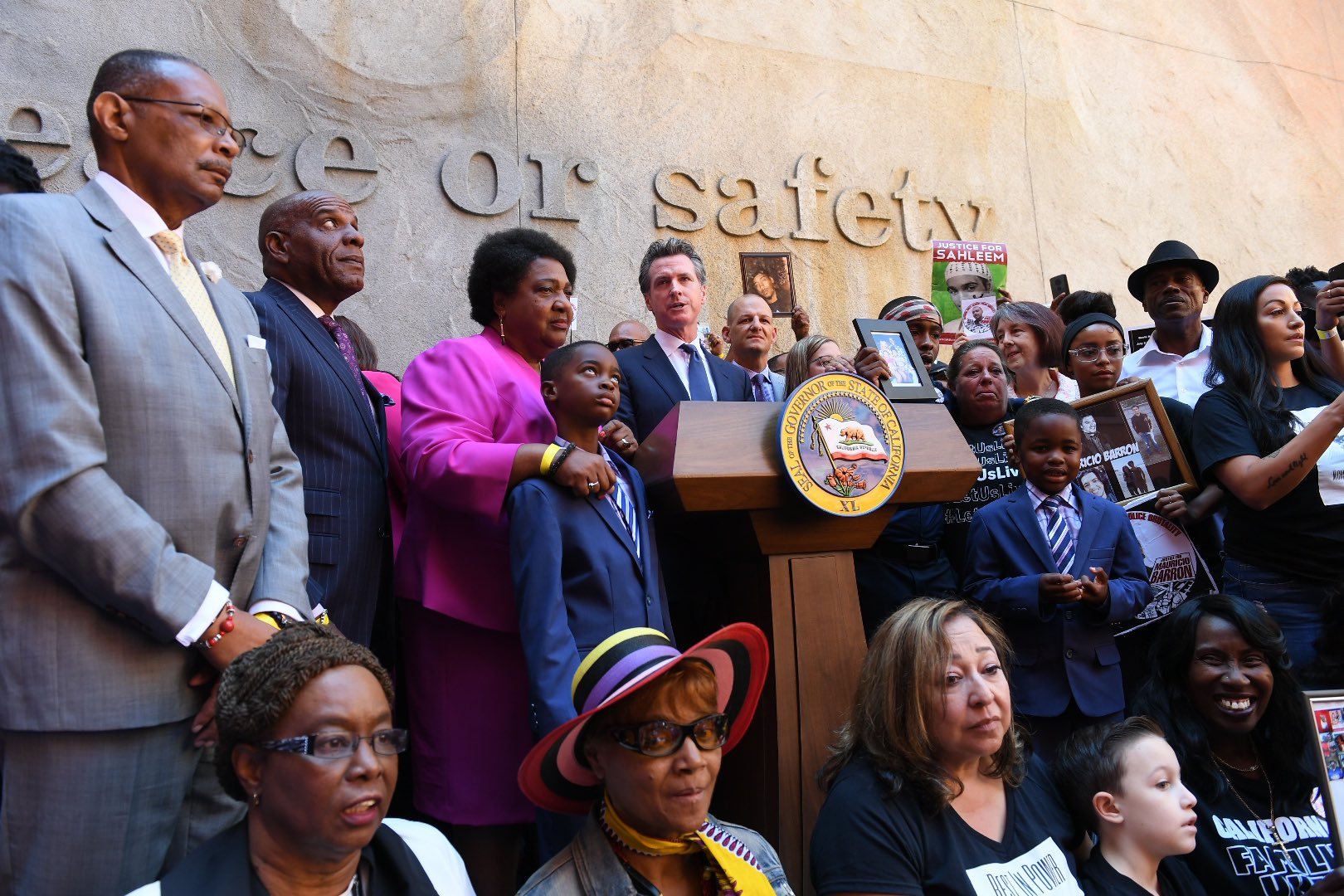
Header photograph: Gavin Newsom signing AB 392 on August 19, 2019, shown as an archival image. It does not depict the November 2026 commutation announcement. Office of the Governor of California, via Wikimedia Commons, public domain.