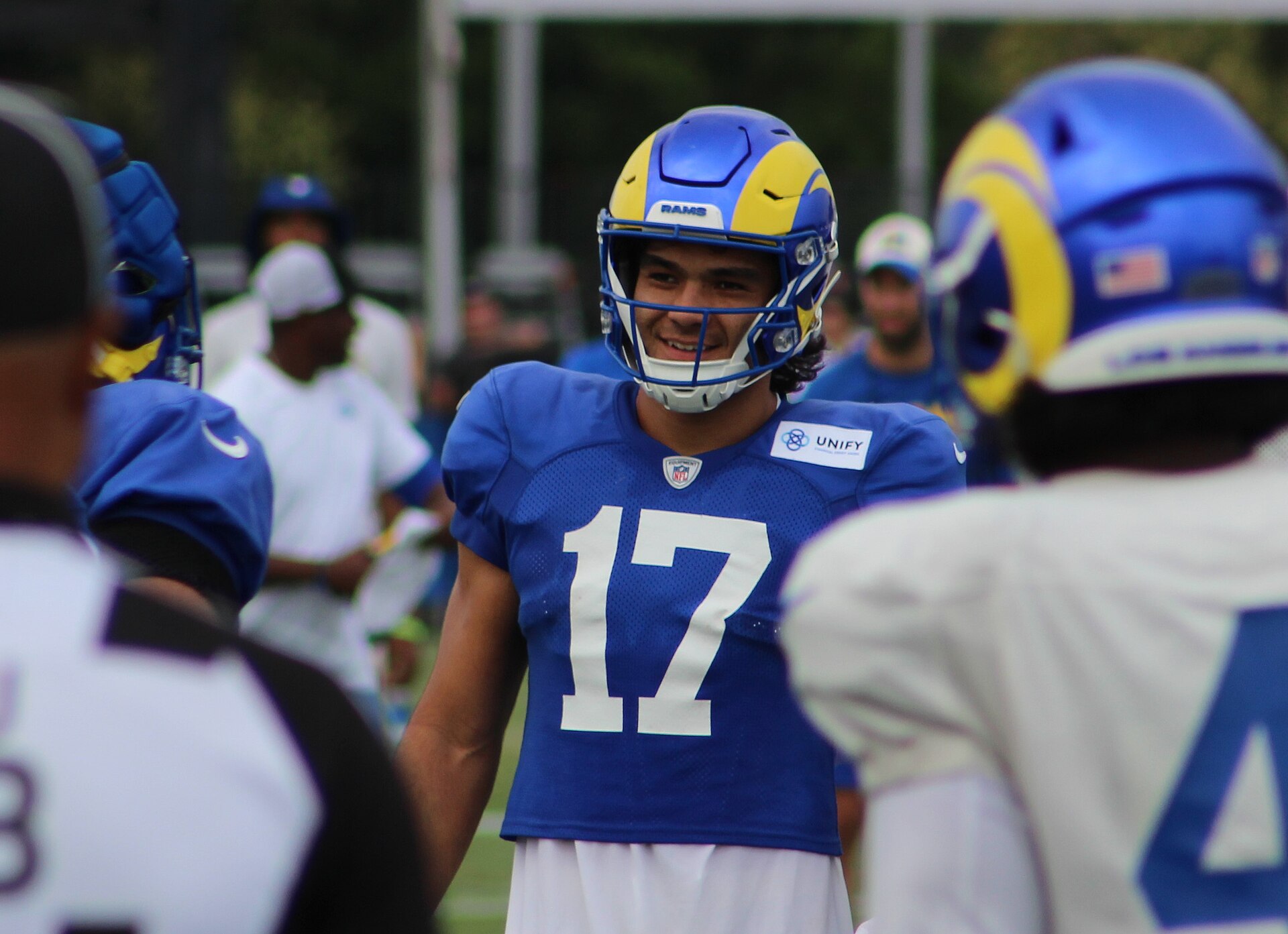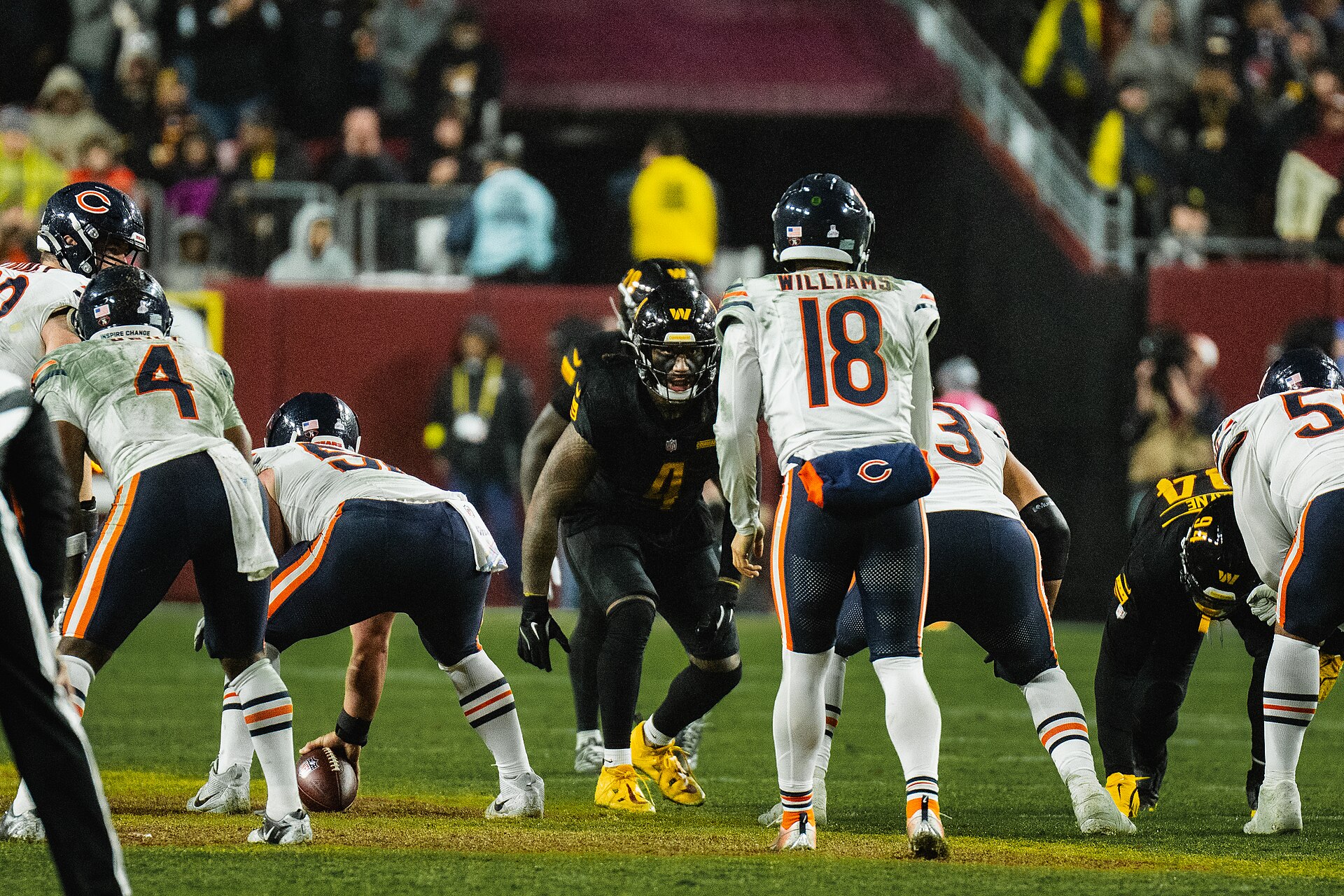
Chicago quarterback Caleb Williams at the line against Washington on Oct. 13, 2025. Archive photo by Joe Glorioso, All-Pro Reels (CC BY-SA 4.0).
Caleb Williams had already thrown four interceptions when the Chicago Bears took possession at their 31-yard line with 2:51 left and the score tied. Tampa Bay had just erased an 11-point fourth-quarter deficit. Chicago needed to move far enough for Cairo Santos to kick a field goal, and ideally use up the remaining time in the process. Williams found Kalif Raymond on third down and then Colston Loveland for 38 yards down the left side. Santos made a 38-yard field goal as time expired, giving the Bears a 27–24 win at Soldier Field on Sunday night and their fourth consecutive victory. Chicago Bears game recap
The final kick decided a game Tampa Bay had repeatedly been in position to take. The Buccaneers forced five turnovers and finished with 352 yards of offense to Chicago’s 349. They had more yards on the ground and two touchdowns from Bucky Irving. Their four interceptions of Williams, however, yielded just three Tampa Bay points on the ensuing drives. One led directly to a Chicago touchdown when Jaylon Johnson intercepted Baker Mayfield and returned the ball 67 yards the other way. The way those possessions ended explains why Chicago could survive such an uneven night on offense. Tampa Bay Buccaneers game recap Chicago Bears game recap
How the Bears won the final possession
Irving’s second touchdown and Mayfield’s two-point run had made it 24–24. A punt on the next series could have put the game back in Mayfield’s hands with time to get into range for Chase McLaughlin, who had already made three field goals. The first pressure point came on third-and-4. Williams hit Raymond for eight yards, extending the series and giving Chicago another set of downs while the clock kept moving. The play changed what either team could reasonably expect from the remaining time. Chicago Bears game recap Official game center
Two plays later, Williams found Loveland with room to run down the left sideline. The tight end reached the Tampa Bay 16 with 38 seconds left. Williams credited his protection and said the tempo and pre-snap movement contributed to confusion in the coverage. Chicago had spent much of the evening seeing its longer throws turn into opportunities for Tampa Bay defensive backs. On this play, Williams had the time and the open target to make the throw without asking Loveland to win a contested catch. Chicago Bears game recap
Loveland’s reception supplied 38 of the 49 yards on the winning drive. It was the largest gain, but Raymond’s earlier catch made it possible. A drive that dies on third-and-4 never gets the chance to put the tight end in space. Once Loveland reached the 16, Chicago could manage the end of regulation from inside a workable kicking distance. Tampa Bay’s offense never got another possession. Santos had made a 25-yarder in the first half. This one, from 38, settled the game. Chicago Bears game recap Tampa Bay Buccaneers game recap
Chicago’s early lead changed Tampa Bay’s choices
The Bears started the night with two touchdowns on two possessions. Zavion Thomas returned the opening kickoff 40 yards, putting Chicago at its own 47. Williams converted a third down with his legs and later found Rome Odunze for a nine-yard touchdown. The Bears forced a three-and-out and scored again when Luther Burden III caught a pass across the middle, escaped tackles and turned it into a 56-yard touchdown. Chicago finished the first quarter up 14–0. Chicago Bears game recap Tampa Bay Buccaneers game recap
The importance of Burden’s touchdown grew as Tampa Bay took away the running game. The Bears gained just 72 yards on 22 rushes, and none went for more than nine. D’Andre Swift managed 31 yards on 12 attempts. Chicago still got 97 receiving yards out of Burden and 279 passing yards from Williams. The danger for the Buccaneers was the yardage a short completion could produce after the catch. On the second scoring drive, they allowed both Odunze and Burden to turn short throws into sizable gains, and the second one reached the end zone. Chicago Bears game recap
Early in the second quarter, Tampa Bay advanced as far as the Chicago 3 and got three points. The Bears later stopped a Mayfield sneak on fourth-and-1 from the Tampa Bay 35. That created a promising field position for the Chicago offense, though Williams gave it up almost immediately on one of Zyon McCollum’s interceptions. The sequence captured the game’s difficulty for both teams. They could manufacture a short field in one snap and spend the next series giving away the advantage. Chicago Bears game recap Tampa Bay Buccaneers game recap
The drive after an interception mattered more than the interception count
McCollum intercepted Williams twice. Tampa Bay’s fourth interception put the Buccaneers at the Chicago 37 late in the third quarter, trailing 17–13. They needed 37 yards to go ahead and had already shown they could hit a long pass, with Mayfield’s 57-yard completion to Tez Johnson setting up Irving’s first touchdown. Instead, Jaylon Johnson intercepted Mayfield and brought it back 67 yards for a score. Chicago led 24–13 after the extra point. The series produced a seven-point gain for the team whose offense had just turned the ball over. Chicago Bears game recap Tampa Bay Buccaneers game recap
In that context, Chicago’s third-down defense explains a great deal. Tampa Bay converted only two of 12 third downs, about 17 percent. Chicago converted seven of 13, about 54 percent. The difference went beyond sustaining long drives. A conversion after a takeaway keeps the defense’s work from turning into a brief change of possession. A stop after your own offense turns it over can force a field goal or get the ball back before the opponent gets close. Chicago’s defense also sacked Mayfield four times. Tampa Bay’s 243 gross passing yards became 226 net once sack yardage was accounted for. Tampa Bay Buccaneers game recap Chicago Bears game recap
Mayfield’s night contained both the best and worst versions of Tampa Bay’s passing offense. The 57-yarder to Tez Johnson needed only one snap to take the Bucs from the middle of the field to the doorstep. Kenny Gainwell caught three passes for 60 yards, and Irving ran for 97 yards on 20 carries. Those plays showed the offense could create meaningful gains against a defense that was limiting it on third down. The challenge came when a drive required several consecutive good snaps. Tampa Bay committed eight penalties, including five false starts, and Mayfield finished with two interceptions. Tampa Bay Buccaneers game recap
Why Tampa Bay’s fourth-quarter rally still mattered
McLaughlin cut the deficit to eight with a 35-yard field goal. When Burden subsequently fumbled, Ifeatu Melifonwu recovered and returned the ball to the Chicago 17. This time the Buccaneers turned the short field into a touchdown. Irving ran in from six yards out, then Mayfield kept the ball on the two-point try to tie it. Tampa Bay had enough time to justify playing for the tie, and a defensive stop could have given McLaughlin the winning attempt. That made Chicago’s conversion to Raymond more valuable than the eight yards printed in the play log. Chicago Bears game recap Tampa Bay Buccaneers game recap
The comeback should count in any assessment of the Buccaneers’ performance. Their run defense put pressure on Chicago’s passing game, and the secondary turned several throws into live opportunities. Their offense got back into the game twice, first after the 14–0 opening and again after the interception return. Getting all the way back required clean execution on a short field and an extra conversion play. The open question for Tampa Bay is how to get those same touchdowns when a drive starts near midfield instead of inside the opponent’s 20. Tampa Bay Buccaneers game recap
The return game made some of that field position volatile. Thomas’s 40-yard return helped Chicago open its first drive near midfield. The Bears also had an apparent 92-yard return touchdown erased by a holding penalty after Irving scored early in the third quarter. That nullified play is easy to miss beside seven turnovers, but it helps explain why neither sideline could simply infer the next starting position from the score. Chicago still needed its offense to make the late trip into kicking range. Chicago Bears game recap
What 27–24 means for both teams
The Bears are 7–2. Williams entered the game with 36 consecutive outings of at least 20 pass attempts and fewer than two interceptions, according to the team. Four interceptions in one night were well outside that run. Chicago can draw confidence from how its defense responded and how the quarterback handled the last drive. Film review will also have four chances to identify why a pass reached a defender. One night provides too little evidence to establish a new pattern, and the offense has every reason to examine how it got into those situations. Chicago Bears game recap
Tampa Bay is 3–6 heading into its bye. The club reported that the loss left it a half-game behind Carolina and New Orleans in the NFC South, with a 2–0 record in division games. The standings give the Buccaneers something to play for after a frustrating loss. They also illustrate the cost of spending a strong defensive performance and a fourth-quarter comeback on a game that yielded no win. The most direct improvement is better execution on third down on both sides, a point Todd Bowles made after the game. Tampa Bay Buccaneers game recap
The Bears won with a defensive touchdown and a drive that made the most of the final 2:51. Tampa Bay had created more opportunities to take control, including the ball at the Chicago 37 with a chance to go ahead. Chicago produced the evening’s two highest-value plays in response to those opportunities. Johnson’s interception return took a potential Buccaneers lead off the board, and Loveland’s catch put a winning kick within reach. That is how a team that lost the turnover battle by three still had the ball and the better chance when the clock ran out.