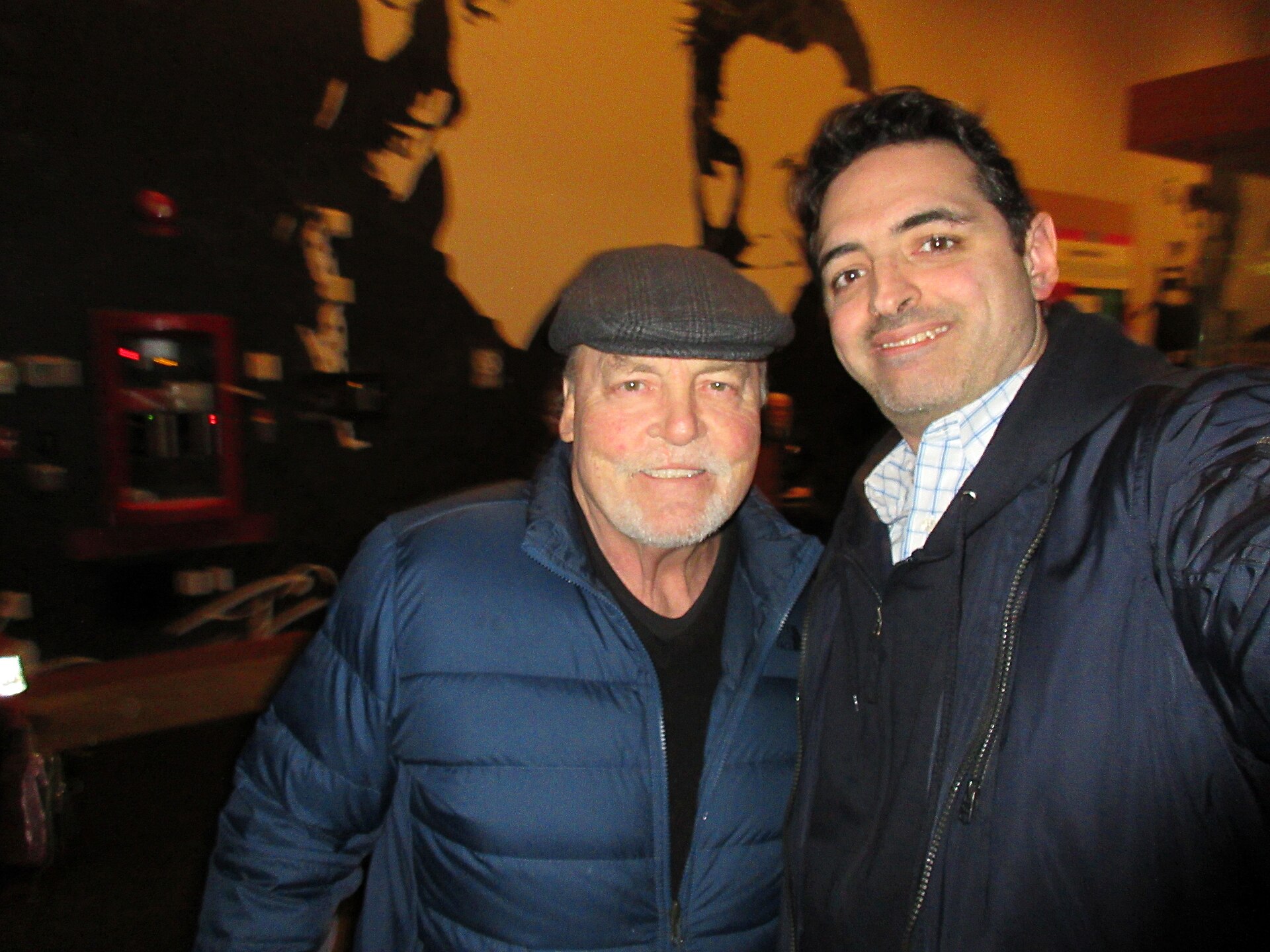
Stacy Keach, left, in New York City in February 2018. Archive photo by Greg2600 (CC BY-SA 2.0).
Stacy Keach, whose commanding voice and wary presence carried him from Shakespeare’s kings to television’s Mike Hammer, died Tuesday, Nov. 10, at 85. His wife, Malgosia Tomassi Keach, said he died at their home in Magdalenka, Poland, following heart disease and heart failure, according to The Associated Press. He was an actor people could recognize from a single line, yet the most useful way to measure his career is to look at how often he found a different use for that voice. The Associated Press’s report of his death
Keach could play the man who controlled a room and the man who had already lost his place in it. His major film work included Billy Tully, the struggling boxer in John Huston’s Fat City. On television, he gave Mickey Spillane’s detective a familiar face and won a Golden Globe for playing Ernest Hemingway. His stage career ran from the classical repertory to new American plays. Those parts did not all lead toward the same public image. They kept an actor with an unmistakable instrument working in different scales, from a close-up to a theater’s back row. AFI’s Fat City record Golden Globe awards and credits His Broadway and touring credits
A stage actor before Mike Hammer became his signature
Born in Savannah, Georgia, on June 2, 1941, Keach grew up in a family that worked in entertainment. He studied English and dramatic art at the University of California, Berkeley, graduating in 1963, according to the Hollywood Chamber of Commerce’s account of his career. That pairing of subjects is a useful place to start. A performer has to make a speech physically clear, but he also has to understand the argument moving through it. Keach spent much of his working life with characters for whom the words were a way to command, persuade or defend a position. The Hollywood Chamber’s biographical record
The Broadway record shows how early the stage was central to that work. In 1965, he appeared in Danton’s Death and played Horner in The Country Wife. The Caucasian Chalk Circle followed. He played Edmund in the 1968 production of King Lear and Buffalo Bill in Indians the next year. The roles placed him in very different kinds of theater: restoration comedy, epic drama and an American play asking how national history gets performed. The range was already there before a long-running television character made him widely familiar. IBDB’s Broadway production chronology
His work as Buffalo Bill brought a Tony nomination. It also offers an early example of a recurring interest in his career: men whose authority depends partly on the story they tell about themselves. Later, he would play Richard Nixon on the national tour of Frost/Nixon. The role required a performer to let an audience see both a historical figure and someone managing the impression he leaves. That is different from simply reproducing a famous cadence. The actor has to make an encounter with another person matter even when the audience knows how history will judge the speaker. The Indians and Frost/Nixon production records
Why Fat City remains a defining performance
In Fat City, Keach played a former boxer named Billy Tully who sees promise in the much younger Ernie Munger, played by Jeff Bridges. Leonard Gardner adapted his own novel for John Huston’s 1972 film, set in Stockton, California. The American Film Institute’s record places Tully at a YMCA gym at the start, looking at another person’s opportunity while trying to work out what remains of his own. It is a sports story in which the interval between bouts matters as much as the action in the ring. AFI’s cast, setting and story record
Tully is a useful contrast with Hammer. A detective can ask a question, force a confrontation and keep the plot moving toward a solution. A boxer between chances has less control over what happens next. The part asks the actor to keep an audience interested in uncertainty, delay and a hope that may be too fragile to name. AFI Silver describes Huston’s approach as unsentimental. Keach’s place beside Bridges helps give the movie its structure: the experienced man sees possibilities in the younger one that he cannot simply recover for himself. AFI Silver’s account of the film
His filmography around that period also includes The Heart Is a Lonely Hunter, Doc, The New Centurions and The Life and Times of Judge Roy Bean. The last of those reunited him with Huston. That early run makes it difficult to treat his film work as a sideline to television. It put him in dramas about power, loneliness and work, sometimes at the center and sometimes in a role that had to make an impression quickly. The actor later known for a durable television persona was already moving between leading parts and sharply defined supporting ones. AFI’s early Keach filmography
The detective audiences kept returning to
Mickey Spillane’s Mike Hammer made Keach especially recognizable in the 1980s. The Golden Globes’ official record lists the series among his principal television credits and records a 1985 acting nomination for it. Hammer comes from a tradition of private detectives who move through a city asking questions the people in charge would rather avoid. The appeal of a recurring performer in that format is cumulative. Viewers learn how the character will listen, when he will push and what a pause means before the next question arrives. The series and its Golden Globe recognition
The role also shows the difference between familiarity and repetition. A viewer can return because the lead actor is recognizable and still expect that week’s encounter to reveal something new. The voice is part of that relationship, but so are the physical decisions: how much attention the character gives a stranger, whether he seems tired or merely impatient, and when he chooses to move. Keach had a repertory actor’s reason to keep working elsewhere. Another part could require him to begin again without asking the audience to forget the detective who had brought him into their homes.
His career included a serious interruption. In 1984 he was arrested in Britain over cocaine in his luggage and later served six months of a nine-month sentence, as Reuters recounts in its obituary. He subsequently returned to television and the stage. The episode belongs in an account of his life, but it does not explain away the decades of work that followed. His memoir, All in All: An Actor’s Life On and Off the Stage, addressed addiction and recovery; the Hollywood Chamber notes that it received a literary award recognizing work on overcoming addictive behavior. Reuters’s account of his career and imprisonment The memoir’s recognition
Hemingway, twice, in very different rooms
Keach won the 1989 Golden Globe for his performance in the television miniseries Hemingway. Years later, he returned to the writer in Jim McGrath’s Pamplona at Chicago’s Goodman Theatre, directed by Robert Falls. The stage production follows Hemingway facing the pressure to write again after major recognition. A familiar public figure becomes a man alone with a deadline. For Keach, the second project was an opportunity to revisit the character after living through much more of his own career. The official award record Goodman’s description of Pamplona
The Goodman’s history of the production makes that return particularly significant. The initial 2017 run ended after Keach became ill on opening night and was advised to recuperate. He came back for the 2018 engagement, which ran July 10 through Aug. 19. The theater documented both the cancellation and the return. A one-person play leaves very little room to pass the momentum to another actor. Reaching the stage again meant taking responsibility for the whole evening’s rhythm, including the stretches where the character has no one to answer but himself. The Goodman’s 2017 cancellation notice The announcement of the 2018 return
That part sits beside his later Broadway work in Jon Robin Baitz’s Other Desert Cities. Keach played Lyman Wyeth, the father in a family confronting a daughter’s account of their history. The Broadway production opened in November 2011 with Stockard Channing, Rachel Griffiths, Judith Light and Thomas Sadoski. A family play allows authority to be tested in smaller exchanges than a historical drama does. Someone can hold his place at the table and find that he no longer controls the meaning of the story being told there. The original Broadway cast and production record
A career larger than any one familiar role
The parts listed by the Golden Globes include The Ninth Configuration, The Long Riders, American History X, The Bourne Legacy and Nebraska. That spread matters to anyone discovering Keach through an obituary. A Western, a psychological drama and a quiet modern American film ask different things of an actor even when they all use the same physical presence. A supporting role can make that range less visible because the audience is following someone else’s story. The work is still there in the way a scene changes when the character enters it. A selection of Keach’s screen credits
In 2019, the Hollywood Chamber honored him with a star in its television category. The ceremony recognized an actor whose career did not fit neatly within the category on the pavement. He had also worked extensively as a narrator, including on American Greed, and performed Hammer in audio. Listeners who knew him without seeing his face were responding to the same qualities theater audiences heard: control of pace, attention to the sentence and a sense that something was being considered before it was said. The award was a public marker for work that had reached people through several different forms. The 2019 Walk of Fame ceremony and audio credits
Keach’s legacy is easiest to encounter through that variety. Fat City offers the uncertain return of a man who once had a skill. Hammer offers a character who keeps moving through another case. Pamplona asks what remains when a famous man has to make something new. The roles required different answers, and Keach kept returning to the question. His death ends a career that made room for all of them. The performances leave an unusually broad set of starting points for anyone who knows only the voice.